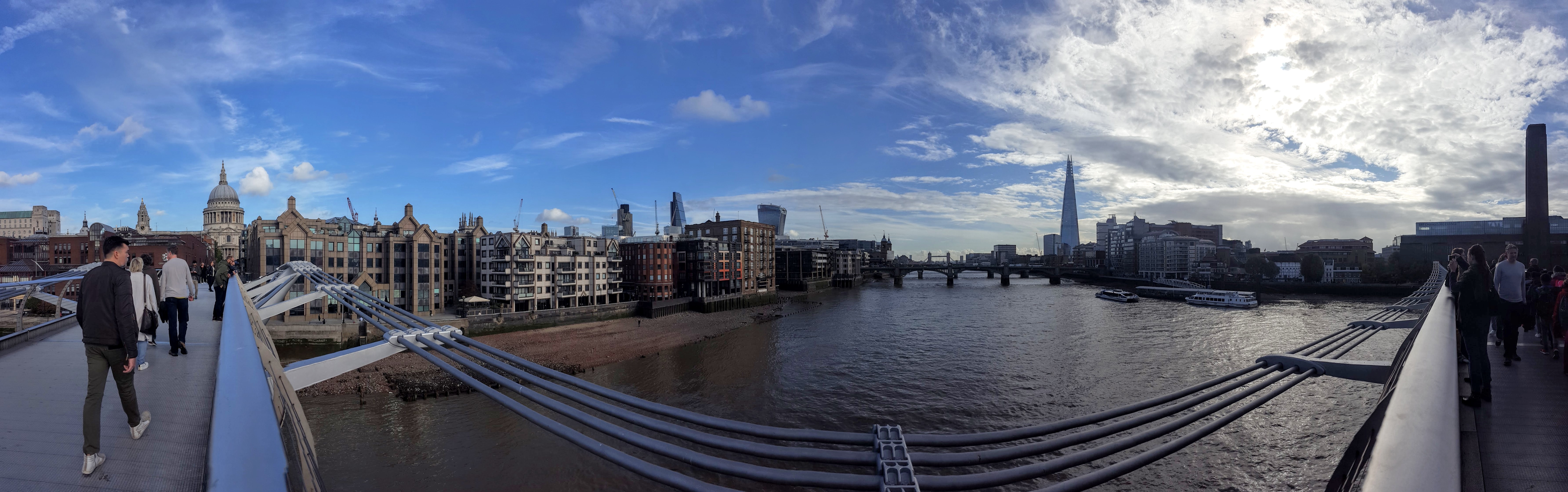
Millennium Bridge, London
On 10 June 2000, ninety thousand people crossed London's newest bridge. By the end of the day, the bridge was closed. The Millennium Bridge, designed as a slender "blade of light" spanning the Thames between St Paul's Cathedral and the Tate Modern, had developed an alarming lateral sway that sent pedestrians lurching sideways. Londoners, who have a gift for affectionate mockery, immediately christened it the Wobbly Bridge. The name has stuck for a quarter of a century, long after the wobble itself was cured.
A Blade of Light
The bridge emerged from a 1996 design competition won by an ambitious collaboration between engineers Arup, architects Foster + Partners, and sculptor Anthony Caro. Their concept was radical: a suspension bridge with its cables slung below deck level rather than above, creating an unprecedentedly shallow profile that would not obstruct the view of St Paul's south facade from the Bankside shore. The result is a 325-metre steel and aluminium span that seems to float just above the water, so thin it almost disappears when viewed from the side. Eight suspension cables, tensioned to pull with a combined force of 2,000 tonnes against the piers, hold the deck steady enough for 5,000 people. At least, that was the theory.
The Day the Bridge Walked
With up to 2,000 people on the bridge at once during opening day, something unexpected happened. The deck began to sway sideways, gently at first, then with increasing amplitude reaching around 70 millimetres. Pedestrians, feeling the lurch, instinctively adjusted their stance to keep their balance, and in doing so they all shifted their weight at the same moment, in the same direction. This unconscious synchronization fed energy back into the bridge, amplifying the oscillation in a positive feedback loop. Engineers had long understood vertical resonance in bridges, the reason soldiers break step when crossing. But this lateral version, which Arup would later term "synchronous lateral excitation," was a phenomenon that bridge designers worldwide had essentially overlooked.
Fixing the Wobble
The bridge closed two days after opening and remained shut for nearly two years while Arup researched the problem and engineered a solution. Laboratory studies at the University of Southampton and Imperial College London put volunteers on moving platforms to study how pedestrians interact with swaying surfaces. One span of the bridge was then instrumented and tested with crowds of up to 275 people. The fix involved installing 37 fluid viscous dampers to control lateral movement and 52 tuned mass dampers to manage vertical oscillation, at a cost of five million pounds. The bridge reopened on 22 February 2002 and has not wobbled since. The research transformed the field of pedestrian bridge engineering worldwide, as designers everywhere incorporated the lessons of the Millennium Bridge into their calculations.
An Accidental Icon
Today the Millennium Bridge is one of London's most photographed structures, framing the dome of St Paul's in a terminating vista that makes it irresistible to camera lenses. It appeared memorably in Harry Potter and the Half-Blood Prince, collapsing under a Death Eater attack. The real bridge, of course, stands firm. Owned by Bridge House Estates, a charitable trust dating to 1282, it serves as both a practical river crossing and a cultural connector, linking the financial City on the north bank to the arts quarter of Bankside, where Shakespeare's Globe and the Tate Modern draw millions of visitors each year. The wobble, far from being a lasting embarrassment, became part of the bridge's identity. Londoners still call it the Wobbly Bridge with something close to affection, the way you might tease an old friend about a stumble everyone witnessed and no one has forgotten.
From the Air
Located at 51.510N, 0.098W, spanning the Thames between St Paul's Cathedral (north) and Tate Modern (south). The slender steel bridge is visible as a thin line across the river from altitude. Nearest airports: EGLC (London City, 5nm E), EGLL (Heathrow, 14nm W). Best viewed at 1,500-3,000 ft AGL.