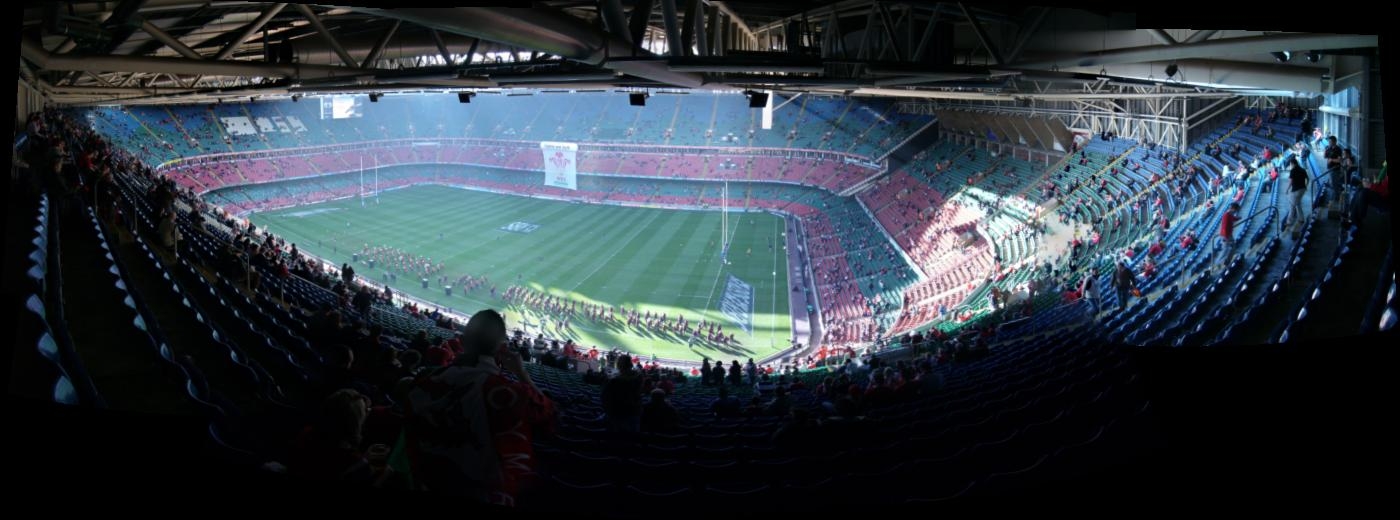
Millennium Stadium
Most national stadiums sit on the outskirts of their cities, ringed by car parks and reached by motorways. The Millennium Stadium sits in the middle of Cardiff, so close to the city centre that you can walk from the train station in five minutes and hear the crowd from the shops on Queen Street. When its retractable roof closes -- one of the first in the world when it opened in 1999 -- the roar of 74,500 voices stays trapped inside, pressing down on the pitch like weather. Welsh rugby players call it their greatest advantage. Visiting teams call it intimidating. Both are right.
From Arms Park to World Cup
The site has hosted rugby since the 19th century, when Cardiff Arms Park became the spiritual home of Welsh rugby union. The old National Stadium, built on the same ground, served Wales for decades but lacked the capacity and modern facilities needed for a major international tournament. When Wales won the bid to host the 1999 Rugby World Cup, the decision was made to demolish the National Stadium and build something unprecedented in its place. The architects, Bligh Lobb Sports Architecture, designed a 74,500-seat arena with three tiers and a fully retractable roof -- only the second of its kind in Europe. The structural engineers were WS Atkins, the builder was Laing, and the total construction cost came to 121 million pounds.
A Roof Over Rugby
The retractable roof takes roughly 20 minutes to close and spans 120 metres, creating a sealed arena that amplifies the atmosphere while protecting the pitch and spectators from the Welsh weather. Its first major test came on 26 June 1999, when Wales beat South Africa 29-19 in a test match before a crowd of 29,000 -- the stadium was not yet complete, but the result announced that the new ground meant business. The full stadium opened in time for the 1999 Rugby World Cup, which saw the tournament final between Australia and France played beneath the closed roof. The stadium quickly became the emotional centre of Welsh sport, a place where the national anthem, sung by tens of thousands of voices in both Welsh and English, creates a wall of sound that has been known to shake camera positions in the press box.
England's Borrowed Home
Between 2001 and 2006, while Wembley Stadium was being rebuilt, the Millennium Stadium served as the venue for English football's showpiece events: FA Cup finals, League Cup finals, and Football League play-off finals. It was an unusual arrangement -- English football's most prestigious matches held in the Welsh capital -- but the stadium proved itself a worthy substitute, and many fans remember the Cardiff finals fondly. The ground also hosted football matches during the 2012 London Olympics and has served as a venue for speedway, motorsport, boxing, and concerts. The Super Special Stage of the Wales Rally Great Britain has run through the stadium, and the Speedway Grand Prix of Great Britain has filled it with engine noise and dirt.
Principality in the City Centre
In 2016, a sponsorship deal with the Principality Building Society renamed the stadium the Principality Stadium, though many in Cardiff still call it by its original name. The stadium is owned by Millennium Stadium plc, a subsidiary of the Welsh Rugby Union, and it remains the home of the Wales national rugby union team and a regular venue for the Wales national football team. Its location -- wedged between the River Taff and Cardiff's central streets, with the castle visible from the upper tiers -- gives it a quality that purpose-built out-of-town stadiums cannot replicate. On match days, the entire city centre becomes an extension of the ground. Pubs overflow, songs echo through the covered arcades, and the retractable roof hangs over it all like a lid on a pressure cooker, holding in the noise and the passion until the final whistle releases them back into the streets.
From the Air
Located at 51.48N, 3.18W in central Cardiff. The stadium is one of the most prominent landmarks from the air, with its distinctive retractable roof structure visible from considerable distance. Best viewed at 2,000-4,000 ft. Nearest airport: Cardiff (EGFF), approximately 10 nm southwest. Cardiff Castle and Bute Park are immediately to the north; the River Taff runs along the western edge of the stadium. On match days, the stadium with its roof open or closed is unmistakable.