The County Seat That Drowned Twice
The first jail in Fresno County lasted about as long as it took a prisoner to test the walls. Completed in 1857 in the settlement of Millerton, the structure was so poorly built that an inmate promptly demonstrated he could escape whenever he pleased. This was governance on the San Joaquin River in the 1850s: county officers conducted business in whatever building was available, then wandered across the street to a saloon. Millerton would serve as Fresno County's seat for barely two decades before the river rose on Christmas Eve 1867 and swept three-quarters of the town into the current. What remained eventually slipped beneath the waters of Millerton Lake when Friant Dam was completed in the 1940s. The town drowned twice - once by flood, once by design.
Cassady's Bar and the Price of Gold
Gold brought the first non-Native settlers to this stretch of the San Joaquin. Around 1851, a man named Cassady established a placer mining operation near where the Temperance Flat Dam was later proposed, working the river gravels for flakes and nuggets. The operation became known as Cassady's Bar. The name persisted after Cassady did not - he was killed by members of a local tribe and found on the riverbank. Despite the violence, miners kept coming. A settlement called Rootville grew along the south bank of the river, sustained by mining and trapping and connected to the wider world by the Stockton-Los Angeles Road, which brought stagecoaches and freight wagons through the foothills. McCray's Ferry offered the only river crossing in the area, linking the settlement to lands on the north bank.
Fort Miller's Shadow
What transformed a rough mining camp into something resembling a town was the U.S. Army. Fort Miller was established about a mile upriver, a permanent garrison tasked with managing relations between settlers and Native populations in the southern Sierra foothills. Under the fort's protection, the settlement rebranded itself as Millerton and began to grow. A hotel went up. Then livery stables, shops, gambling halls, and - inevitably - many saloons. When Fresno County was carved out of the surrounding territory in 1856, Millerton became its first county seat. The county it governed was enormous, encompassing not just modern Fresno County but all of what would become Madera County and portions of what are now San Benito, Tulare, Kings, Inyo, and Mono Counties. County officers were elected that same year, though the formality of governance sat lightly on a town where official proceedings competed for attention with the nearest bar.
Christmas Eve, 1867
The San Joaquin River had always been temperamental, swelling with Sierra snowmelt each spring and occasionally flooding its banks. But the flood of Christmas Eve 1867 was something else entirely. The river rose fast enough that women and children had to take refuge in the courthouse, the sturdiest building in town. No lives were lost, but three out of four buildings were carried away by the current. Farm animals and household pets perished in the floodwaters. Millerton never recovered. The county seat eventually relocated to the railroad town of Fresno Station, which had the advantage of sitting well away from the river on flat, dry ground served by the Central Pacific Railroad. Millerton limped on through the 1870s and into the 1880s, its population dwindling as the economic center of gravity shifted west to the new Fresno.
Under the Lake
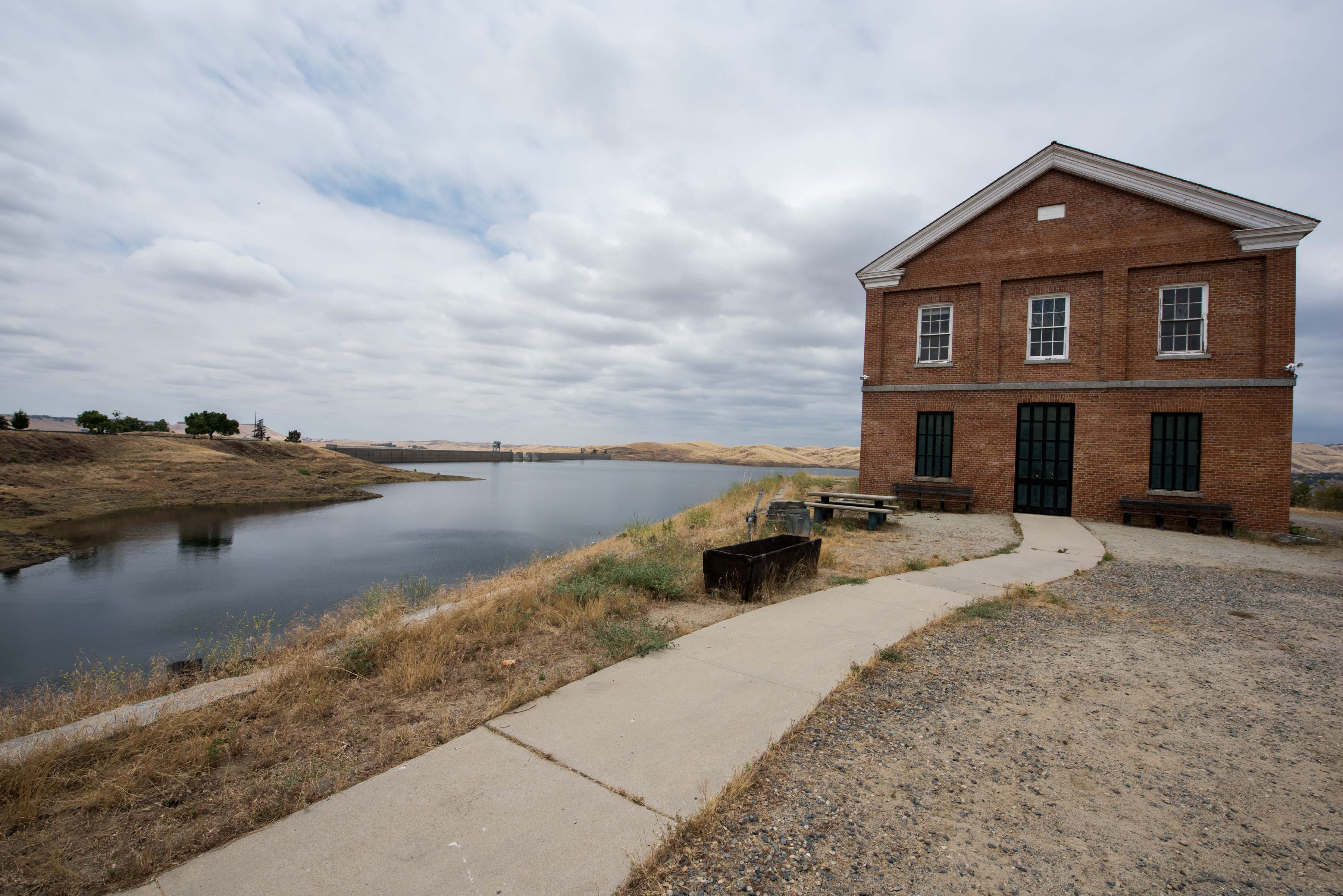
The final chapter came in the 1940s when the Bureau of Reclamation completed Friant Dam on the San Joaquin River, creating Millerton Lake. The rising waters submerged what remained of old Millerton - foundations, road traces, whatever the 1867 flood and decades of abandonment had left behind. But one piece of the town survives, in altered form. The original granite courthouse, which had sheltered families during the Christmas Eve flood, was reconstructed on higher ground in 1965. The Fresno County Centennial Millerton Memorial Committee raised funds, supplemented by the California Legislature, to reassemble the courthouse using its original stones. It stands today at Mariners Point on the edge of Millerton Lake, looking out over the water that covers the town it once served - a courthouse without a county seat, perched above a settlement that exists only in memory and in the occasional severe drought, when the lake drops low enough to reveal hints of what lies below.
From the Air
Millerton's former location is submerged beneath Millerton Lake at approximately 37.00N, 119.67W. The reconstructed courthouse at Mariners Point is visible on the lake's southern shore. Friant Dam sits at the reservoir's western end. Best viewed at 2,000-4,000 feet AGL, when the lake's irregular shoreline and the contrast between blue water and golden foothills are most striking. Nearby airports include Fresno Yosemite International (KFAT) about 15 nm south and Sierra Sky Park (0Q4) approximately 12 nm southwest. During severe drought years, falling water levels may reveal remnants of the original settlement.