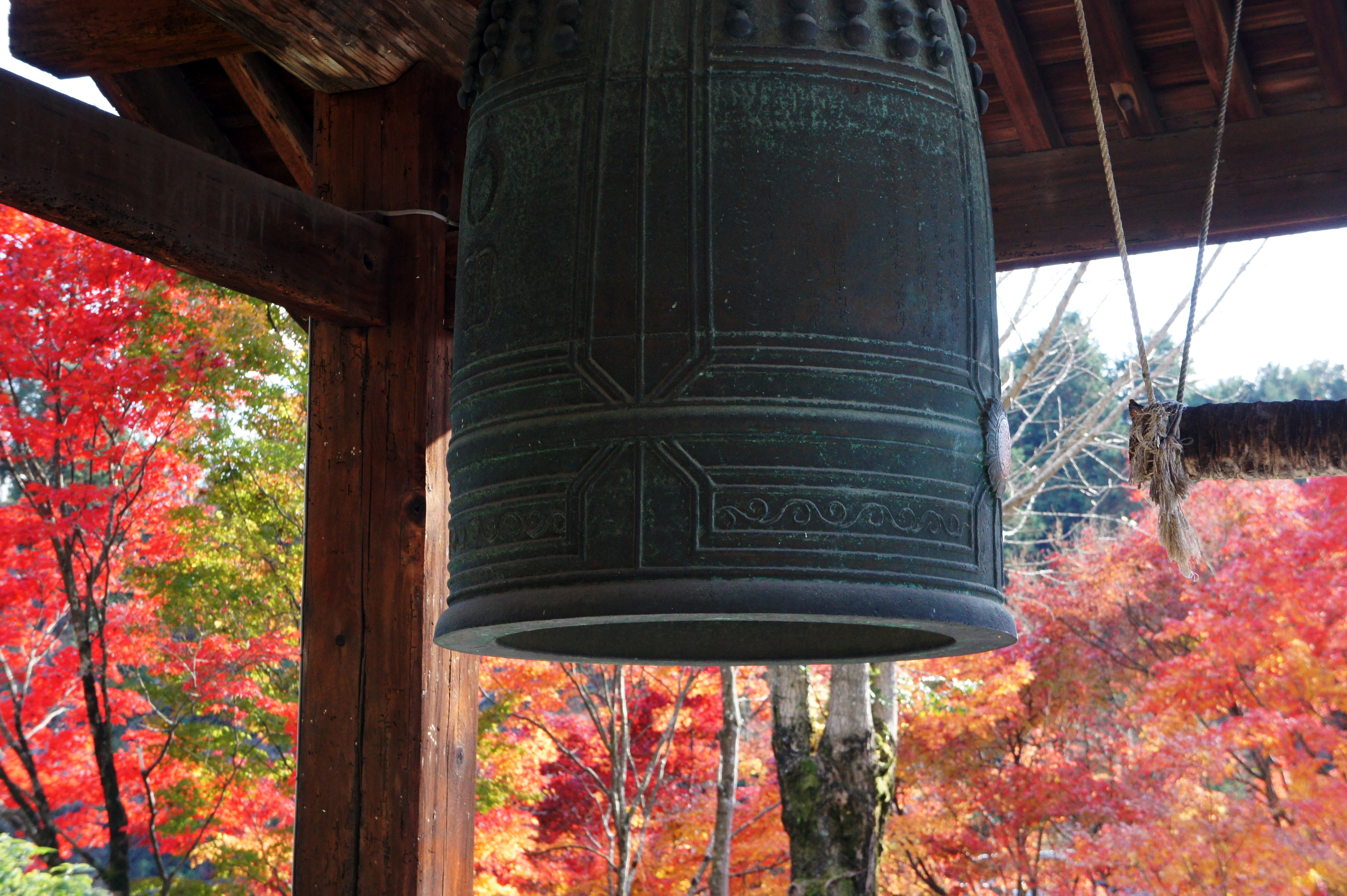
Mimuroto-ji: The Temple Built to Chase a Golden Light
Every night, a golden light reached the Imperial Palace. Emperor Konin's grandson wanted to know where it came from, so he sent Fujiwara no Inukai upstream along the Shizu River, a tributary of the Uji River, to find the source. According to temple legend, Inukai followed the glow to a waterfall basin, where he saw a two-foot-tall statue of Senju Kannon -- the Thousand-Armed Bodhisattva of Compassion -- gleaming in the water. When he jumped into the falls, a lotus petal drifted down and transformed into a smaller, two-armed Kannon measuring one foot and two inches. Emperor Konin enshrined the statue, a monk named Gyohyo from Daian-ji in the old capital of Heijo-kyo established the temple in 770, and Emperor Kanmu later placed the smaller figure inside the womb of a new, larger Kannon statue. There is no documentary evidence for any of this. But the temple it explains -- Mimuroto-ji, perched in the forested hills above Uji in Kyoto Prefecture -- has stood for more than twelve centuries, accumulating emperors, fire, war, and gardens along the way.
Shield Against Evil Spirits
Mimuroto-ji was positioned deliberately. When the temple was built in ancient times, it was intended to shield Kyoto from evil spirits -- part of a network of sacred sites arranged around the capital according to principles of spiritual geography. The temple belongs to the Honzanshugen-shu, a branch of Shugendo loosely affiliated with Tendai Buddhism, and its central image is a hibutsu -- a hidden Buddha statue of Senju Kannon Bosatsu that is rarely, if ever, shown to the public. The temple's full name, Akaboshi-san Mimuroto-ji, translates roughly as 'Morning Star Mountain, Three Chambers Temple.' Its placement on the Saigoku Kannon Pilgrimage as the tenth stop solidified its importance in the network of thirty-three temples dedicated to the Bodhisattva of Compassion across western Japan -- one of the oldest pilgrimage circuits in the country, dating back to the late Heian period.
Three Emperors' Villa
The temple's rise was tied to imperial patronage. During the Chowa era (1012-1017), Emperor Sanjo built the Hokke Sammi-do hall, and Emperor Shirakawa built the Jyogyo Sammi-do and donated a shoen manor estate for the temple's upkeep. When Emperor Shirakawa undertook his famous pilgrimage to Kumano, a seventeen-day goma fire offering ritual was performed at Mimuroto-ji. In the Kowa era (1099-1103), the abbot Ryumei of Onjo-ji restored the temple and relocated a sub-temple called Raku-in from Onjo-ji's grounds. Emperor Horikawa, a devoted follower of Ryumei, expanded the temple's buildings. Around this time, the temple came to serve as a retreat villa for three emperors -- Konin, Kazan, and Shirakawa -- and its name shifted from the original Omuroto-ji to Mimuroto-ji, meaning 'Three Chambers Temple,' reflecting its triple imperial connection.
Fire, Confiscation, and Oda Nobunaga
Imperial favor could not protect the temple forever. By the Muromachi period, Mimuroto-ji had begun to decline. On December 13, 1462, fire spread from the dining hall and destroyed most of the main complex. Emperor Go-Tsuchimikado ordered its reconstruction in 1487, and the rebuilt main hall from that year still stands today as a National Important Cultural Property. But a more devastating blow came in 1573, when the temple sided with Shogun Ashikaga Yoshiaki against the warlord Oda Nobunaga. Yoshiaki had fled to nearby Makishima Castle, and Mimuroto-ji threw in its lot with the losing side. Nobunaga confiscated all of the temple's lands, and the complex fell into deep decline. Recovery came slowly: in 1639, Prince Doko, the cloistered son of Emperor Go-Yozei and head of the monzeki temple of Shogo-in, restored the grounds. But by the Meiwa era (1764-1772), the main hall had again deteriorated, and it was not fully rebuilt until 1814.
Pilgrims and Hydrangeas
Today Mimuroto-ji is best known for two things: its place on the Saigoku Pilgrimage and its gardens. The temple grounds climb a hillside above the Uji River valley, with a pagoda rising above the treeline and a landscape garden spreading below it. The complex holds multiple National Important Cultural Properties, including the 1487 main hall, a Heian-period wooden statue attributed to the master sculptor Jocho, and Kamakura-period Buddhist sculptures. The Juhachi Jinja Honden, a Shinto shrine within the temple grounds, reflects the characteristic blending of Buddhist and Shinto worship that defined Japanese religious life for centuries. The temple sits approximately fifteen minutes on foot from Mimurodo Station on the Keihan Railway, tucked into the Shigadani neighborhood of Uji -- a city already famous for the Byodo-in temple and its green tea. Among devotees of the Saigoku circuit, Mimuroto-ji holds a particular distinction: in the oldest surviving pilgrimage record, written by the monk Gyoson around the end of the eleventh century, the temple was listed as the thirty-third and final stop -- the culmination of the entire journey.
From the Air
Located at 34.90°N, 135.82°E in the hills of Uji, Kyoto Prefecture, southeast of central Kyoto. From altitude, the temple sits in a forested hillside above the Uji River valley, with the pagoda sometimes visible through the canopy. The broader Uji area is identifiable by the Uji River threading through the city. Best viewed at 3,000-5,000 feet AGL from the west to see the temple against the eastern hills. Osaka International Airport (RJOO) lies approximately 25 nautical miles southwest, and Kyoto itself is roughly 10 kilometers to the northwest. The Keihan Railway line is visible running through Uji below.