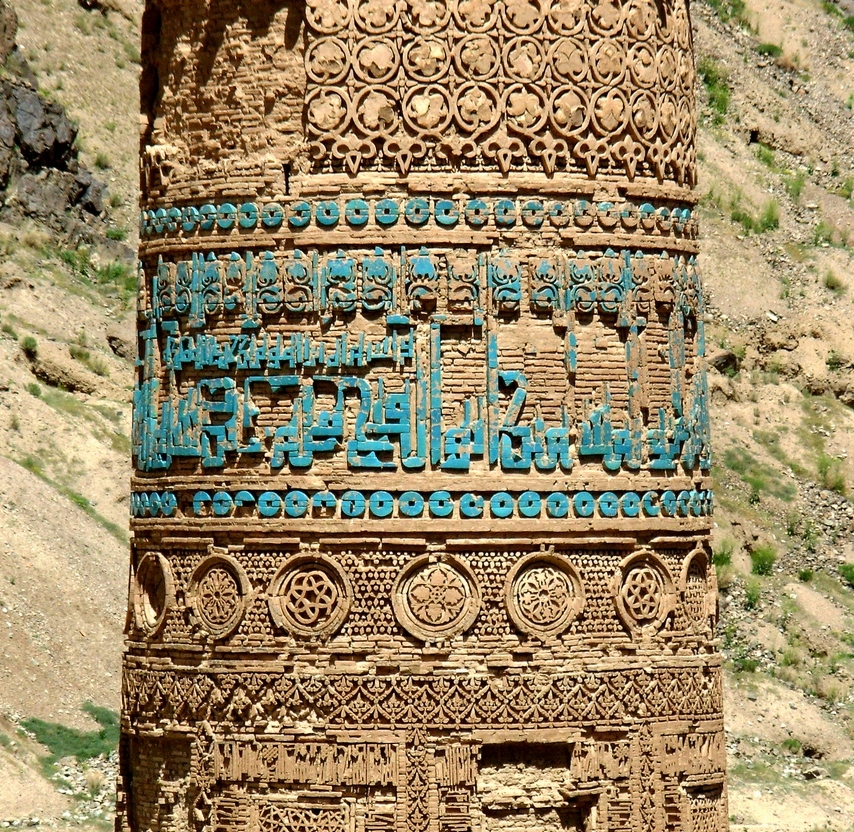
Minaret of Jam
Somewhere in western Afghanistan, wedged between the Hari and Jam rivers in a gorge so narrow that sunlight reaches the base for only a few hours each day, a tower stands that should not still be standing. The Minaret of Jam rises 65 meters from its octagonal base, built entirely of baked brick and decorated with bands of Kufic and Naskhi calligraphy, geometric lattice, and turquoise glazed tile that still catches the light after more than eight centuries. No road leads here. No city surrounds it. The Friday mosque it once adjoined was swept away by a flash flood sometime before the Mongols arrived. What remains is a monument so remote that the outside world did not rediscover it until 1886, and so fragile that every flood season threatens to be its last.
Turquoise Mountain
The minaret almost certainly marks the site of Firozkoh, the summer capital of the Ghurid dynasty, whose name translates as "Turquoise Mountain." In the late 12th century, the Ghurids controlled an empire stretching from eastern Iran to the plains of northern India, and Firozkoh was its beating heart. Sultan Ghiyath ad-Din Muhammad bin Sam commissioned the tower around 1193 to 1194, and his name encircles it in turquoise mosaic tiles. His architect, 'Ali ibn Ibrahim al-Naysaburi, signed his work in cursive naskhi script on the eastern face. Inside, a central pillar supports double spiral staircases, each with 159 steps leading to wooden balconies that once overlooked a courtyard, a palace, and fortifications. Archaeological analysis of satellite imagery suggests the capital spread across roughly 19.5 hectares. A Jewish cemetery discovered 10 kilometers away hints at the cosmopolitan population that once lived in these mountains.
An Empire Written in Brick
Reading the minaret from top to bottom is like reading a declaration of faith and power. The uppermost band carries the shahada, the Muslim profession of belief. Below it, verses from the Quran alternate with the sultan's names and titles, rendered in both angular Kufic script and flowing cursive. Interlaced geometric bands weave through Surat Maryam. Ribbon-like strands of intersecting knots spiral around the shaft. The whole composition belongs to a tradition of monumental towers that flourished between the 11th and 13th centuries across Central Asia, Iran, and Afghanistan. Around 60 such minarets and towers were built during this period. The Minaret of Jam bears a striking resemblance to the Ghazni minarets built by Masud III, and scholars believe it directly inspired the Qutub Minar in Delhi, a tower that would outlast the civilization that built its model.
The Long Silence
The Ghurid Empire faded after Ghiyath ad-Din's death in 1203, squeezed by the expanding Khwarazm Empire. The chronicler Minhaj-i Siraj Juzjani records that the Mongols destroyed Firozkoh in 1222. What the Mongols did not destroy, the rivers did. Flash floods washed away the adjacent mosque and buried courtyard paving under layers of sediment. The valley returned to silence. Centuries passed. Western scholars knew the tower only through secondhand accounts until French archaeologists André Maricq and Gaston Wiet documented it in 1957. Stabilization work began in the 1970s but collapsed along with everything else when the Soviets invaded in 1979. Brief archaeological campaigns resumed after 2001, only to stall again by 2008. Rory Stewart, the British explorer and politician, visited in 2002 and found looters had riddled the surrounding site with pits. Taliban skirmishes near the minaret in 2018 set surrounding forests ablaze.
Standing Against the Current
The Minaret of Jam has been on UNESCO's list of World Heritage in Danger since 2002, and the description understates the situation. The tower visibly leans. A January 2022 earthquake knocked bricks from its surface. Severe flooding threatened it again in 2014, 2019, and 2024. The rivers that once gave Firozkoh its lifeblood now gnaw at the minaret's foundation. In early 2025, retaining gabion walls were completed after 50 days of work, but experts warn that more drastic intervention is needed to prevent long-term deterioration. Access remains extraordinarily difficult, making sustained conservation work a logistical ordeal. The tower endures less because of human effort than despite the lack of it, held together by the quality of brickwork laid down by craftsmen who could not have imagined their work would need to last this long.
A Calligraphy of Survival
What makes the Minaret of Jam extraordinary is not just its architecture or its inscriptions but its sheer improbability. Eight centuries of earthquakes, floods, invasions, and neglect have failed to bring it down. It stands in a valley where no tourist infrastructure exists, where landmines were only recently cleared from the surrounding hills, where geopolitical turmoil makes every conservation effort provisional. Afghanistan's first cultural heritage site listed by ICESCO in 2020, it carries the weight of representing an entire civilization that the Mongols nearly erased. The turquoise tiles still catch the afternoon light. The calligraphy still declares the faith and ambitions of a sultan whose capital has otherwise vanished from the earth. In a region where so much has been destroyed, the minaret's persistence feels less like luck than like stubbornness, the baked bricks refusing to concede what the rivers and the centuries demand.
From the Air
Located at 34.396N, 64.516E in a deep river gorge at the confluence of the Jam and Hari rivers in Ghor Province, western Afghanistan. The minaret is extremely difficult to spot from high altitude due to the narrow valley. Best viewed from low altitude following the river valley. Elevation approximately 1,900 meters (6,200 feet). No nearby airports with ICAO codes; the nearest city is Chaghcharan (OACC) roughly 170 km to the northeast. Terrain is rugged Hindu Kush mountains with limited visual references.