Miners Foundry
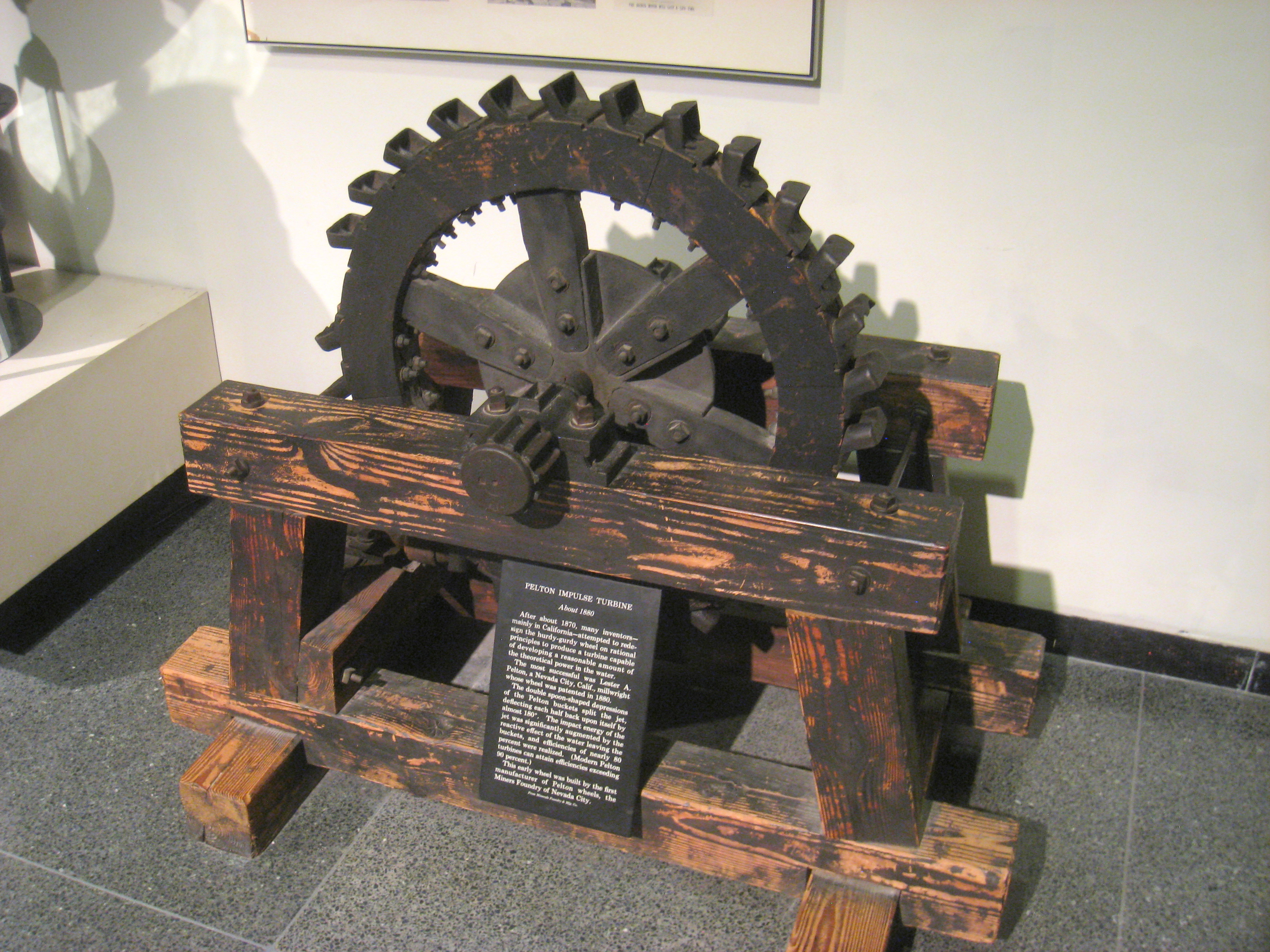
The invention that would eventually power cities across six continents was first tested in a modest foundry on the corner of Bridge and Spring streets in Nevada City, California. In the late 1870s, Lester Allan Pelton walked into George Allan's Foundry and Machine Works carrying a design for a new kind of water wheel. The cup-shaped buckets he proposed were split down the middle, deflecting the water jet in opposite directions and capturing nearly all of its kinetic energy. The concept was elegantly simple. Its consequences were enormous. The Pelton wheel became the most efficient impulse turbine ever designed, and the foundry where it was born - a building constructed of native timber and stone in 1856 - would outlast the Gold Rush, two world wars, and the entire era of industrial foundry work before reinventing itself as a cultural center.
Ashes and Iron
Edward Coker started the Nevada Iron Foundry and Machine Shop in 1855, setting up a blacksmith shop in a rented building on Spring Street behind the National Exchange Hotel. The foundry served the practical needs of Gold Rush-era loggers and miners working claims in the Sierra Nevada foothills - pick heads, pry bars, the heavy iron tools that placer mining consumed and destroyed. When a fire swept through Nevada City in July 1856, it destroyed Coker's small operation. He rebuilt on the corner of Bridge and Spring streets, this time constructing from native timber and stone, materials that could survive the fires that plagued California mining towns. By 1857, the Nevada Foundry had built its first complete steam engine. But Coker's ambitions didn't match his endurance. Before the new building was finished, he sold the machinery to David Thom, Thomas J. Williams, and J. Jones.
Quartz Crushers and Five-Thousand-Pound Mortars
Under the partnership of William Heugh and David Thom, the foundry grew from a blacksmith operation into a serious industrial works. By 1866, they employed around 22 men. A year later, they cast the mortar of a quartz mill weighing 5,600 pounds - believed to be the heaviest in California at the time. These were the massive iron bowls in which stamp mills pounded gold-bearing quartz into powder, and producing one required precision casting on a scale few Western foundries could manage. When Heugh died in 1867, George Grant Allan acquired his share and eventually became sole proprietor. Under Allan, the foundry exploded in scale. By 1868, approximately 150 men worked the machine shops and boiler works, consuming 1,800 tons of pig iron, 300 tons of wrought iron, and 700 tons of coal annually, all powered by a 60-horsepower steam engine.
The Wheel That Changed Everything
Lester Allan Pelton was a carpenter and millwright from Camptonville, about thirty miles north of Nevada City. Through years of observing water wheels at mining operations, he developed an insight that eluded trained engineers: a bucket split down the center, creating two symmetrical cups, would reverse the direction of a water jet and extract far more energy than conventional designs. Pelton brought his prototype to Allan's foundry in the late 1870s. Together, Pelton and Allan tested and refined the design, then manufactured the first production Pelton wheels on Spring Street. The invention proved so successful that demand soon overwhelmed the foundry's capacity, and production shifted to San Francisco - though limited manufacturing continued in Nevada City. Pelton received his patent in October 1880. The wheel he invented remains the standard for high-head hydroelectric installations worldwide.
From Turbines to Juicers
The foundry's later decades read like a time-lapse of American industrial evolution. Allan brought his son Albert into the business in 1892. W.H. Martin purchased the operation from the estate in 1907 and renamed it Miners Foundry and Supply Co. The company diversified, building non-mining commercial vehicles alongside its traditional output. By 1947, the transformation was complete: one division sold welding supplies, logging equipment, rubber products, and Bethlehem Steel wire rope, while another produced centrifugal juicers. Ray Amick owned the foundry from 1965 until 1974, when manufacturing finally ceased. For over 110 years, the building on Bridge and Spring streets had been continuously used as a foundry - a span of unbroken industrial production that few American buildings can match.
Second Act on Spring Street
Today the Miners Foundry Cultural Center hosts concerts, weddings, theater performances, and community events inside the same stone-and-timber walls where ironworkers once cast quartz-crushing mortars and Pelton tested his revolutionary wheel. A California Historical Landmark plaque, designated No. 1012 and dated May 11, 1994, commemorates the Pelton wheel's origins at the site. The Nevada City Winery, the first bonded winery to open in Nevada County after Prohibition, operates from the Foundry's garage. The building's transformation from industrial powerhouse to cultural venue mirrors Nevada City's own reinvention - a Gold Rush town that lost its economic reason for existing and found another. Where molten iron once poured, audiences now gather, and the walls that absorbed the percussion of steam hammers for a century now resonate with music instead.
From the Air
Miners Foundry is located at 39.262N, 121.020W in the heart of Nevada City, California. Best viewed at 1,500-2,500 feet AGL. The building sits at the corner of Bridge and Spring streets in the Nevada City Downtown Historic District. The compact, walkable downtown is identifiable from the air by its grid of streets nestled into the wooded Sierra foothills. Nearest airport: Nevada County Air Park (GOO), approximately 3 nm northwest. Auburn Municipal Airport (AUN) is about 22 nm south. The area sits at roughly 2,500 feet MSL elevation.