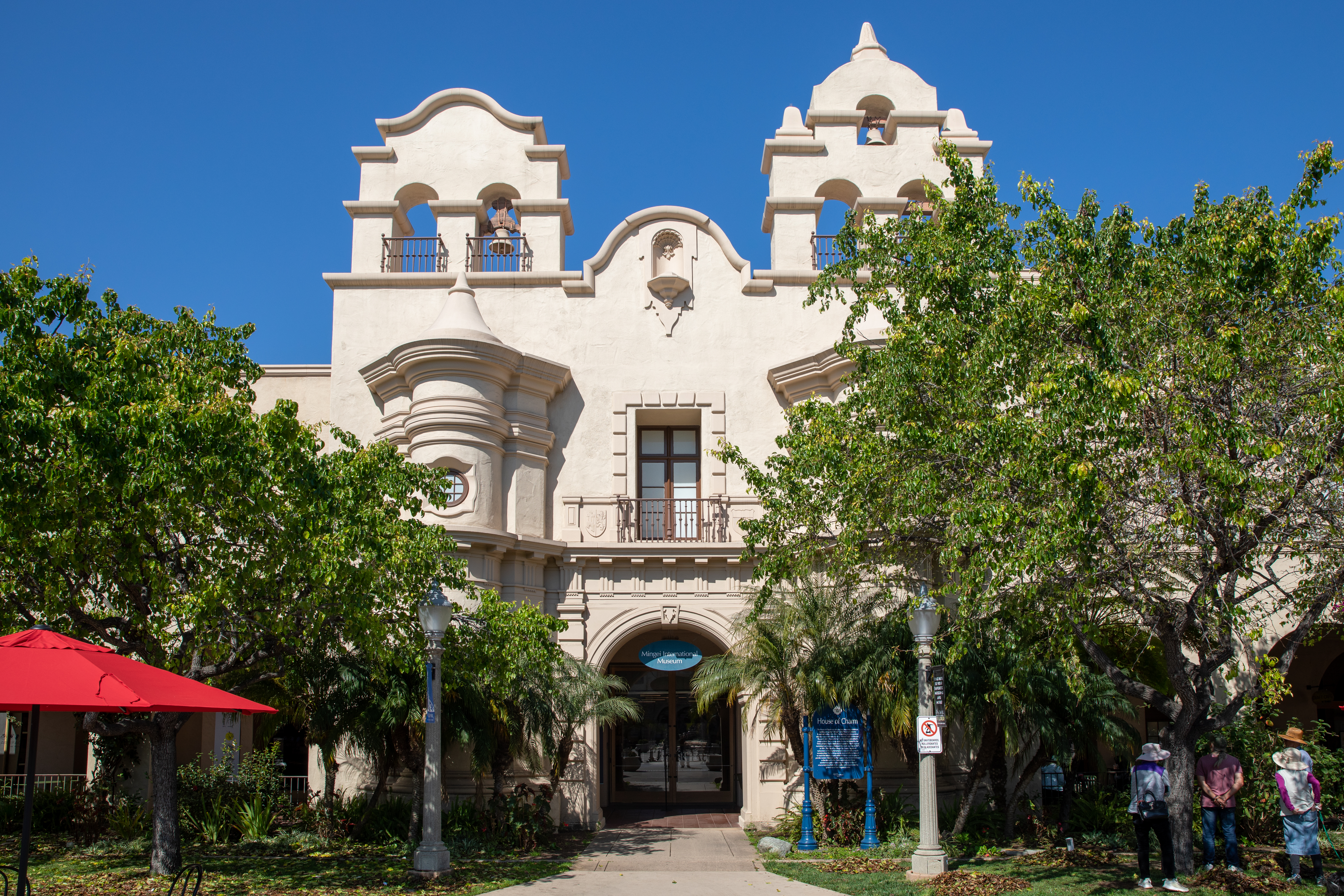
Mingei International Museum
The word mingei combines the Japanese characters for all people and art. Dr. Soetsu Yanagi coined it to describe objects made by anonymous craftspeople for everyday use, items that achieve beauty through function rather than conscious artistry. Martha Longenecker encountered this philosophy while studying pottery-making in Japan, and in 1974 she brought it home to San Diego. The museum she founded in Balboa Park now holds 17,500 objects from 141 countries, spanning from ancient clay vessels to contemporary Venetian glass.
From Shopping Mall to Spanish Colonial Plaza
Mingei International Museum opened in May 1978 at University Towne Centre, a shopping mall that might seem an unlikely birthplace for an institution devoted to folk art. Its first exhibition, Dolls and Folk Toys of the World, announced an approach that would define the museum: taking seriously the objects ordinary people make for ordinary purposes. In August 1996, the museum relocated to the historic House of Charm on the Plaza de Panama in Balboa Park, joining the San Diego Museum of Art and the Timken Museum of Art on the central square. The Spanish Colonial Revival building, dating from the 1915 Panama-California Exposition, provided a setting that matched the museum's philosophy: architecture built for the people, ornamented by craftspeople working in traditional styles.
Objects That Carry Culture
The collection draws from traditions across the globe. Mexican pottery, wood carvings, textiles, retablos, and masks represent one of the museum's strongest regional holdings. Indian bronzes and textiles join Chinese costumes, jewelry, and lacquerware. Japanese ceramics, wood carvings, and metalwork connect directly to the mingei movement that inspired the museum's founding. Indonesian ancestral monuments and masks, African pottery, head rests, and stools demonstrate how utilitarian objects carry cultural meaning. Pre-Columbian pottery and textiles from Central and South America, Middle Eastern textiles and jewelry, and American works from mid-twentieth-century pottery to Navajo weavings round out a collection that spans continents and millennia. The earliest pieces date to the 3rd century BCE.
A Potter's Legacy
Martha Longenecker, Professor of Art Emerita at San Diego State University, guided the museum for more than 27 years. Her background as a working potter shaped the institution's values: the museum never condescended to folk art as primitive or naive, but recognized the skill, knowledge, and aesthetic judgment that go into making a well-thrown pot, a finely woven textile, or a carefully carved figure. In 2003, Mingei International opened a second location in downtown Escondido, premiering with an exhibition of Niki de Saint Phalle's work from the permanent collection. That satellite closed in 2010, but over its history the museum has presented 140 exhibitions, each accompanied by lectures, demonstrations, workshops, and performances that help visitors understand not just the objects but the traditions that produced them.
Art Without Names
Walk through Mingei International and you encounter works whose makers are mostly unknown. A Mexican potter shaped a vessel for storing water. A Navajo weaver created a blanket to keep someone warm. A Japanese craftsman lacquered a box for holding treasures. These objects achieved beauty without the self-consciousness of fine art, without gallery prices or critical reviews. Yanagi believed that such objects, made within living traditions by craftspeople who inherited their skills and materials, possessed a special kind of authenticity. They were honest in a way that art made for museums could never be. Longenecker brought that idea to Southern California, creating a space where a 3,000-year-old clay vessel and a contemporary glass piece could share a room as equals, each representing human hands making something useful and, in the making, beautiful.
From the Air
Located at 32.73N, 117.15W in Balboa Park. The museum occupies the House of Charm on Plaza de Panama, identifiable by its Spanish Colonial Revival architecture. Balboa Park's distinctive layout is visible from above, with its museums clustered around formal gardens. San Diego International Airport (KSAN) lies approximately 3 nm west. Montgomery-Gibbs Executive Airport (KMYF) is approximately 5 nm north.