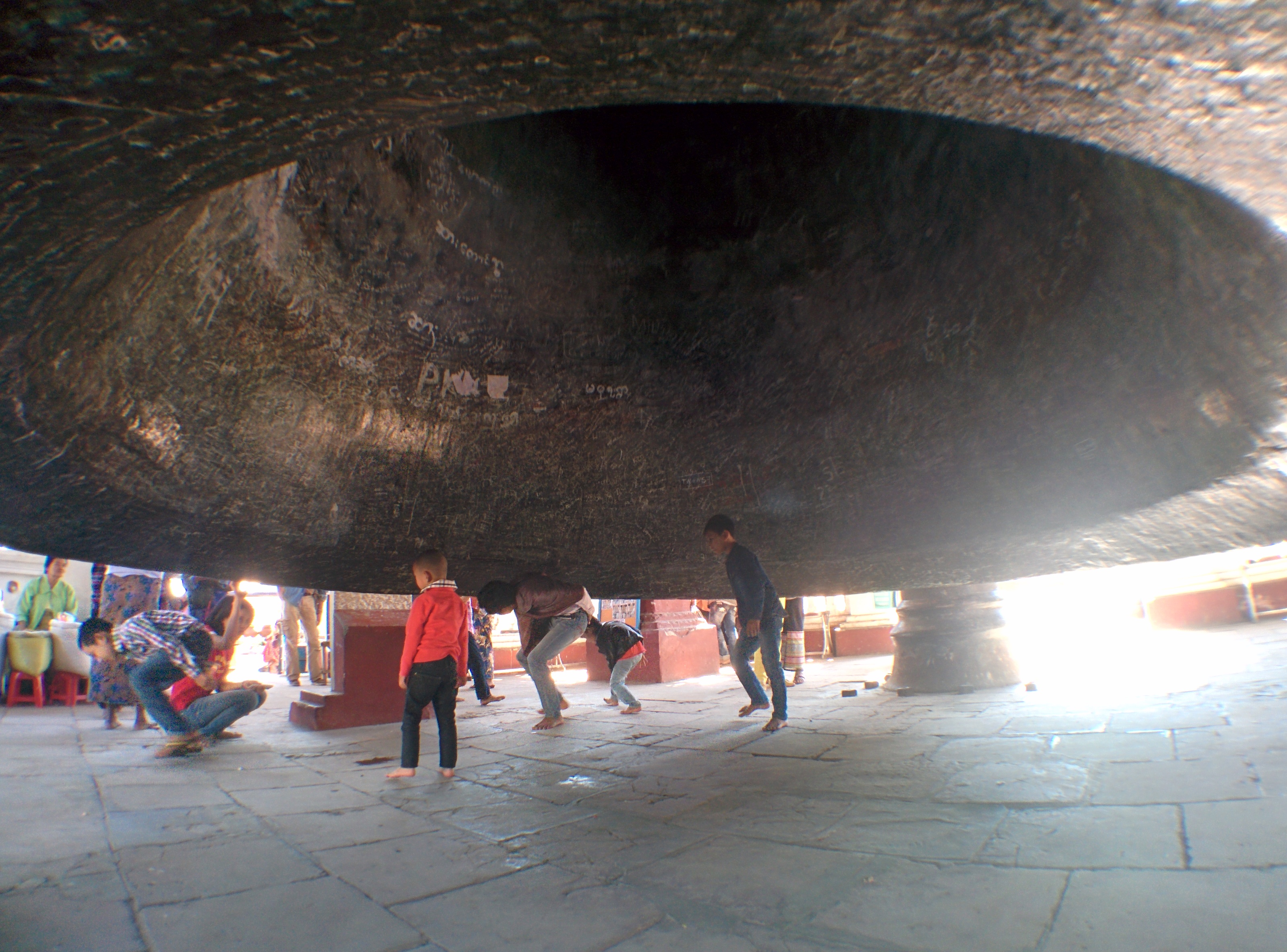
Mingun Bell
The number 55,555 is easy to remember in Burmese. Say the phrase "Min Hpyu Hman Hman Pyaw" and every consonant maps to the digit five in Burmese numerology -- a mnemonic for the bell's weight in viss, the traditional unit of mass. That a country invented a tongue-twister to remember how heavy a single bell is tells you something about the object's hold on the national imagination. Sitting in a zayat on the western bank of the Irrawaddy River, roughly 11 kilometers north of Mandalay, the Mingun Bell has been drawing visitors and astonishment since King Bodawpaya ordered it cast in the early nineteenth century.
A King's Commission
King Bodawpaya, who ruled the Konbaung dynasty from 1782 to 1819, was not a man of modest ambitions. His temple complex at Mingun was intended to be the largest Buddhist stupa ever built, and he wanted a bell to match. Commissioned as part of this grand project, the Mingun Bell was cast in 1808 from an alloy of gold, silver, bronze, iron, and lead. The result weighed 55,555 viss -- approximately 90,718 kilograms, or just over 90 metric tons. Bodawpaya personally supervised much of the construction from an observation post he had set up on a nearby island in the Irrawaddy, watching as his vision took physical shape on the riverbank.
Built to Extraordinary Scale
The bell's dimensions are as striking as its weight. Standing 20.7 feet from rim to crown, with an exterior height of 12 feet and an outer rim diameter of 16 feet, its circumference at the base stretches over 50 feet. The walls are roughly six inches thick throughout. Unlike many Western bells, the Mingun Bell has no clapper -- it is sounded by striking the outer edge, a method that produces a deep, resonant tone that carries across the river valley. The bell remains uncracked and in good ringing condition, a testament to the quality of its casting over two centuries ago. The Italian-British photographer Felice Beato captured images of the bell before it was resuspended, providing a rare early photographic record of the monument.
A Mnemonic in Metal
The weight inscribed in white on the bell's surface -- 55,555 viss -- is more than a measurement. In Burmese astronomy and numerology, consonant sounds correspond to numbers, and the phrase "Min Hpyu Hman Hman Pyaw" encodes the digit five in each consonant. This elegant pairing of language and mathematics turned a raw statistic into something people carry in their heads, a piece of cultural shorthand that has outlived the dynasty that created it. The mnemonic remains widely known in Myanmar today, passed along as casually as a nursery rhyme, binding the bell to the national memory in a way that sheer tonnage alone could not achieve.
The Title Changes Hands
For nearly 200 years, the Mingun Bell held its place as the largest functioning bell on Earth. That distinction ended in 2000, when the 116-ton Bell of Good Luck was installed at Foquan Temple in Pingdingshan, Henan, China. The Mingun Bell now ranks as the second-heaviest ringing bell in the world. But the title's transfer has done little to diminish the bell's stature among visitors who make the river journey from Mandalay. Arriving by ferry and then walking or riding a bullock cart from the jetty, they find the bell sheltered in its open-sided zayat, children sometimes playing beneath its vast bronze rim -- a 90-ton artifact that people still touch, still strike, still listen to.
From the Air
Located at 22.053N, 96.018E on the western bank of the Irrawaddy River, approximately 11 km north of Mandalay. The bell sits in the village of Mingun, adjacent to the massive Mingun Pahtodawgyi stupa which serves as a prominent landmark. The Irrawaddy River is the key navigation reference -- follow it north from Mandalay. Nearest major airport is Mandalay International (VYMD), roughly 45 km to the south. Recommended viewing altitude: 2,000-4,000 feet for context with the river and stupa.