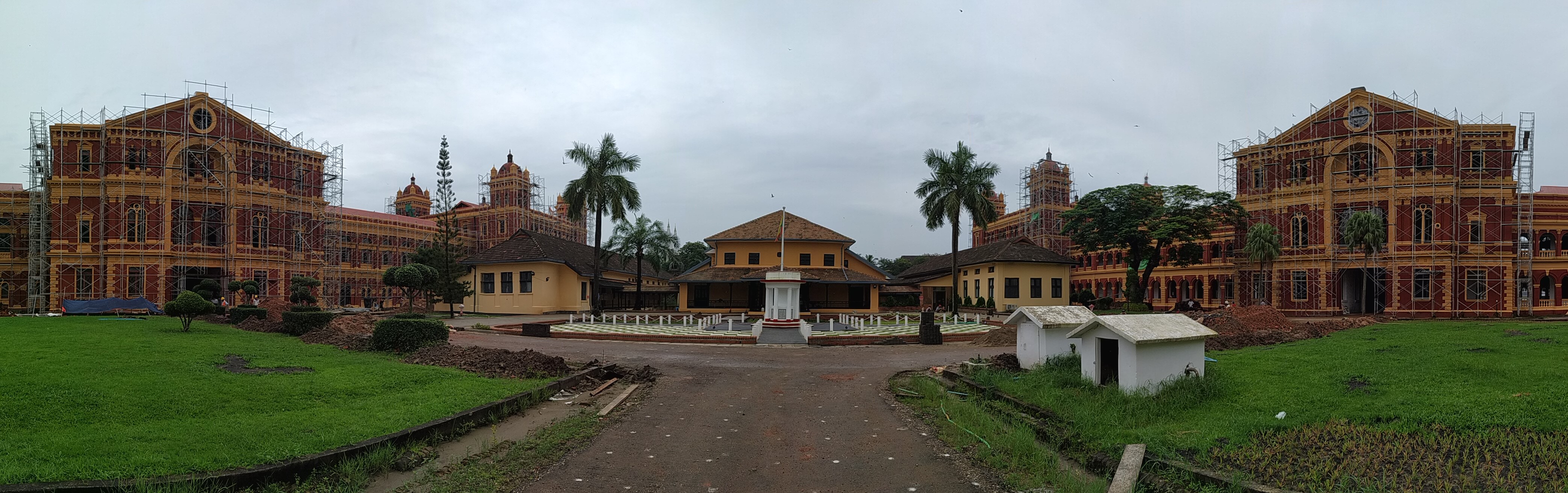
Ministers' Building
On the morning of July 19, 1947, gunmen burst into a cabinet meeting inside this building and killed General Aung San along with six of his ministers. The act extinguished the leadership of Burma's independence movement just months before the country would break free from British rule. Today the Ministers' Building -- known formally as the Secretariat -- fills an entire city block in downtown Yangon, its red and yellow Victorian brickwork crumbling behind scaffolding, its corridors carrying the weight of colonial administration, political murder, and decades of neglect.
Empire's Administrative Heart
Construction began in 1889, when British Burma's administrators outgrew their cramped offices on Strand Road. The central building rose first, completed in 1902, followed by the eastern and western wings in 1905, at a cost of 2.5 million rupees. Built in a U-shape from red and yellow brick, the complex sprawls across 6.5 hectares -- bounded by Anawrahta Road to the north, Theinbyu Road to the east, Maha Bandoola Road to the south, and Bo Aung Kyaw Street to the west. A double spiral iron staircase in the south wing became the building's architectural signature, an engineering flourish that still draws admiration from visitors who manage to see it through the renovation scaffolding. For decades, every major administrative decision governing Burma passed through these halls, making the Secretariat the nerve center of colonial power in Southeast Asia.
The Assassination That Shaped a Nation
By 1947, General Aung San had negotiated Burma's path to independence from Britain. He served as head of the interim government, and the cabinet met regularly inside the Secretariat. On July 19, armed men entered the building and opened fire during a council meeting. Aung San and six cabinet members died, along with a bodyguard named Ko Htwe, whose position was later marked on the floor where he fell. The assassinations were orchestrated by political rival U Saw, who was subsequently tried and executed. The room where the killings took place was preserved as a Buddhist shrine until 2016, and every year on July 19 -- Martyrs' Day -- Myanmar opens the building to the public. In 2017, the 70th anniversary drew 42,101 Myanmar citizens and 205 foreigners, who filed past original furniture, fountain pens, wristwatches, and personal belongings of the fallen leaders.
Abandoned Grandeur
After independence, the building continued as the Government Secretariat until 1972. When Myanmar's government relocated to the purpose-built capital of Naypyidaw, the Secretariat was left empty. Yangon's tropical climate is unforgiving to vacant buildings -- moisture seeps into brick, mold colonizes teak, and vegetation pushes through cracks in masonry. For years, the government debated the building's future. Proposals ranged from conversion into a hotel to demolition. In 2011, preservationists won a critical victory when plans were finalized to transform it into a museum rather than a commercial property. The Yangon Heritage Trust, led by historian Thant Myint-U, championed the cause. In November 2014, U.S. President Barack Obama visited the Secretariat, touring the assassination room and pledging American support for urban development and heritage protection.
A Slow Resurrection
Restoration has proceeded in phases, with guided heritage tours now available daily from 9:30 a.m. to 4:30 p.m. Visitors walk through soaring corridors where original teak woodwork survives alongside construction scaffolding, past the Yangon Parliament House where Burma's self-rule first took shape, and into the west wing where the assassination occurred. In early 2017, German artist Wolfgang Laib opened an exhibition in the southeast wing called "Where the Land and Water End," installing one of his signature pollen works at the base of the double spiral staircase. The delicate pollen lasted only two days in the building's humid conditions, but the exhibition also featured his famous "milkstones" and a fleet of brass ships surrounded by rice. The Secretariat sits roughly one kilometer southeast of Yangon Central Railway Station and 600 meters east of the golden Sule Pagoda, anchoring a colonial-era district that preservationists hope will become a draw for heritage tourism.
From the Air
Located at 16.776°N, 96.166°E in the heart of downtown Yangon. The Secretariat's U-shaped roofline covers an entire city block and is identifiable from above. Nearby landmarks include Sule Pagoda (600 m west) and Yangon Central Railway Station (1 km northwest). Nearest airport is Yangon International (VYYY), approximately 15 km north of downtown. Best viewed at 2,000-3,000 ft AGL for building-level detail, or at higher altitudes to see the colonial grid surrounding the complex.