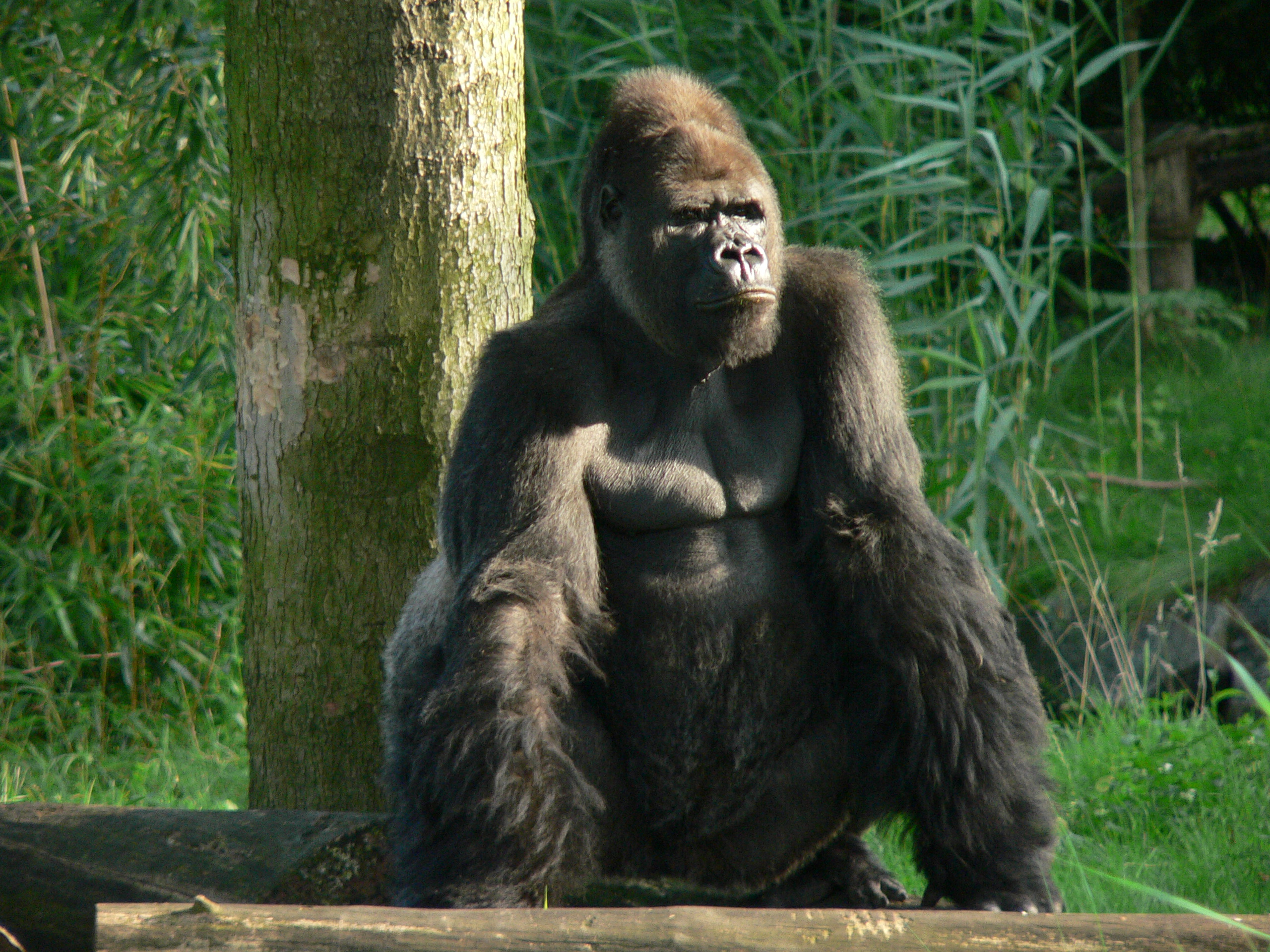
Minkebe National Park
There are places on Earth where the absence of roads is the most important feature on the map. Minkebe National Park, in the extreme northeast corner of Gabon, is one of them. Covering 7,570 square kilometers of equatorial rainforest -- an area larger than the state of Delaware -- the park has no permanent human population, no paved access, and no infrastructure to speak of. This inaccessibility is its greatest protection. Beneath a canopy that includes trees hundreds of years old, forest elephants move along trails they have carved over generations, western lowland gorillas build their nests in the understory, and the Nouna River winds through a landscape that looks much as it did before the Fang people named this place. Minkebe means "valleys" or "ditches" in the Fang language -- a name that captures the terrain's character without exaggeration.
Granite Domes Above Endless Green
From the air, Minkebe presents a paradox: nearly unbroken forest canopy interrupted by isolated rock domes -- inselbergs that rise above the treetops like bald granite islands in a green sea. The wider Minkebe forest covers 30,000 square kilometers, with the national park protecting the densest core. Within the park, habitats shift between inselberg forest, herbaceous swamps, inundated river forest, and secondary growth. Four main rivers thread through the landscape, their floodplains creating marshy clearings that break the forest cover and attract wildlife. Grasslands marked by elephant trails offer rare open views. The overall impression from altitude is of a vast, living organism -- the forest canopy rippling with topography, punctuated by the gray skulls of ancient rock, and crossed by dark ribbons of water that catch the light only when the sun hits them at the right angle.
Elephants in the Cathedral
The forest elephant is Minkebe's signature species, and the WWF believes the park harbors one of the largest populations in Africa. Unlike their savanna cousins, forest elephants are smaller, with straighter, downward-pointing tusks adapted for navigating dense undergrowth. They are also far more elusive. In a forest this thick, elephants are heard more often than seen -- the crack of a branch, the low rumble of communication that travels through the ground. Western lowland gorillas, listed on the IUCN Red List, also inhabit the park. The biological richness extends beyond megafauna: Minkebe lies within the Northwest Congolian Lowland Forest ecoregion, recognized by the WWF as one of the most biologically significant forests on the continent. The park has been proposed as a World Heritage Site, a designation that would place it alongside the Congo Basin's most celebrated protected areas.
Three Nations, One Forest
Minkebe does not exist in isolation. It forms part of the Dja-Odzala-Minkebe Tri-National initiative, known as TRIDOM, a conservation effort spanning Gabon, the Republic of the Congo, and Cameroon. The TRIDOM zone covers 140,000 square kilometers -- approximately 7.5 percent of the Congo Basin's forests -- making it one of the largest transboundary conservation areas in the world. The WWF identified Minkebe as needing protection as early as 1989 and began active conservation work in 1997, establishing forest command centers at Oyem and Makokou, with a central camp at the mouth of the Nouna River. The park was designated a provisional reserve in 2000 and officially established by the Gabonese government in August 2002. Funding has come from the Netherlands, USAID, the European Union, UNESCO, and France's Global Environment Facility -- a roster that reflects both the park's importance and the recognition that protecting a forest this remote requires sustained international commitment.
The People of the Forest Edge
Although no one lives permanently within the park's boundaries, the surrounding forest region is home to communities of Baka, Fang, Kota, and Kwel peoples whose cultural traditions are as layered as the ecosystem itself. The Fang once inhabited the Minkebe area before it became protected. Their name for the place endures on every map. The Kota people are known for their distinctive masks -- abstract copper-covered reliquary figures that have influenced modern art far beyond Central Africa. The Baka practice a spiritual tradition centered on Edzengui, a forest spirit integral to their relationship with the landscape. The Kwel Deke dance carries meaning that connects community to forest in ways outsiders can observe but rarely fully grasp. These cultures are not museum pieces. They are living traditions maintained by people who share a border with one of the planet's most significant remaining wildernesses, and whose knowledge of that wilderness often exceeds anything science has yet documented.
From the Air
Located at 1.68N, 12.76E in extreme northeastern Gabon, near the triple border with Cameroon and the Republic of the Congo. From cruising altitude, Minkebe appears as an unbroken expanse of dense equatorial rainforest punctuated by isolated granite inselbergs. The Nouna River and its tributaries are visible as dark meandering lines through the canopy. No airstrips exist within the park. The nearest airports are at Makokou (FOGM) to the south and Oyem (FOGO) to the west. Libreville's Leon Mba International Airport (FOOL) is the country's main entry point, approximately 500 km to the southwest.