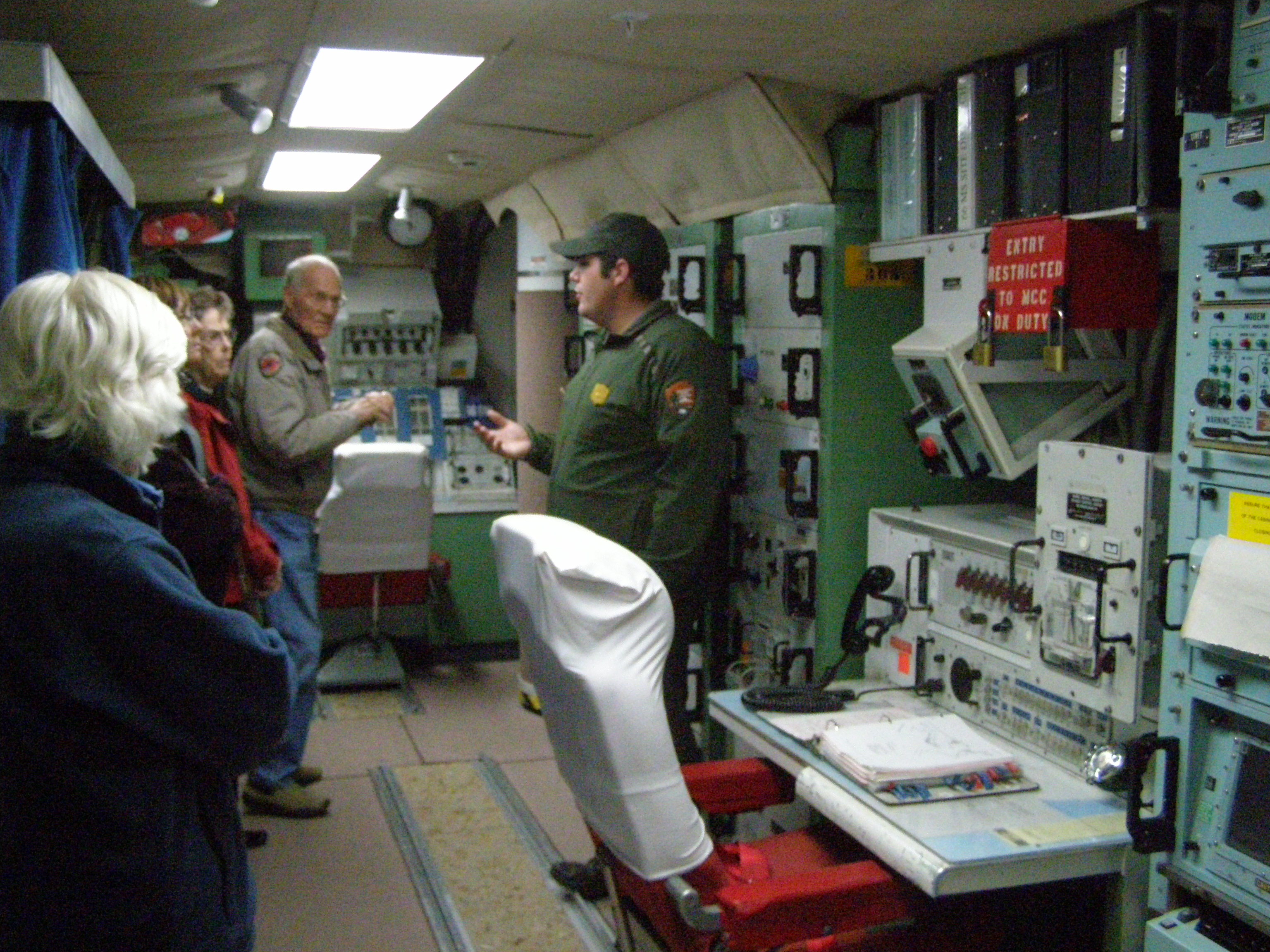
Minuteman Missile National Historic Site
Two launch keys hang in a glass case, suspended eight inches apart. That distance was deliberate. In the bunker sixty feet below the South Dakota prairie, no single person could turn both keys simultaneously. It took two missileers, strapped into their chairs, each turning their key at the exact same moment, to send a thermonuclear warhead screaming toward its target at fifteen thousand miles per hour. This is Delta-01, and for nearly thirty years, it was one of the most dangerous rooms on Earth.
Thirty Minutes to Anywhere
The numbers still stagger. A Minuteman II missile could travel over 6,000 miles in under half an hour. Launched from this patch of South Dakota grassland, it could reach Moscow in about twenty-five minutes. The United States built 150 of these missiles in this complex alone, spread across 13,500 square miles of southwestern South Dakota, each one capable of carrying a warhead with eighty times the destructive power of the bomb that destroyed Hiroshima. The strategy was grimly logical: scatter the missiles across such a vast area that no Soviet first strike could destroy them all. Enough would survive to ensure mutual destruction.
The Watch That Never Ended
From 1963 to 1991, two-person crews rotated through Delta-01 on twenty-four-hour shifts. They descended through blast doors designed to withstand a nearby nuclear detonation, though not a direct hit. Inside the capsule, they monitored instruments, ran drills, and waited. The bunker stored enough food and water for one week. If the worst happened, they were expected to launch their missiles, then wait for the outside world to tell them whether anything remained. A quote from Sun Tzu still marks the site: 'The supreme art of war is to subdue the enemy without fighting.' For three decades, that was the entire point.
The Silent Stand-Down
The Strategic Arms Reduction Treaty of 1991 ended the vigil. The 44th Missile Wing was inactivated, and crews began the careful work of dismantling what had taken decades to build. Most of the 150 silos were destroyed, their concrete lids blown off and the missiles removed. But Delta-01 and Delta-09 were preserved, chosen for their proximity to Interstate 90 and the stark message they could deliver to future generations. Today, you can peer into the silo from above, where a Minuteman II still stands, its warhead removed but its menace intact.
A Memorial to Madness
The visitor center sits just off the interstate, unremarkable against the prairie landscape. But step inside and confront the reality: some 450 Minuteman III missiles remain on active alert at bases in Montana, North Dakota, and Wyoming. The Cold War ended, but nuclear deterrence did not. Touring Delta-01 requires reservations made months in advance, a reminder of the site's enduring power to draw visitors who need to see where the unthinkable was once routine. The blast door still bears the art painted by missileers during those long underground shifts, evidence of humanity in the most inhuman of circumstances.
From the Air
Located at 43.93N, 102.16W near Wall, South Dakota. The site consists of three facilities spread along Interstate 90: the visitor center at Exit 131, Delta-01 Launch Control Facility at Exit 127, and Delta-09 silo at Exit 116. Best viewed at 3,000-5,000 feet AGL. The flat prairie terrain makes the sites difficult to distinguish from the air, but the silo's concrete pad is visible in clear conditions. Nearby airports include Philip (KPHP) 30nm west and Rapid City Regional (KRAP) 75nm northwest. The site lies within the Buffalo Gap National Grassland, with Badlands National Park visible to the south.