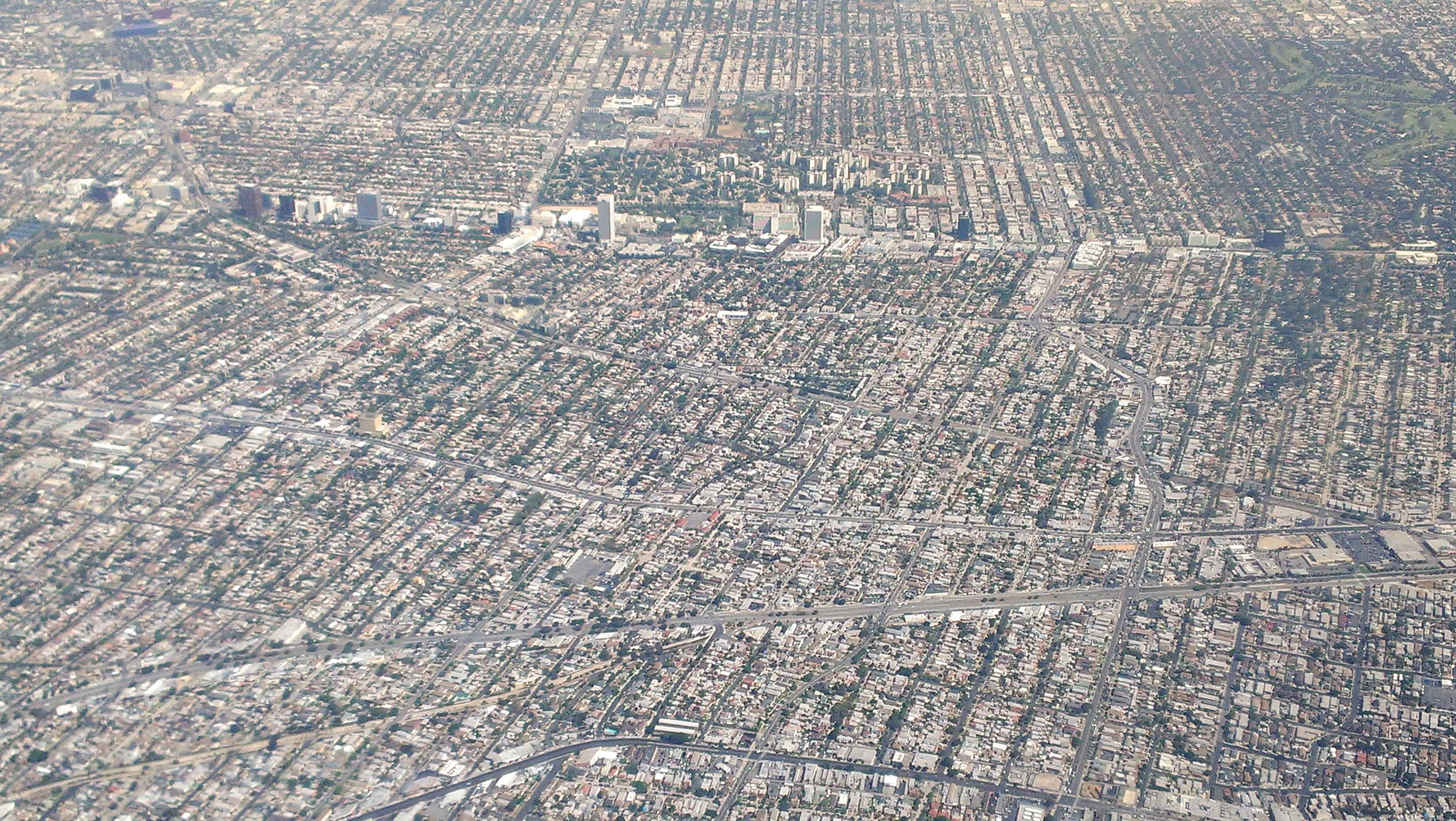
Miracle Mile, Los Angeles
A.W. Ross had a theory about the future of cities, and he expressed it in concrete and asphalt on Wilshire Boulevard in the 1920s. The future, he believed, belonged to the automobile — and the streets of that future needed to be designed accordingly. What he built between La Brea and Fairfax was the first commercial corridor in America deliberately engineered for drivers, and he called it the Miracle Mile.
Designing for the Windshield
The name appeared in Los Angeles newspapers on January 27, 1929, though the development had been underway since earlier in the decade. Ross had purchased land along Wilshire Boulevard and imposed conditions on the merchants who built there: they had to provide off-street parking lots, a novelty in an era when most commercial streets relied entirely on foot traffic and transit.
The storefronts were designed with drivers in mind. Large windows, bold signage, horizontal proportions — all calculated to communicate with someone passing at 30 miles per hour rather than walking at three. The Miracle Mile gave Wilshire Boulevard the first dedicated left-turn lanes in the United States and some of the first timed traffic signals in the country, coordinated to create the 'green wave' that drivers still chase along the boulevard today.
This was not merely an architectural experiment. It was a vision of urban life organized entirely around the private automobile — a vision that would go on to reshape American cities for the next century. Los Angeles, with its sprawling geography and relative absence of transit infrastructure, was the natural place for that vision to be first articulated and built.
What Grew Along the Mile
The Miracle Mile attracted department stores, office buildings, and eventually some of the most important cultural institutions in Los Angeles. The Los Angeles County Museum of Art occupies several blocks along this stretch of Wilshire, having grown from a wing of the Natural History Museum in 1961 into a sprawling complex of buildings that now anchors the city's cultural life.
La Brea Tar Pits lie immediately adjacent to LACMA, their asphalt pools still releasing the same methane that confused ancient animals into fatal missteps. The Petersen Automotive Museum — housed in a building whose silver ribbons of steel evoke the speed that the Miracle Mile was always about — faces the tar pits from across the street. The Academy Museum of Motion Pictures, which opened in 2021, extends the cultural cluster to the east.
The irony of this cultural concentration is complete: a street designed for the automobile has become, in its middle stretch, one of Los Angeles's most significant pedestrian destinations. The same drivers who Ross designed the strip to serve are now advised to park and walk.
The Mile Today
The Miracle Mile Historic District is listed on the National Register of Historic Places, a recognition that the commercial architecture of the 1920s and '30s along Wilshire represents something worth preserving — not just as individual buildings but as a coherent vision of urban design.
The subway reached the Miracle Mile in 2026, with the opening of the D Line Extension stations at Wilshire/La Brea, Wilshire/Fairfax, and Wilshire/La Cienega on May 8, 2026. For a street designed in explicit opposition to transit, the arrival of underground rail is a kind of historical reversal — the city's belated acknowledgment that the automobile-centered urbanism that the Miracle Mile pioneered has costs that a different kind of infrastructure must now address.
The buildings Ross designed for speed still stand, facing a boulevard that is now as likely to be clogged with traffic as flowing with it. The miracle he imagined was real, for a time. What replaced it is something more complicated — a city still negotiating, a century later, the consequences of the choices its founders made.