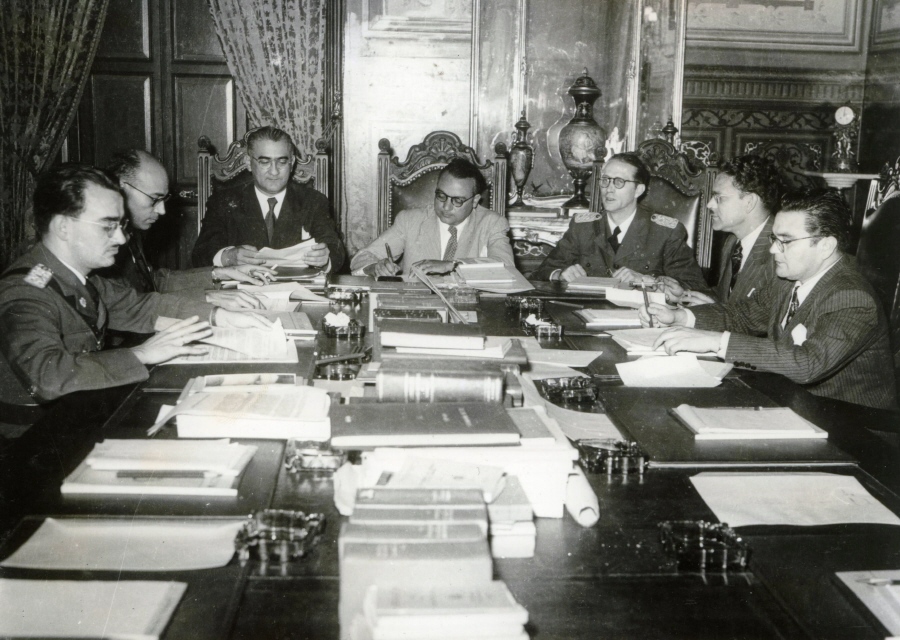
Miraflores Palace
Four gigantic rock-crystal mirrors line the walls of the Joaquin Crespo Hall, reflecting the faces of every diplomat, minister, and head of state who has entered the room since 1884. Crespo built the palace as his family home, importing furniture from Barcelona and commissioning bronze lamps from a foundry in the Venezuelan countryside. He never imagined it would become the nerve center of the republic. But Miraflores Palace, standing on Urdaneta Avenue in the heart of Caracas, has served as Venezuela's presidential headquarters for over a century -- a building where the country's turbulent political history is written into the walls, the artwork, and even the names of the rooms.
A General's Private Ambition
Construction began on April 27, 1884, under the direction of architect Giuseppe Orsi. General Joaquin Crespo wanted a residence that announced his stature in the European style then fashionable among South American elites. He assembled a team that included painter Julian Onate and sculptor Juan Bautista Sales, whose carvers and decorators gave the building an ornamental richness unusual even by the standards of Caracas's wealthy class. Furniture arrived from Barcelona, Spain. A bronze rosette came from the Marrera foundry. Twenty-four bronze lamps were ordered from the Requena brothers in San Juan de los Morros, Guarico state. The palace Crespo built was a private statement of power and taste -- but power in Venezuela was never entirely private for long. In 1911, the national administration purchased the property from General Felix Galavis for five hundred thousand bolivares, and Miraflores became the official presidential residence and office.
Dictators, Democrats, and Empty Hallways
The palace's early decades as a seat of government were defined by the strongmen who occupied it. Cipriano Castro governed from Miraflores, followed by Juan Vicente Gomez, who held power until 1913 and then ruled through proxies -- the palace served as the office of his placeholder president, Victorino Marquez Bustillos, from 1914 to 1922. In 1923, Gomez's brother, Vice President Juan Crisostomo Gomez, died within the palace walls under circumstances the historical record leaves ambiguous. From 1931 to 1935, the building sat uninhabited, guarded only by soldiers -- a palace without a president, waiting for the next chapter. That chapter arrived in 1945 when Romulo Betancourt became the first leader to formally designate the seat of government as Miraflores Palace, retiring the older name Federal Palace and giving the building the identity it carries today.
Rooms Named for Battles
Walk through Miraflores and you walk through the mythology of Venezuelan independence. The Ayacucho Hall, where presidents address the nation from behind a painting of Simon Bolivar, is named for the battle that sealed South American liberation. The Boyaca Room, one of the largest in the palace, honors Bolivar's decisive victory of August 7, 1819, and features a mural by Gabriel Bracho depicting Bolivar, Francisco de Paula Santander, and Jose Antonio Anzoategui. The Vargas Swamp Room commemorates the battle of July 25, 1819, and serves as a waiting area where presidential chairs from former administrations sit like relics -- the seats of Jose Antonio Paez, Antonio Guzman Blanco, Joaquin Crespo, and Juan Vicente Gomez, each representing a different era of the republic. The Sun of Peru Hall displays a golden sun donated by the Peruvian government and paintings by Arturo Michelena and Tito Salas, connecting Venezuelan history to the broader liberation of the continent.
Layers of Renovation
Every administration has left its mark on the building. During the dictatorship of Marcos Perez Jimenez, architect Luis Malaussena gutted portions of the original Crespo-era decoration and introduced modernist changes. Subsequent governments added a Japanese garden, an administrative building, and the Bicentennial square. Under Rafael Caldera's first presidency, from 1969 to 1974, a new Administrative Building began rising alongside the historic structure. In February 1979, the palace was declared a National Historical Monument, and during Luis Herrera Campins's administration the major construction projects were completed. By the 1990s and 2000s, the pendulum had swung back: restoration efforts sought to recover the palace's original character, peeling away decades of modification to reveal what Crespo's craftsmen had built more than a century earlier. Beneath the layers, the Miraflores Historical Archive preserves nearly 15 million pages of presidential documents, a collection begun in 1959 when files from the Castro and Gomez administrations were rescued from the basement of the Presidential Guard.
The Mirror Hall's New Name
Until 2003, the grandest room in the palace was simply called the Hall of the Mirrors -- a name that described its four enormous rock-crystal looking glasses without invoking any particular history. That year, it was renamed the Joaquin Crespo Hall, honoring the general who had built the palace as his home. The renaming completed a circle: the man who commissioned the mirrors finally got his name on the door. Today the room hosts formal cabinet meetings, receives the diplomatic corps, and witnesses the swearing-in of ministers and ambassadors. Two large paintings hang behind the presidential chair, and the crystal mirrors multiply everything -- the pomp, the politics, and the reflected images of a country still working out its relationship with the men who have governed from this building. Miraflores endures, its walls thick enough to absorb 140 years of Venezuelan history and still stand.
From the Air
Located at 10.508N, 66.919W on Urdaneta Avenue in the Libertador Municipality of central Caracas. The palace is identifiable from the air as a large compound with gardens and courtyards in the dense urban core, north of the main east-west highway corridor. Simon Bolivar International Airport (SVMI) is approximately 20 km to the northwest near Maiquetia. The nearby landmark of El Calvario Park and its hilltop arch are visible to the west. Paseo Los Proceres extends to the south. Best viewed at lower altitudes for architectural detail; the compound is distinguishable at 3,000-5,000 feet AGL.