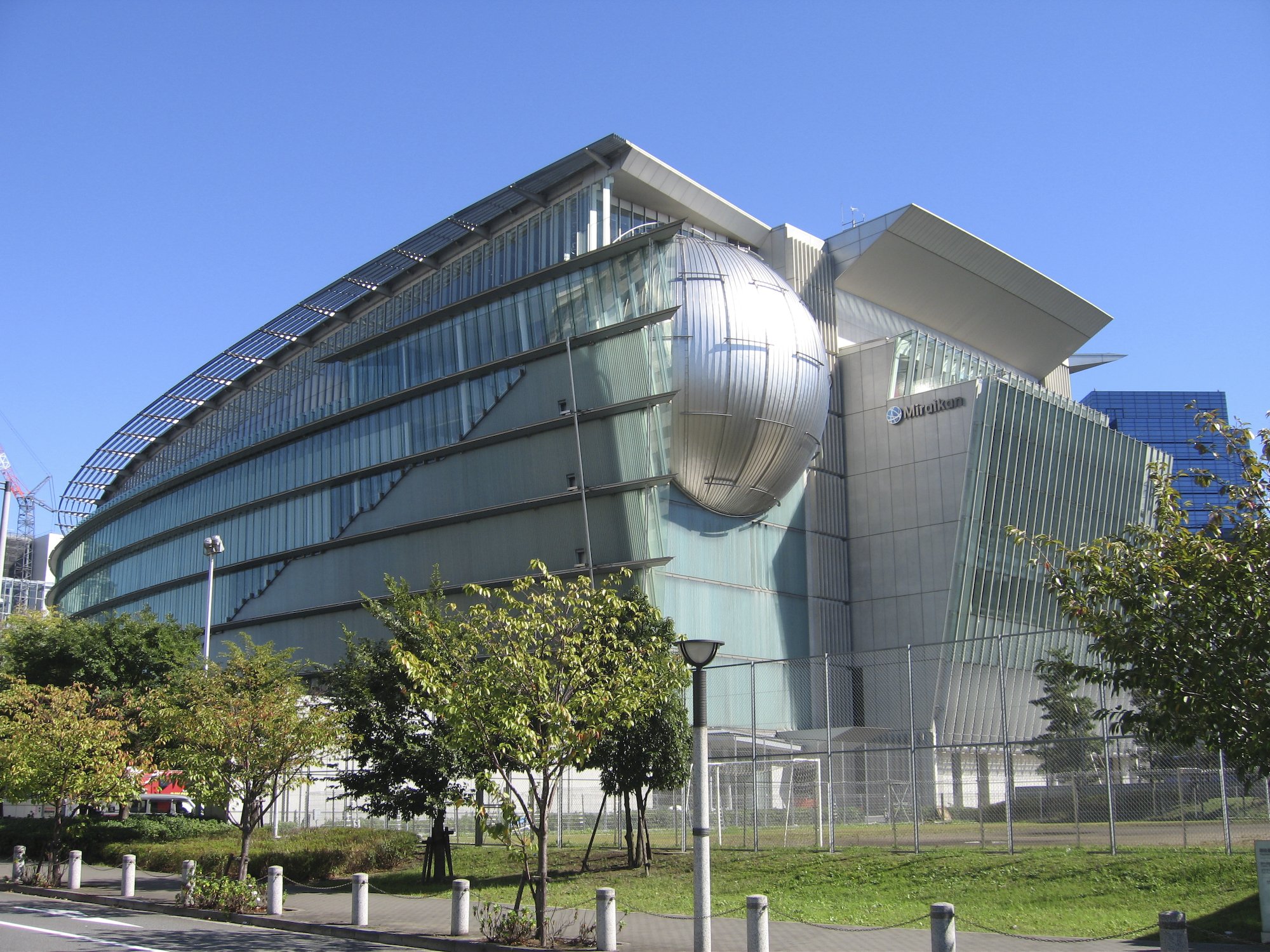
Miraikan
A sphere the size of a small house hangs eighteen meters above the atrium floor, and it is glowing. The Geo-Cosmos -- a 6.5-meter globe surfaced with 10,362 OLED panels delivering over ten million pixels -- displays the Earth as seen from space, rotating slowly, showing real-time weather patterns, ocean currents, and the glow of city lights after dark. It is the signature exhibit of Miraikan, the National Museum of Emerging Science and Innovation, and it was conceived by the museum's founding director, Mamoru Mohri, Japan's first astronaut from an official Japanese space program, who wanted visitors to experience the Overview Effect -- that shift in perspective astronauts describe when they first see Earth from orbit. The museum opened on July 9, 2001, in a purpose-built glass-and-steel structure on the artificial island of Odaiba in Tokyo Bay, and it has been challenging visitors to think about the future ever since.
An Astronaut's Vision
Mamoru Mohri flew on the Space Shuttle Endeavour in 1992 and again on the Space Shuttle Endeavour in 2000, and both flights changed how he thought about science communication. When the Japanese government asked him to lead a new national science museum, Mohri insisted it should not be a place that simply displayed artifacts behind glass. He wanted a museum where visitors would confront the questions that scientists are actually working on right now -- not the settled answers of textbook science, but the open frontiers. The result was Miraikan, whose very name means 'future museum.' Mohri served as Chief Executive Director from the museum's founding, shaping an institution that treats science not as a collection of facts but as an ongoing conversation about where humanity is headed.
Ten Thousand Panels, One Planet
The Geo-Cosmos dominates Miraikan's soaring atrium. Built by Mitsubishi Electric and unveiled in 2011 as an upgrade to the original LED globe, the sphere is an aluminum frame covered with 10,362 small OLED panels, each measuring 96 by 96 millimeters with a resolution of 32 by 32 pixels. The panels use passive-matrix OLED technology and are arranged with a 3-millimeter dot pitch, creating a seamless spherical display unlike anything else in the world. The globe hangs eighteen meters from the floor, slowly rotating, and its content shifts throughout the day: satellite imagery of weather systems, visualizations of ocean temperature, population density maps, and simulations of how the planet looked millions of years ago. HDR panels and a wide color gamut deliver light and color with startling fidelity. Standing beneath it, looking up, the effect is genuinely disorienting -- the Earth appears to float above you, luminous and fragile.
Frontiers, Not Fossils
Miraikan's permanent exhibitions are organized around two themes. 'Explore the Frontiers' takes visitors from the subatomic scale to the cosmic, examining the construction of the physical world, Earth's environment, the solar system, and the universe across 13.8 billion years of history. 'Create Your Future' turns the lens forward, asking what science and technology are needed to sustain a global population exceeding eight billion. The exhibits change regularly, reflecting new research and discoveries. For years, Honda's humanoid robot ASIMO performed daily demonstrations in the museum, greeting visitors and climbing stairs -- those demonstrations ended on March 31, 2022, after ASIMO was retired. Special exhibitions rotate two to three times per year, covering topics from ninja culture to robotics to the aftermath of the 2011 Tohoku earthquake.
Where Presidents Meet Robots
Miraikan has become a regular stop for visiting heads of state and dignitaries. In April 2014, U.S. President Barack Obama visited the museum, where he talked with Japanese astronaut Soichi Noguchi beneath the Geo-Cosmos and interacted with ASIMO. The visit captured international attention when Obama was photographed kicking a soccer ball back and forth with the humanoid robot. The moment was quintessentially Miraikan -- playful, futuristic, and disarming. The museum's glass-walled building, designed by Nikken Sekkei, won a Good Design Award in 2001 and a BCS Award in 2003. Its transparent facade was intentional, meant to symbolize openness and accessibility, and its waterfront location on Odaiba gives it a futuristic setting that matches its mission.
Odaiba and the Driverless Train
Reaching Miraikan is itself a small preview of the future. The Yurikamome, a driverless, fully automated transit line, carries passengers from central Tokyo across the Rainbow Bridge to Odaiba in about twenty minutes. The train has no driver's cab -- passengers in the front car look straight out through a panoramic window as the line curves high above Tokyo Bay, offering views of the city skyline, the bridge's suspension cables, and the container port below. Odaiba, built on reclaimed land in the bay, was developed in the 1990s as a showcase for urban innovation, and Miraikan fits naturally into the district's identity. From the air, the museum's glass-and-steel form is visible on Odaiba's waterfront, adjacent to the Telecom Center and the distinctive inverted-pyramid shape of the Fuji Television building.
From the Air
Located at 35.619N, 139.777E on Odaiba, an artificial island in Tokyo Bay. The museum's glass-and-steel building sits on the waterfront, identifiable from the air by its proximity to the distinctive Fuji Television building and the Telecom Center. The Rainbow Bridge connecting Odaiba to central Tokyo is a major visual landmark. Tokyo Haneda International Airport (RJTT) lies approximately 6 nautical miles to the south-southwest, making Odaiba part of the approach corridor. The Yurikamome elevated rail line is visible curving across the bay. Best viewed at 2,000-4,000 feet AGL from the north or west, with Tokyo Bay providing clear contrast.