Miramar National Cemetery
The same mesa that trained soldiers for World War I, hosted Charles Lindbergh's practice landings, and became 'Fightertown USA' for a generation of Navy fighter pilots is now also the site of Miramar National Cemetery — a place where 313 acres of the Miramar plateau are dedicated not to training or operations but to rest. The cemetery was formally dedicated on January 30, 2010, and received its first interment on November 22 of that year. It is an extension of Fort Rosecrans National Cemetery and serves as the primary veterans' burial facility for the San Diego region, with capacity for approximately 235,000 interments.
Ground With History in It
Miramar National Cemetery occupies land that has meant different things to different generations. Camp Kearny, the World War I training installation that occupied the mesa beginning in 1917, was eventually abandoned and its grounds repurposed — first by the Navy, then by the Marine Corps, and now partly by the cemetery that uses land adjacent to the still-active MCAS Miramar.
The cemetery's designers took deliberate steps to accommodate the ecological context of the Miramar mesa. The landscape design preserves habitat for California gnatcatchers — small, endangered songbirds whose population has declined as coastal sage scrub has been developed across Southern California — and for fairy shrimp, tiny crustaceans that inhabit seasonal pools and require undisturbed vernal pool habitat to complete their life cycle. The fact that an active national cemetery accommodates these species alongside its primary function of honoring veterans reflects a kind of ecological awareness that would have been unimaginable in earlier generations of cemetery planning.
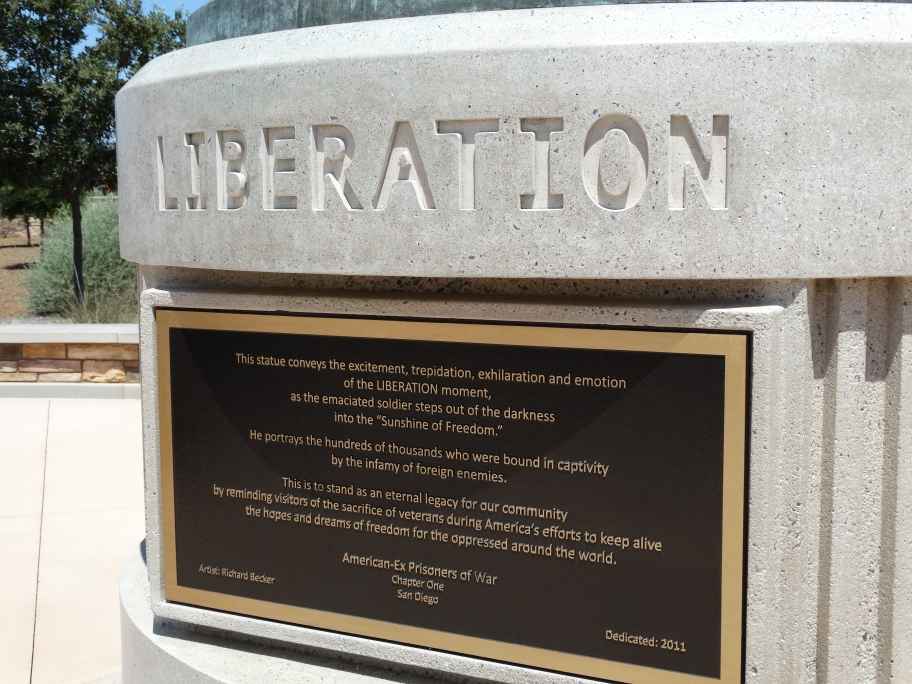
The Avenue of Flags, lined with fifty flag poles representing each state, provides the ceremonial approach that a national cemetery requires. The 'Liberation' bronze statue — depicting a POW — serves as the cemetery's central sculptural monument, connecting its purpose to the experiences of those who served in captivity as well as those who died in service.
The Medal of Honor and the Broadcaster
Among those interred at Miramar National Cemetery is Charles Schroeter, a recipient of the Medal of Honor during the Civil War — the nation's highest military decoration, awarded for conspicuous gallantry above and beyond the call of duty. Schroeter's burial at a cemetery that opened in 2010 links the facility's short institutional history to the full span of American military history.
The cemetery also holds the remains of Jerry Coleman, whose life story belongs in the category of experiences that seem, in retrospect, almost impossible to have compressed into a single lifetime. Coleman played second base for the New York Yankees and was a member of four World Series championship teams. He served as a Marine Corps aviator in both World War II and the Korean War — flying combat missions in each conflict while maintaining a professional baseball career in the years between. After his playing days ended, he became a broadcaster for the San Diego Padres and spent decades as the voice of the team to generations of San Diego fans. He died in 2014 and is buried at Miramar.
Tim LaHaye, the co-author of the 'Left Behind' series of novels that sold tens of millions of copies and shaped evangelical Christian culture across America, also served in World War II and is interred at Miramar. Rudy Bukich, who played quarterback in the NFL for fifteen years, rounds out a remarkable set of burials that includes decorated combat veterans, world-famous athletes, and one of the most commercially successful Christian authors of the twentieth century.
What a National Cemetery Is
National cemeteries exist because a society has decided that military service creates an obligation that extends beyond the service member's death. The obligation is concrete: a burial place, properly maintained, in a setting that acknowledges the significance of what the person chose to do. Miramar National Cemetery will eventually hold 235,000 veterans — a number that encompasses the full spectrum of military service, from enlisted personnel who spent four years in peacetime service to Medal of Honor recipients who risked everything in combat.
The cemetery sits within earshot of MCAS Miramar, and the sound of military aircraft overhead is a constant presence. Depending on your perspective, this is either a fitting tribute — the living military honoring the dead — or simply the coincidence of geography, the cemetery occupying available land near an active installation. What is not a coincidence is that the mesa Edward Scripps named for its view of the sea has accumulated, across a single century, an almost complete inventory of what military presence means: the training of soldiers, the development of aviation, the creation of fighter tactics, the imprisonment of offenders, and finally, the honoring of those who served and died. Miramar holds all of it.
From the Air
Miramar National Cemetery sits at 32.87°N, 117.19°W on the Miramar Mesa, adjacent to MCAS Miramar (KNKX). From altitude, the cemetery's distinctive orderly rows and the Avenue of Flags are visible within the larger military complex of the Miramar installation. Pilots transiting the San Diego area should be aware of KNKX's Class C airspace beginning at the surface. Nearest civilian airports: KMYF (Montgomery-Gibbs Executive, 7 miles west) and KSAN (San Diego International, 13 miles southwest). The cemetery is identifiable on sectional charts within the Miramar complex boundary.