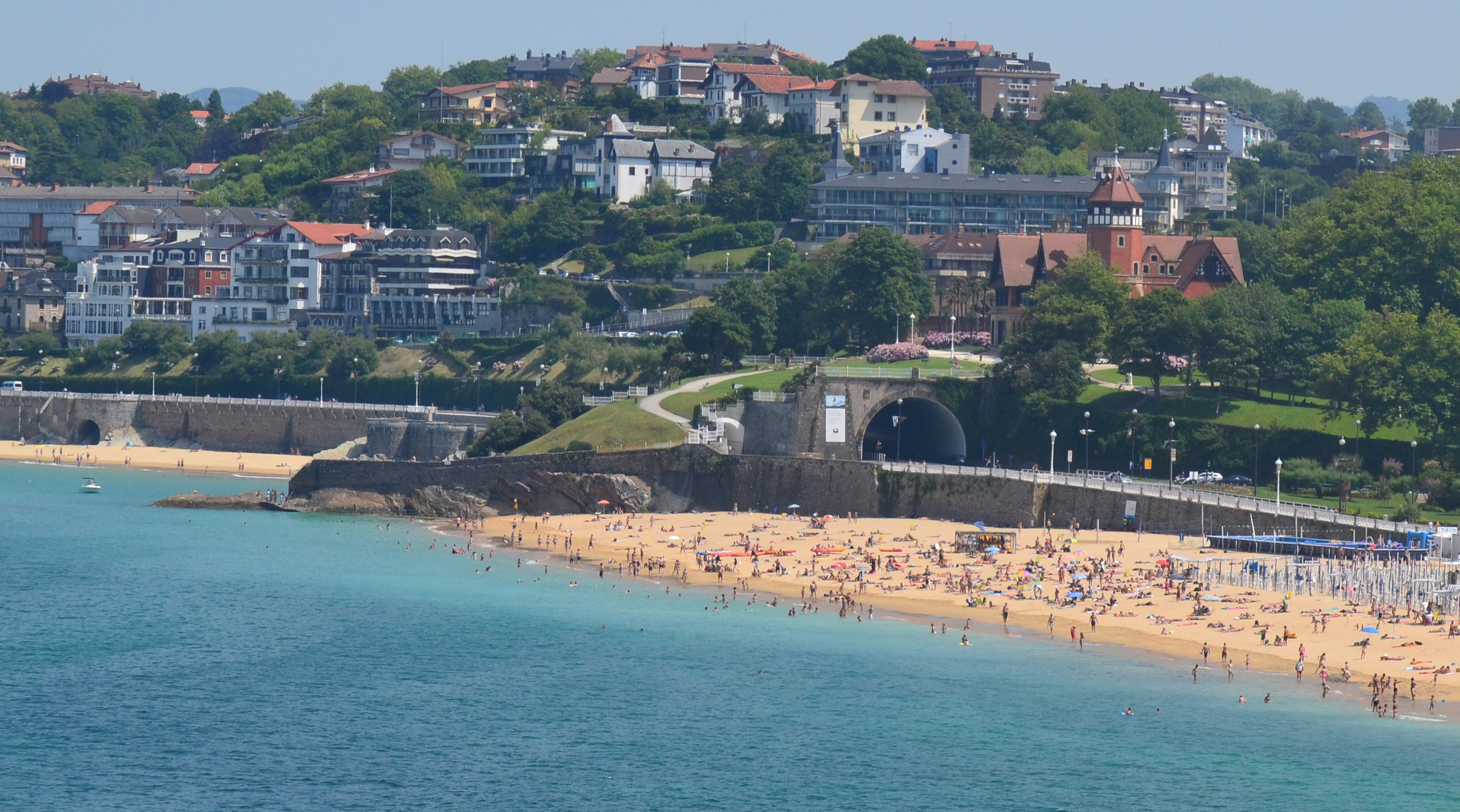
Miramar Palace
A queen needed sea air, and a city was transformed. When Maria Christina of Austria, recently widowed consort of Alfonso XII, moved the Spanish court's summer residence to San Sebastian in the late 1880s, she chose a promontory overlooking La Concha Bay where a medieval monastery had once stood. She commissioned English architect Selden Wornum to build her a palace there, and by 1893 the Miramar Palace rose above the bay in a style unmistakably English - neogothic ornaments, proper halls for music and dining, gardens cascading toward two of the most celebrated beaches in Spain. The palace required demolishing a church, which had to be relocated to a nearby site, and building a false tunnel beneath its gardens so the local trams could continue running.
Sea Baths and the Spanish Crown
San Sebastian's relationship with the monarchy began with Isabella II, who started summering in the city in the mid-19th century to take therapeutic sea baths. The bond deepened when Maria Christina, left to rule as regent after her husband's death, chose the Basque coast over the scorching summers of Madrid. Where the court went, society followed. San Sebastian's transformation from a provincial town into an international resort destination traces directly to these royal summers. The queen purchased the estate from the Count of Moriana and expanded it by acquiring adjacent properties, assembling a compound of roughly 80,000 square metres perched above the bay between the beaches of La Concha and Ondarreta.
An English House on the Basque Coast
Wornum's design stands as an architectural curiosity - a thoroughly English palace planted on the Cantabrian coast. The exterior features neogothic detailing that would look at home in the English countryside, while the interior preserves noble rooms in their original configuration: the White Hall, the Music Hall, the Wooden Hall, the Petit Salon, a formal library, and the Royal Dining Room. In 1920, a new wing called the Pabellon del Principe was added, extending the complex. The tower that anchors the composition was refurbished as recently as 2007. For all its English character, the palace is inseparable from its setting, the gardens offering sweeping views across La Concha Bay that no manor house in Hampshire could match.
Confiscated, Returned, Diminished
Maria Christina's death in 1929 passed the palace to Alfonso XIII, but the king's hold would be brief. The Second Spanish Republic confiscated it in 1931, and by 1933 it belonged to the San Sebastian City Council with one condition: it would serve as the summer retreat of the republic's president while also hosting educational and cultural programs. The Franco era reversed this arrangement, returning the palace to Alfonso XIII's heirs, principally Don Juan de Borbon. When the family's joint ownership dissolved in 1958, the original 80,000-square-metre estate began to shrink. Plots of 10,000 and 37,000 square metres were sold off in 1963 for housing construction, leaving barely a third of the original grounds intact.
From Royal Retreat to Public Stage
The San Sebastian City Council purchased the remaining 34,136 square metres from Don Juan in 1972, beginning the palace's transformation into a civic institution. Today the gardens are open to the public on fixed schedules, and guided tours lead visitors through the noble rooms where Maria Christina once entertained. The University of the Basque Country holds its summer courses here, filling halls designed for royal receptions with academic lectures. Until 2016, the palace housed Musikene, the Higher School of Music of the Basque Country, its students practicing in rooms where chamber orchestras once played for queens. The San Sebastian International Film Festival uses the gardens and halls for its events, bringing a different kind of glamour to a place that has never quite stopped attracting the spotlight. The palace has been renovated repeatedly since the city took ownership, each renovation making it more functional while preserving the original exterior that Wornum designed over a century ago.
From the Air
Miramar Palace sits on a promontory between La Concha and Ondarreta beaches in San Sebastian at 43.31N, 2.00W, clearly visible from the air as the green-gardened point dividing the two beach arcs along La Concha Bay. Best viewed at 1,500-3,000 feet AGL approaching from the bay. The nearest airport is San Sebastian (LESO), approximately 12 nautical miles east. Biarritz-Anglet-Bayonne (LFBZ) is about 20 nautical miles northeast. The distinctive shell-shaped bay is an excellent visual landmark. Coastal fog is common in morning hours.