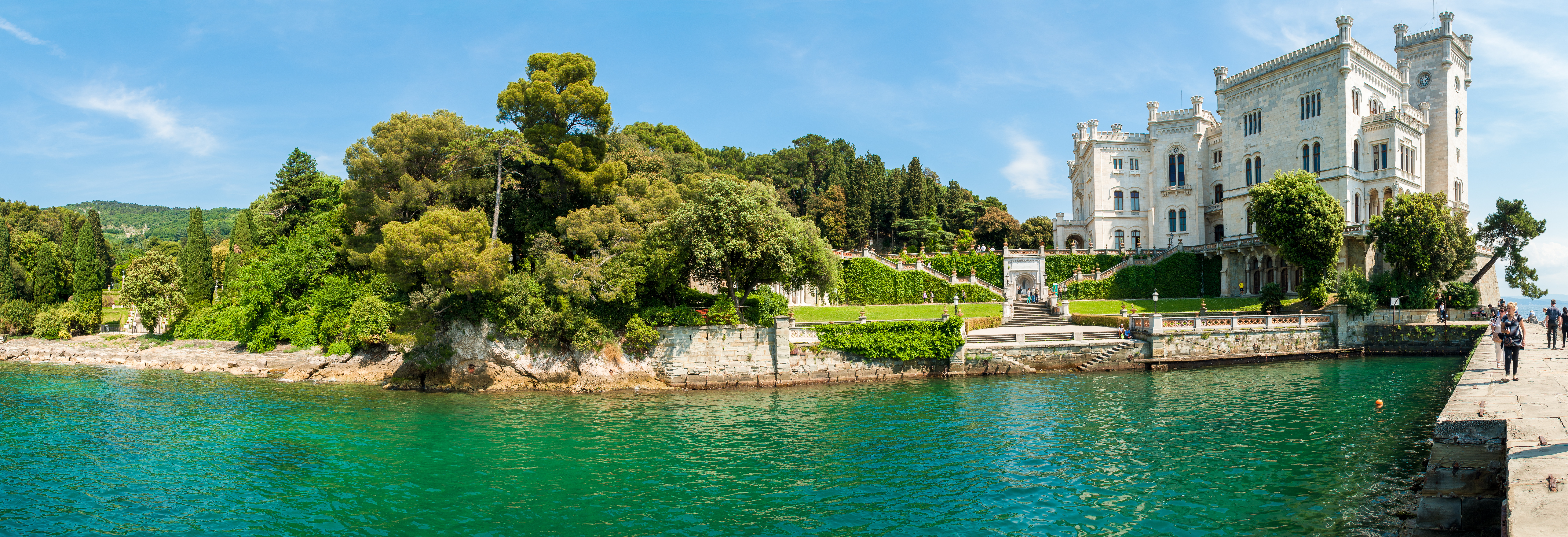
Miramare Castle
The story of Miramare Castle begins with a storm. In the 1850s, Archduke Ferdinand Maximilian of Austria, younger brother of Emperor Franz Joseph, was caught in rough weather while sailing the Gulf of Trieste. He took shelter in the little harbor of Grignano, looked up at the bare limestone headland above, and decided this was where he would build his home. By 1860, a white castle stood on the rocky spur, surrounded by a park of exotic trees gathered from every continent. Within seven years, Maximilian would be dead -- executed by firing squad in Mexico after a doomed attempt to rule as emperor. The castle he left behind, perched above the Adriatic with its rooms still furnished exactly as he arranged them, became one of Europe's most haunting monuments to ambition and its consequences.
A Sailor Prince's Dream
Ferdinand Maximilian arrived in Trieste in 1850 at the age of eighteen. By 1854, he had risen to Commander in Chief of the Imperial Austrian Navy, and the sea defined his life. He commissioned the architect Carl Junker to design a castle facing the water, and the gardener Anton Jelinek -- a Bohemian who had circumnavigated the globe aboard the frigate Novara -- to transform the barren promontory into a botanical garden. Before construction began in 1856, the site held nothing but shrubs and thorny bushes. Within a decade, cedars from Lebanon, North Africa, and the Himalayas grew alongside cypresses from California and Mexico, pines from Asia, giant sequoias, and ginkgo bilobas. The 22-hectare park was modeled on English landscape gardens -- no monumental entrance, no formal driveway, just winding paths through trees arranged to look as if nature had placed them there.
The Rooms He Never Returned To
Maximilian and his wife Charlotte of Belgium lived in the smaller Castelletto while the main castle was under construction. They furnished the rooms with obsessive care: Charlotte's music room with her fortepiano, guest chambers fitted for visiting royalty, the throne room designed for ceremonies that would soon take place on another continent. In 1864, a Mexican delegation arrived at Miramare to offer Maximilian the crown of a puppet empire backed by Napoleon III of France. He accepted. Charlotte sailed for Belgium to plead for European support that never came. Maximilian was captured by republican forces under Benito Juarez and executed on June 19, 1867. He was thirty-four. Charlotte, who had suffered a mental breakdown in Europe, never returned to Miramare. She lived in seclusion in Belgium until her death in 1927, sixty years after her husband's execution.
Habsburgs, Wars, and Occupying Armies
The castle did not sit empty after Maximilian's death. Empress Elisabeth visited at least fourteen times between 1869 and 1896. In 1900, Stephanie of Belgium -- Charlotte's niece -- chose the castle chapel for her second marriage. In 1914, Archduke Franz Ferdinand stayed at Miramare from March through April, hosting German Emperor Wilhelm II; two months later, Franz Ferdinand was assassinated in Sarajevo, triggering the First World War. During that war, all of Miramare's furnishings were shipped to Vienna for safekeeping in the Schonbrunn and Belvedere palaces. Austria returned everything between 1925 and 1926, and the museum opened to the public in 1929. Then came the Second World War: German troops used it as an officers' school, and only the refusal of Gauleiter Friedrich Rainer to convert it into Nazi headquarters saved it from Allied bombardment. New Zealand, British, and American forces occupied it in succession until 1954.
A Museum of Frozen Time
Since June 1955, Miramare has operated as a historical museum, and what makes it extraordinary is its completeness. The original furnishings, ornaments, and objects from the mid-nineteenth century remain in place. In Room XIX, paintings by Cesare dell'Acqua depict the castle's own history, creating a strange loop in which the building narrates itself. The throne room has been restored to its former gilded state. Duke Amedeo of Aosta, who lived at Miramare from 1931 until his appointment as viceroy of Ethiopia in 1937, left behind an apartment furnished in the Rationalist style of the 1930s, adding yet another layer of taste and era to the castle's interior. Visitors walk through rooms where the passage of time has been arrested at several different moments, as if each generation that occupied Miramare left a pocket of preserved atmosphere behind.
The White Castle on the Gulf
From the air, Miramare is unmistakable: a white rectangle perched on a green promontory jutting into the deep blue of the Gulf of Trieste. The park forms a dense canopy of tropical and Mediterranean species that contrasts sharply with the pale limestone of the Karst hills behind. The castle sits between the neighborhoods of Barcola and Grignano, with a dedicated railway station on the Trieste-Venice line. To the south, the city of Trieste curves along the waterfront. To the east, the Slovenian border lies just kilometers away. Maximilian chose this spot because a storm drove him to shelter here, but the real reason the castle endures is simpler: there are few places on the Adriatic where architecture, landscape, and tragedy converge so precisely.
From the Air
Located at 45.70N, 13.71E on a limestone promontory on the Gulf of Trieste, between the neighborhoods of Barcola and Grignano. The white castle and its green park are clearly visible from the air against the pale Karst hills. Recommended viewing altitude: 2,000-3,000 feet for the castle and promontory detail. Nearest airport: Trieste-Friuli Venezia Giulia Airport (LIPQ), approximately 25 km northwest. Trieste Miramare railway station sits adjacent to the park. The Gulf of Trieste and Slovenian coast are visible to the east.