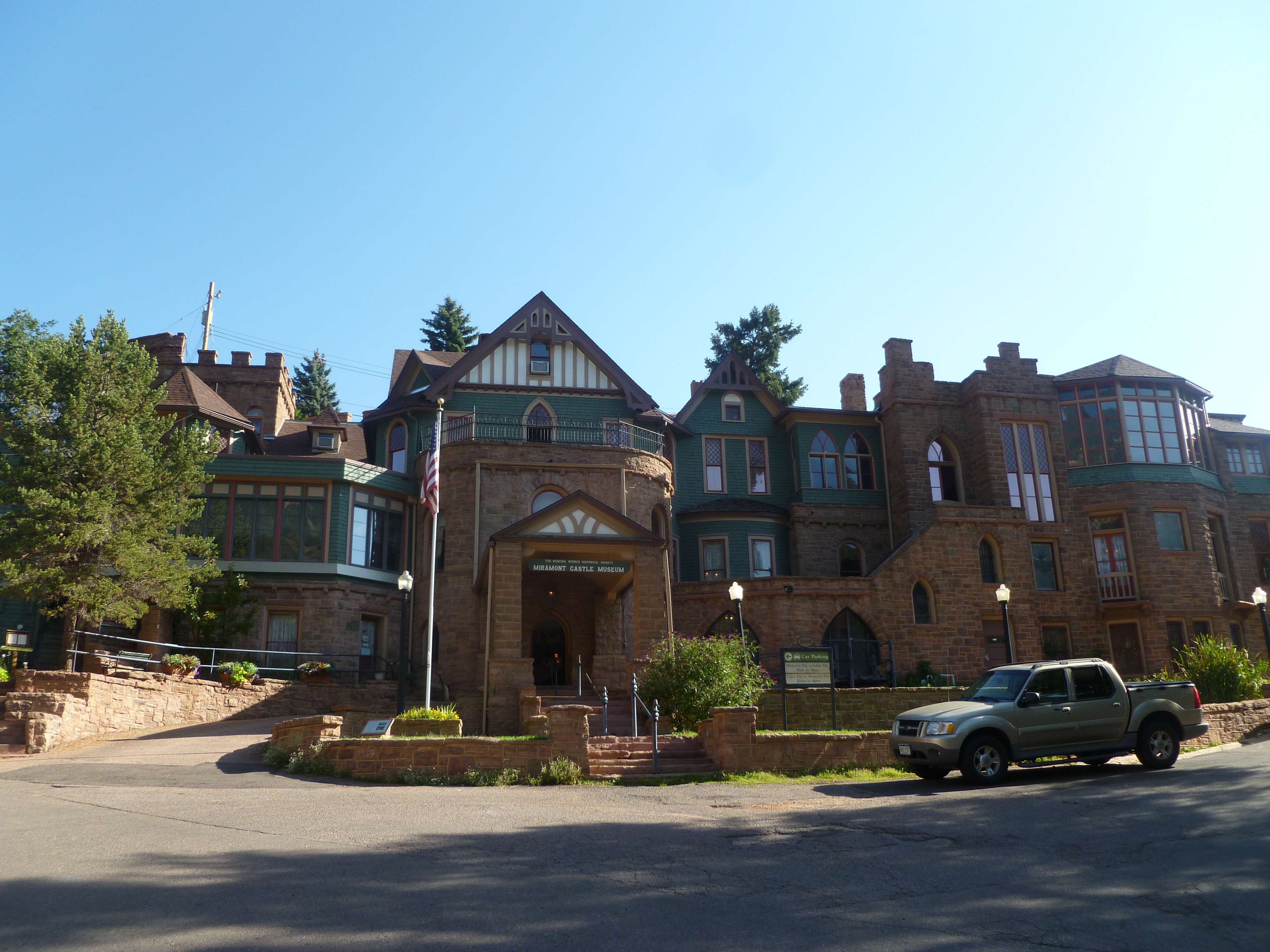
Miramont Castle
Count the architectural styles and you run out of fingers. Shingle-style Queen Anne, Romanesque, English Tudor, Flemish stepped gables, domestic Elizabethan, Venetian Ogee, Byzantine, Moorish, and half-timber Chateau -- nine distinct traditions jammed into a single 14,000-square-foot castle perched on a mountainside in Manitou Springs, Colorado. Father Jean Baptist Francolon built this place in 1895, and he did not believe in choosing just one look. The front door opens on the first floor. The back door opens on the fourth. The floors in between each have their own exit to level ground. Hardly any room has four square corners. Miramont Castle is architecture as autobiography -- the accumulated obsessions of a man who spent his life collecting ideas from every corner of the world.
A Priest with a Diplomat's Eye
Francolon was born in France in 1854 into a wealthy aristocratic family. His father was a diplomat, and the young Francolon traveled widely during childhood, absorbing the architecture of Europe and beyond. He immigrated to the United States in 1878 at age 24, recruited by Bishop Lamy of Santa Fe to serve as an assistant priest at the Cathedral of St. Francis of Assisi. For nine years he moved across the southwestern United States, overseeing mission churches for Native American tribes and tending to eighteen small chapels. The work took a toll on his health. He returned to France in late 1886 to recover, resumed parish duties in America a year later, and by 1892 had relocated to Manitou Springs -- a town famous for its healing mineral spring waters and clean mountain air. His mother joined him there in July 1893.
Dark Ground, New Foundations
The land beneath Miramont carries its own troubled history. The earliest deed for the property dates to 1862, and the parcel was once owned by Colonel John Chivington, commander of the infamous Sand Creek Massacre of 1864. Records show Chivington sold the land in 1867 through a son-in-law holding power of attorney, then filed a lawsuit claiming he had never granted that authority. He lost the case. The property passed through the Colorado Springs Company from 1871 to 1882 before being sold to the City of Manitou. When Francolon began construction in the fall of 1895, the Manitou Springs Journal reported on the progress. The name he chose -- Miramont, translating to "look at the mountain" -- suited the town's mountain setting perfectly. The castle was built with indoor plumbing and electricity, modern luxuries for the era.
The Recluse and the Empty Rooms
Despite hosting two fundraising balls at the castle in 1897, Father Francolon and his mother were considered reclusive by the local community. Then, unexpectedly, the Francolons left Manitou Springs in 1900, abandoning their furniture inside the castle they had so carefully built. Madam Francolon returned to France, where she died in 1907. Father Francolon spent his final years in New York City, passing away in 1922. The castle stood vacant until 1904, when the Sisters of Mercy purchased it to supplement their Montcalm Sanitarium, which primarily treated tuberculosis patients. After the original sanitarium burned down in 1907, the Sisters moved their patients into Miramont itself, and for the next twenty years the castle served as a place of healing under the name Montcalm Sanitarium. By 1928, economic pressure forced the Sisters to convert it into a boarding and retreat house before eventually vacating altogether.
Forty-Two Rooms and a Ghost or Two
Today Miramont Castle operates as a Victorian-era historic house museum, owned and run by the Manitou Springs Historical Society. Visitors can wander through 42 furnished rooms, each one shaped to its own purpose in Francolon's unconventional floor plan. The site includes a tea room, a gift shop, and castle gardens, and the building can be reserved for weddings and events. It sits within the Manitou Springs Historic District and holds a listing on the National Register of Historic Places. Popular folklore holds that the castle is haunted, with visitors and staff reporting various apparitions and unexplained phenomena over the years. Whether or not you believe in ghosts, there is something undeniably atmospheric about a castle built by a sickly French priest who vanished one day and never came back.
Spotting the Castle from Above
Miramont Castle sits at approximately 38.86 degrees north latitude and 104.92 degrees west longitude, at the base of the Pikes Peak Cog Railway and near the Manitou Incline. From the air, the castle's distinctive stone mass is nestled among the trees on the mountainside above Manitou Springs. The Colorado Springs Airport (KCOS) lies roughly 15 nautical miles to the southeast. In clear weather, the castle is identifiable by its unusual roofline and position partway up the slope, surrounded by the historic buildings of Manitou Springs below and the steep terrain of Pikes Peak rising behind it. The contrast between the compact town and the rugged mountain backdrop makes this stretch of the Front Range one of the more visually striking corridors along the eastern edge of the Rockies.
From the Air
Located at 38.859N, 104.922W in Manitou Springs, at the base of the Pikes Peak Cog Railway. Nearest airport: Colorado Springs (KCOS), approximately 15 nm southeast. The castle sits on the mountainside above the town of Manitou Springs, identifiable by its distinctive multi-style roofline. Best viewed at 2,000-4,000 ft AGL. Pikes Peak (14,115 ft) rises prominently to the west. The Manitou Incline trail is visible as a steep line climbing the adjacent slope.