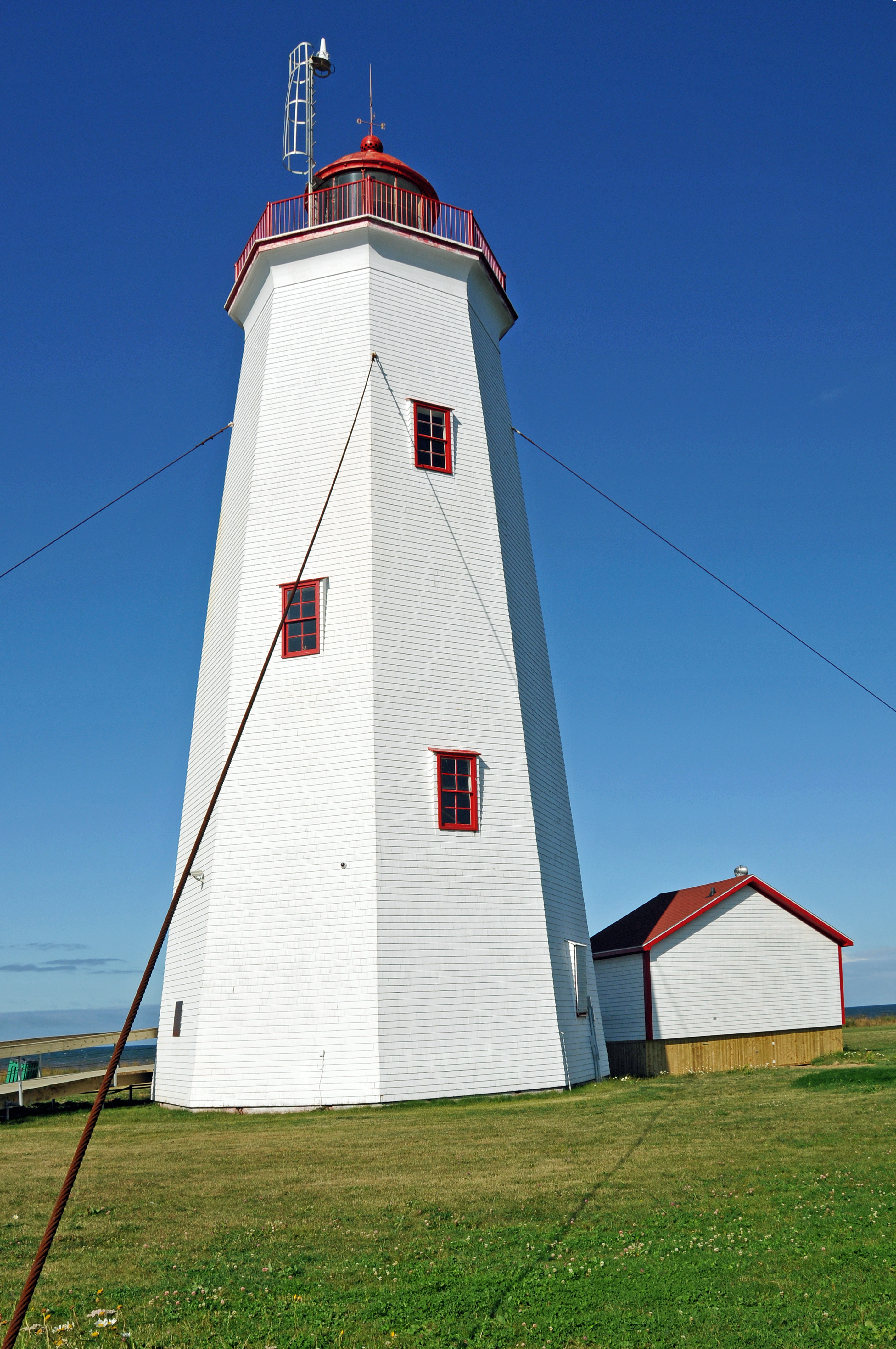
Miscou Island Lighthouse
The lens arrived by ship from England on October 10, 1856 -- a precision instrument crossing the Atlantic to be installed in a wooden tower at the edge of the known world. Miscou Island Lighthouse stands 24.3 meters tall at the northeastern tip of Miscou Island, where Chaleur Bay opens into the Gulf of St. Lawrence. It was built because ships kept wrecking on these shores, and the solution was exactly what it had been for centuries: put a light on the point and hope sailors see it in time. More than 160 years later, the Canadian Coast Guard still maintains the light, making it one of the longest continuously operating lighthouses in New Brunswick.
Built to Save Ships
The need was straightforward. Vessels entering Chaleur Bay from the Gulf of St. Lawrence faced treacherous waters along the northern New Brunswick coast, and wrecks were a regular occurrence. James Murray from Newcastle won the construction bid, and the wooden tower went up in 1856. At the time, only one other lighthouse existed on the entire northern coast of New Brunswick, tended by William Hay, who was dispatched to Miscou to oversee the installation of the English-made lens. The lighthouse was designated a National Historic Site of Canada in 1974 and later recognized as a federal Heritage Building in 1991, acknowledging both its age and its role in the maritime history of the Gulf. It is one of the oldest wooden lighthouses in Canada, its octagonal frame having survived storms that have reshaped the coastline around it.
Smoke, Fog, and an Inland Move
Operating a lighthouse in the 19th century meant solving problems that modern mariners never consider. By 1860, the keepers at Miscou had a persistent issue: on calm nights, smoke from the oil lamps could not clear the lantern room quickly enough, obscuring the very light meant to guide ships to safety. Smoke conductors were installed to draw the fumes out. In 1874, a separate building was constructed to house a steam fog whistle -- five-second blasts separated by twenty-five seconds of silence, its rhythm becoming part of the island's soundscape. Then, in 1946, the entire lighthouse was moved 200 feet inland, an engineering effort driven by coastal erosion that was eating away at the point where the tower originally stood. The sea that made the lighthouse necessary was also trying to claim it.
Keepers of the Light
For decades, lighthouse keepers and their families lived at this remote posting, maintaining the lamp through winter gales and summer fog. The keeper's life was one of isolation and routine -- trimming wicks, cleaning lenses, logging weather conditions, and listening for the sound of ships in distress. The position required someone who could tolerate months of solitude at the farthest tip of an island that was itself at the farthest tip of the mainland. Automation eventually ended the era of resident keepers, but the human dimension of the lighthouse's history gives it a weight that the structure alone cannot convey. Each keeper who climbed the tower on a stormy night was placing themselves between the sea and the sailors trying to navigate it.
A Living Landmark
Today the lighthouse is open to the public during summer months, with guided tours, a cafe, and a gift shop. In 2009, a parking area, washrooms, picnic area, and a viewing deck were added around the base. Visitors climb the tower for panoramic views of Chaleur Bay to the west and the open Gulf to the east -- a vista that explains immediately why a light was needed here. The Canadian Coast Guard owns and maintains both the lighthouse and the surrounding land, ensuring the structure continues to function as an active aid to navigation. It remains a working lighthouse first, a tourist attraction second, and a reminder that the simplest solutions -- a tall structure, a bright light, a fixed position -- are sometimes the ones that endure.
From the Air
Located at 48.01N, 64.49W at the northeastern tip of Miscou Island, New Brunswick. The white wooden lighthouse tower is visible from the air as a prominent landmark at the point where Chaleur Bay meets the Gulf of St. Lawrence. Nearest airport is Bathurst Airport (CZBF) approximately 95 km southwest. The lighthouse marks the entrance to Chaleur Bay and serves as an excellent coastal navigation reference. Elevation is near sea level.