Misfat al Abriyeen
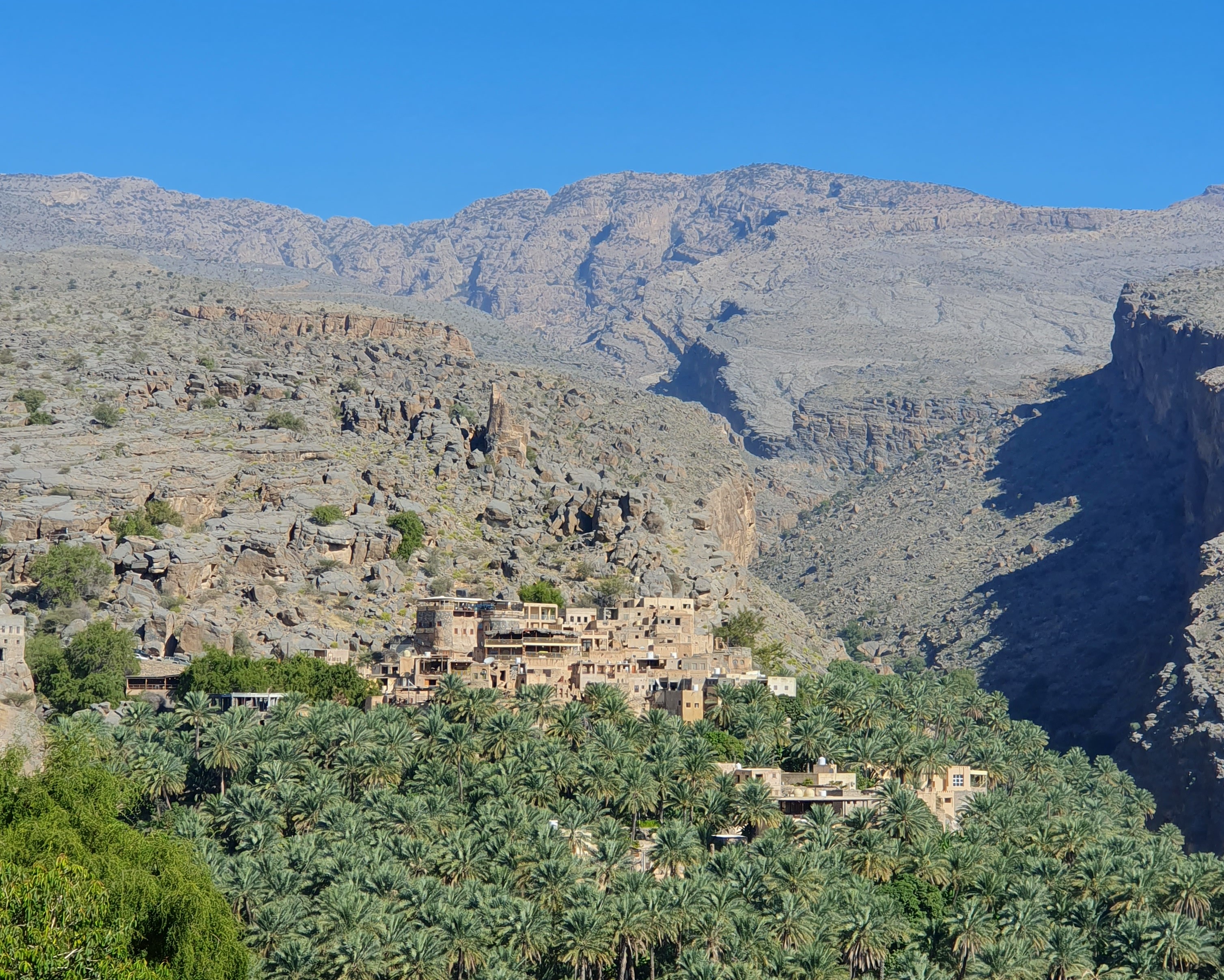
Water has no business being here. At 900 meters above sea level in the Western Hajar mountains, on a rock jutting from a cliff face, the village of Misfat al Abriyeen shouldn't be able to sustain anything greener than scrub. Yet terraced gardens cascade down the slope below the houses, thick with mango trees, pomegranate bushes, fig trees, and olive groves. The explanation is a falaj system more than 2,000 years old that channels spring water through stone channels to every terrace, every garden, every home. The water arrived here before the Romans built their aqueducts.
A Village Carved from Stone
Misfat al Abriyeen clings to its rock like something that grew there rather than was built. The settlement sits on a natural stone outcrop that serves as both foundation and fortification. Narrow stone-paved roads wind between houses constructed of mud, mountain stone, and sarooj, a traditional Omani lime mortar. Several buildings still standing date back more than 200 years. The architectural style resembles the highland villages of Yemen more than the lowland settlements of coastal Oman, a visual reminder that these mountain communities developed in relative isolation, connected more to the vertical world of peaks and wadis than to the trading ports below. The village has a population of about 962 people, most of Bedouin descent, and nearly 40 percent are children under fourteen.
Hanging Gardens of the Hajar
The terraced fields below the village are the falaj system's masterwork. Spring water flows by gravity through narrow channels, irrigating crops arranged on stepped platforms carved into the mountainside. Mangoes ripen alongside pomegranates, figs share soil with olives. The system requires no mechanical power, no fuel, no electricity. It asks only for maintenance, the periodic clearing of channels, the repair of stone walls, the attention of people who understand that their survival depends on keeping water moving. This is agriculture as sculpture: functional, beautiful, and entirely dependent on a community's willingness to tend what their ancestors built.
From Abandonment to Best Tourism Village
Like many traditional Omani mountain villages, Misfat al Abriyeen faced the threat of abandonment as younger generations moved to lowland cities for work and modern conveniences. But in recent years, the village has undergone significant restoration. Heritage houses have been converted into small hotels. Stone paths have been repaired. In 2021, the World Tourism Organization named Misfat al Abriyeen to its Best Tourism Villages list, recognizing both its preservation efforts and its living cultural heritage. The village sits at the starting point of trekking route W9, an ancient donkey path that winds through the mountains to connect with trails leading to Bilad Sayt and Sharaf Al Alamayn. The valley of Wadi Al-Saq, reachable from the village, draws hikers into a landscape where the geological and the human-made are difficult to tell apart.
What Endures
The falaj still runs. The terraces still produce. The stone houses still hold families. In an age when ancient villages across the Arabian Peninsula are being abandoned or bulldozed for development, Misfat al Abriyeen persists as a working example of how people once lived in these mountains -- and how some still choose to. The rock it sits on has not changed in millennia. The water that feeds it has followed the same channels for two thousand years. What changes is whether anyone stays to keep the system alive. For now, the answer is yes.
From the Air
Located at 23.14N, 57.31E in the Western Hajar Mountains of Oman, at approximately 900 m elevation. The village is nestled into a cliff face and visible as a cluster of stone structures with green terraced gardens below. Nearest major airport is Muscat International (OOMS), approximately 200 km northeast. Terrain is mountainous; maintain safe altitude above the Hajar peaks.