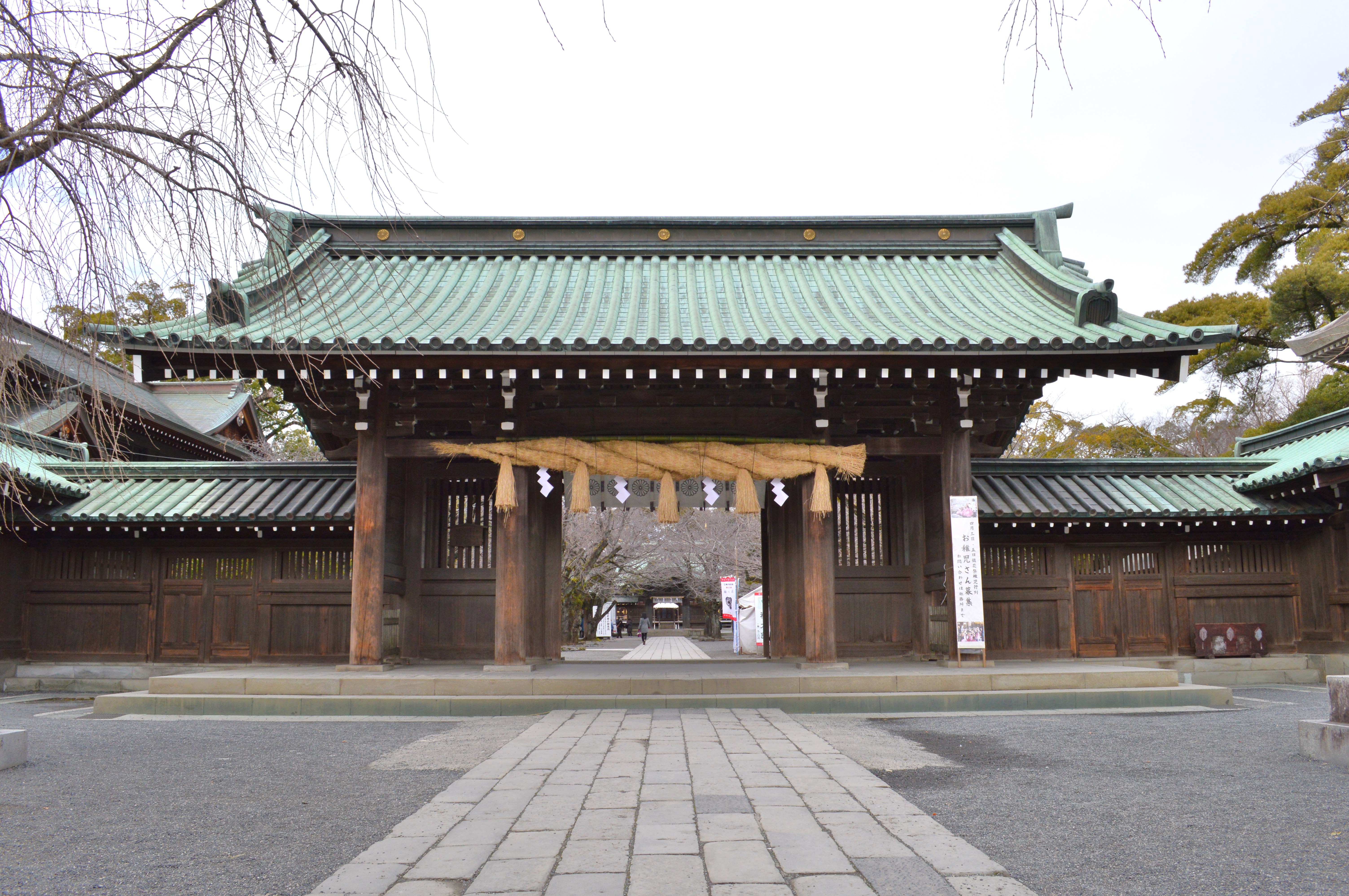
Mishima Taisha
The shrine moved before it settled. According to tradition and Nara period records, the deity of Mishima Taisha first resided on the volcanic island of Miyakejima, far out in the Philippine Sea. Over the centuries, the shrine migrated from island to shore, place to place along the Izu Peninsula, before arriving at its present location in the city of Mishima, Shizuoka Prefecture. The earliest written mention appears in the Nihon Koki chronicle under the year 832 AD, placing it near modern Shimoda on the peninsula's southern coast. By the time the Engishiki compiled its register of shrines in 927 AD, Mishima Taisha had moved north to Tagata county -- where it stands today. As the ichinomiya, the highest-ranked shrine of old Izu Province, it has anchored the spiritual life of this region for over a thousand years, gathering warriors, pilgrims, and artists through every era of Japanese history.
The Warrior's Shrine
Minamoto no Yoritomo knew Izu intimately. Exiled to the province after the Heiji Rebellion, he spent two decades planning his return to power, and Mishima Taisha was central to his devotions. Before launching the Genpei War against the ruling Heike clan, Yoritomo prayed at this shrine for divine aid. When victory came and he established the Kamakura shogunate -- Japan's first military government -- he repaid the debt. He rebuilt Mishima Taisha on a grand scale, and worship of the Mishima Daimyojin spread rapidly among the samurai class. His successors continued the patronage, especially the fourth Shogun Kujo Yoritsune. During the Sengoku period of warring states, the shrine's kami became explicitly associated with victory in battle, drawing the devotion of the Odawara Hojo, the Imagawa clan, and the Tokugawa -- three of the most powerful military houses in Japanese history.
Pilgrims on the Tokaido
The Edo period transformed Mishima Taisha from a warrior's shrine into a traveler's landmark. The city of Mishima served as a post town -- Mishima-shuku -- on the Tokaido, the great highway connecting the shogun's capital at Edo with the imperial court in Kyoto. The sankin-kotai system, which required feudal lords to travel regularly between their domains and Edo, ensured a constant flow of wealthy and powerful visitors past the shrine's gates. The great ukiyo-e artist Hiroshige immortalized the shrine's torii gate in one of his prints, fixing Mishima Taisha in the popular imagination. A calendar produced by the shrine became a coveted souvenir, carried home by pilgrims from every corner of Japan and known simply as the "Mishima Calendar." The shrine was no longer just a place of prayer -- it had become a cultural institution, a fixed point on the mental map of the nation.
Treasures Across the Centuries
Mishima Taisha guards objects that span nearly the entire arc of Japanese civilization. The shrine's most precious possession is a lacquerware cosmetics box from the Heian period, decorated with maki-e gold lacquer depicting plum blossoms. Measuring just 25.8 by 34.5 centimeters, this wooden box still contains its original cosmetics utensils -- the oldest complete hand box of its kind in existence. It was donated to the shrine by Hojo Masako, the formidable wife of Yoritomo himself, and has been designated a National Treasure of Japan since 1900. The shrine also holds a Kamakura-period sword forged by Munetada of the Ichimonji school, its 81.8-centimeter blade retaining the style of the late Heian period, donated by Emperor Meiji. A collection of 592 documents spanning the Kamakura through Edo periods preserves centuries of shrine administration in ink and paper.
The Tree That Remembers
In the shrine precincts stands an osmanthus fragrans tree estimated to be 1,200 years old, protected by the national government as a Natural Monument. Each autumn, its tiny golden flowers release a fragrance so sweet it can be detected from across the compound -- a living thread connecting the present to an era when the shrine's location was still being recorded for the first time in national chronicles. The main hall, or honden, is itself a survivor. Built in the nagare-zukuri architectural style with three bays, the current structure dates from 1867, rebuilt after the devastating Ansei Tokai earthquake flattened the shrine in 1854. During the Meiji era, the government designated Mishima Taisha as a first-rank nationally supported shrine in 1871. Its name changed from "Mishima Jinja" to the grander "Mishima Taisha" only after World War II. Each August 16, mounted archers perform yabusame -- horseback archery -- at the shrine's annual festival, continuing a martial tradition that stretches back to the samurai who once prayed here for victory.
From the Air
Located at 35.122N, 138.919E in the city of Mishima, at the northwestern base of the Izu Peninsula in Shizuoka Prefecture. The shrine compound is a notable patch of dense tree cover within the urban grid of Mishima. From the air, the city sits on the plain between the Izu Peninsula's mountainous interior and the coastal lowlands along Suruga Bay. Mount Fuji dominates the skyline to the northwest. The Tokaido Shinkansen line passes through Mishima Station approximately 1km south of the shrine. Nearest airports: RJNS (Mt. Fuji Shizuoka Airport) approximately 40nm west, RJTT (Tokyo Haneda) approximately 55nm northeast. The Izu Peninsula's dramatic volcanic coastline extends to the south.