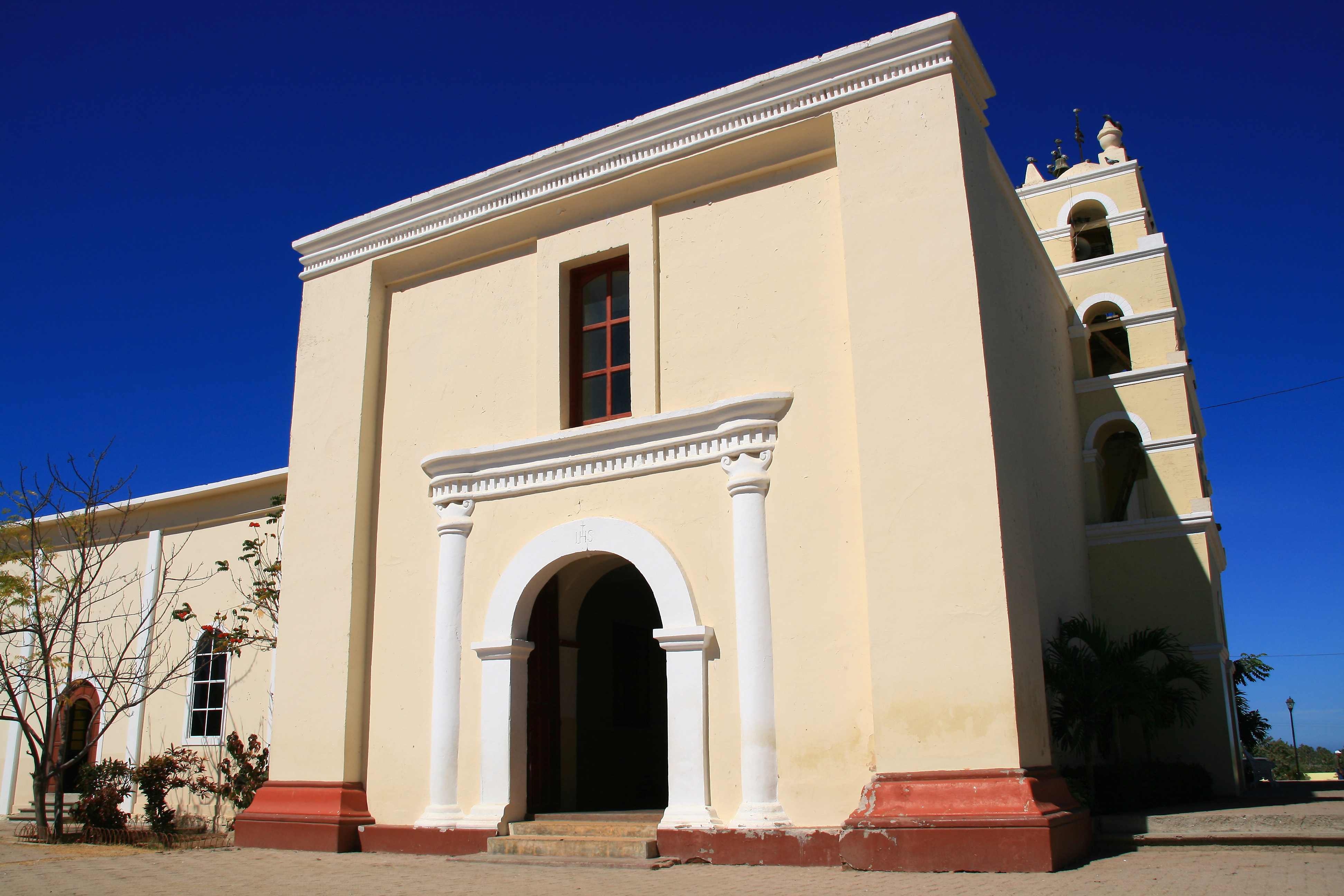
Mision Santa Rosa de las Palmas
In the deserts of Baja California, water is everything. When Jesuit priest Jaime Bravo rode out from his post at La Paz in 1724 and found a place with tillable land, decent grazing, and -- most critically -- a reliable water supply near the Pacific coast, he named it Todos Santos, "All Saints." The site was home to the Uchiti, a band of the Guaycura people, who had lived in these lands long before any European arrived. What Bravo established as a subsidiary mission post would become, by 1733, the full Mission of Santa Rosa de las Palmas -- the first European settlement where the modern town of Todos Santos now stands. Its history is a concentrated lesson in what the mission system meant for the indigenous peoples of Baja California.
An Oasis in the Desert
Baja California offered the Jesuits almost nothing they needed. The peninsula was largely desert, its interior mountains harsh and waterless, its coasts battered by heat. Todos Santos was a rare exception. The area had enough water for irrigation, enough arable soil for crops, and enough pasture for livestock. Agriculture at the new mission proved successful under Sigismundo Taraval, who took charge when Santa Rosa became a full mission in 1733. But the Jesuits had not arrived in an empty land. The Guaycura people -- including the Uchiti and the Pericues to the south -- had their own claims to this territory, their own patterns of life across these arid landscapes. The Uchiti, in particular, were hostile to the mission and to the Christian converts, known as neophytes, whom the Jesuits gathered around it. A garrison of roughly ten Spanish soldiers and a few dozen indigenous converts tried to hold the peace.
Rebellion and Reconquest
In 1734, the fragile order collapsed. The Pericues, the Uchiti, and other Guaycura bands revolted across southern Baja California, targeting the missions that were reshaping their world. The proximate trigger was the Jesuits' attempt to outlaw polygamy, but the rebellion ran deeper than any single grievance. Indigenous fighters killed Jesuits at two of the four southern missions, along with several Spanish soldiers and, in January 1735, thirteen sailors who had come ashore from a merchant vessel. Taraval escaped Santa Rosa. A large military force sent from the mainland eventually suppressed the uprising, and the mission was reestablished in 1737 under Jesuit Bernardo Zumziel. The Uchiti, however, refused to submit for another eleven years, continuing to resist until 1748.
The Weight of Disease
What warfare could not accomplish, disease did with terrible efficiency. Epidemics struck the southern peninsula in 1742, 1744, and 1748, devastating the Guaycura population. By 1748, the surviving Guaycura from across southern Baja California were congregated at Todos Santos. The Jesuits held children at the mission, knowing their parents and relatives would stay nearby rather than abandon them. A military garrison, independent of the missionaries, enforced the arrangement. By 1755, only 151 Guaycura remained at the mission. When the Franciscans took over from the expelled Jesuits in 1768, they found just 83 indigenous residents. Desperate for agricultural labor, the Franciscans relocated 746 Guaycura from northern missions to Todos Santos. These people were still semi-nomadic, unaccustomed to sedentary life. Within a year, 300 of them died in a measles epidemic. Others fled or destroyed mission property in protest.
The Last Count
By 1771, only 170 Guaycura lived at Todos Santos. By 1808, the number had fallen to 82. At that point, the Guaycura had become, in the words of historians, almost culturally extinct -- their languages fading, their lifeways dismantled by a century of missionization, forced relocation, and disease. The mission closed in 1825. Today, the mission church in Todos Santos -- parts of which date to 1747 -- still stands, containing a statue of the Virgin of Pilar that remains the focus of the town's main November festival. The building endures as a monument to the ambitions of the Jesuit project, but the people the Jesuits came to convert left almost no descendants to remember the world that existed before the first priest arrived.
From the Air
Located at 23.46N, 110.22W on the Pacific coast of the southern Baja California Peninsula, at the site of present-day Todos Santos. Best viewed at 2,000-4,000 feet AGL. The mission church is visible in the town center near the main plaza. Nearest airport is La Paz International (MMLP/LAP), approximately 75 km to the northeast. The Sierra de la Laguna mountains rise to the east, and the Pacific coastline is visible to the west.