Mission Point (Mackinac Island)
In 1803, Father Gabriel Richard arrived at the old mission on the southeast shore of Mackinac Island to offer the sacraments and found the altar desecrated, the priest's quarters converted into a brothel. The discovery captured something essential about Mission Point: it is a place that has been claimed, abandoned, and reinvented so many times that the ground itself seems restless. French explorers first passed through here in 1634, just fourteen years after the Pilgrims reached Plymouth Rock. Since then, this narrow stretch between Robinson's Folly and Franks Street has hosted a birchbark chapel, a British officer's summer house, a Protestant boarding school, Victorian cottages for Detroit's wealthy, a Moral Re-Armament conference center, a liberal arts college, a televangelist's Bible school, a Hollywood film set, and a full-service vacation resort. No single acre on Mackinac Island has lived more lives.
Before the Europeans Came
For millennia, Mackinac Island served as a gathering place for the Chippewa, Huron, Menominee, Potawatomi, Ojibwe, Ottawa, and other nations. They came for the aurora borealis, the pure freshwater, the sheltered harbors. An Indian chief's reminiscence, preserved in the historical record, describes the island in terms that feel almost liturgical: the Great Spirit allowing peaceful stillness to dwell, light winds barely ruffling the mirror surface of surrounding waters, the sound of Giant Fairies dancing their mystic dance on the limestone battlements at twilight. Jean Nicolet became the first European known to pass through the Straits of Mackinac in 1634, guided by a small group of Huron. Father Barthelemy Vimont documented the journey in The Jesuit Relations in 1642, though Vimont was not present on the expedition. Jesuit fathers Charles Dablon and Jacques Marquette followed, founding Catholic missions on the island, at St. Ignace, and at Mackinaw City. Dablon built a birchbark chapel on the island in 1670.
The Folly on the Cliff
In 1782, British Captain Daniel Robertson took command of Fort Mackinac and built a small summer house on a high limestone outcropping at the southeast corner of the island, the first recorded structure at Mission Point. Robertson, his son, and fellow officers gathered there for pipes, cigars, and wine, served by enslaved household workers Jean and Marie-Jean Bonga. Among the Bongas' children was Pierre Bonga, who grew up to become a noted fur trader with the British Northwest Company and later the American Fur Company. Robertson freed the family when he was reassigned in 1787; they stayed and the parents opened a small hotel. Years after Robertson's departure, the cliff collapsed, sending the summer house plunging 127 feet to the road and lake below. The remaining blunt precipice became known as Robertson's Folly, later corrupted for unknown reasons to Robinson's Folly. It remains the easternmost point of the island, a jagged reminder of impermanence.
The School at the Edge of the Frontier
In 1822, the United Foreign Missionary Society founded a Protestant mission on the island to train Native youth as teachers of English, Christianity, and interpretation. The U.S. government transferred twelve acres at the southeast end to support the effort. Mission House, designed as both residence and boarding school, opened in 1825 and educated more than 500 Indian girls and boys drawn from tribes across the upper Great Lakes and headwaters of the Mississippi, some traveling over a thousand miles. The area around Mission Point became a peaceable gathering place where 1,500 to 2,000 individuals from many nations traded and socialized. This was also the headquarters of John Jacob Astor's American Fur Company, and the intersection of missionary zeal and commercial ambition defined the character of Mission Point for decades. Edward Everett Hale opened his famous 1863 story The Man Without a Country with a sentence set right here: 'I was stranded at the old Mission House in Mackinaw, waiting for a Lake Superior steamer which did not choose to come.'
Stages, Studios, and Sing-Outs
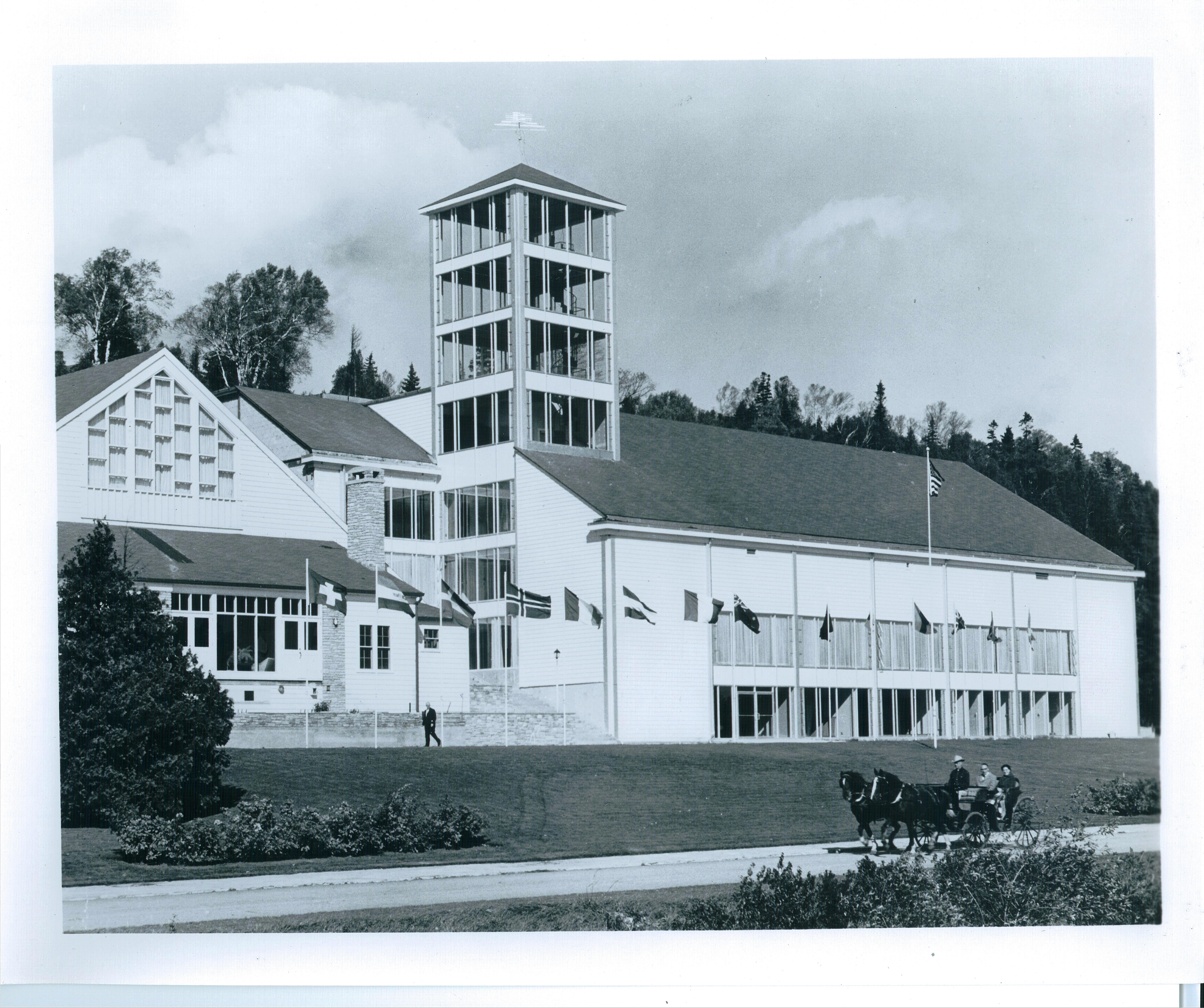
By the 1950s, the Moral Re-Armament movement had acquired much of Mission Point and began building at a remarkable pace. The Mission Point Theater, seating 575, was dedicated on June 4, 1955. The Great Hall complex, a tepee-shaped structure inspired by a Chippewa legend of the Great Spirit gathering nations under a great wigwam to find the secret of peace, followed in 1956. A film studio produced several movies on site. In the summer of 1965, approximately 7,000 young people from around the world gathered for MRA conferences, and the studio's sound stage hosted the original performances of the musical show Sing-Out '65. The following year, Sing-Out changed its name to Up With People and launched international touring casts. Mackinac College operated from 1966 to 1970, followed by TV evangelist Rex Humbard's Bible college. In 1979, Universal Studios leased the sound stage to film Somewhere in Time with Christopher Reeve and Jane Seymour. Today Mission Point Resort operates as a full-service facility with guest lodging, three restaurants, a museum, and a theater that screens films nightly from May through October.
From the Air
Mission Point sits at 45.8506N, 84.6067W on the southeast shore of Mackinac Island, visible as the prominent cleared area east of the main village and harbor. Robinson's Folly, the sheer limestone cliff at the easternmost tip, is a distinctive visual landmark from the air. Mackinac Island Airport (KMCD) is a small field on the interior of the island with a 3,500-foot runway but no fuel services. Pellston Regional Airport (KPLN), 15 nm south, is the nearest fully serviced airport. Best viewed from the east or southeast at altitudes below 2,500 feet AGL, where the resort buildings, theater, and Great Hall complex are clearly distinguishable against the shoreline. Round Island is visible just to the south across the straits.