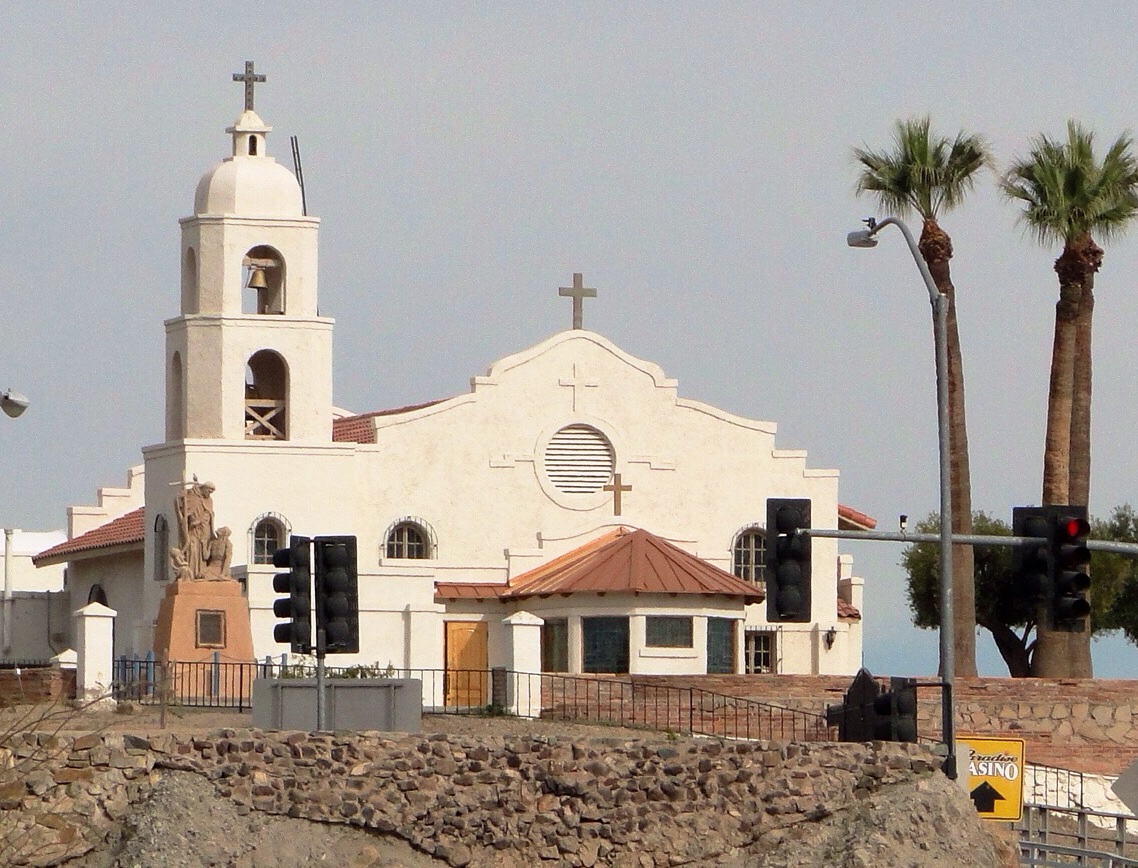
Mission Puerto de la Purísima Concepción
Father Francisco Garcés founded Mission Puerto de la Purísima Concepción on October 25, 1780, certain that a Spanish colonial foothold on the Colorado River would endure. He had traveled this country before, had met the Quechan people, believed he understood them. Less than nine months later, the Quechan rose up and killed him, along with three other priests and dozens of Spanish soldiers and settlers. The mission was gone before it had properly begun.
Outside the Mission Chain
The California mission system is often imagined as a coherent chain stretching up the coast, each mission a day's travel from the next. Mission Purísima Concepción was something different: an inland outpost, established not along El Camino Real but at the junction of the Colorado and Gila Rivers, at the place the Quechan called the Yuma Crossing.
The mission was not part of the coastal chain. It was a separate colonial venture, intended to secure the overland route from Mexico to California that Juan Bautista de Anza had pioneered in 1774 and 1775. Spain wanted a permanent presence at the crossing — a way station, a waypoint, a symbol of sovereignty over the desert interior. Two missions were established simultaneously: Purísima Concepción and La Bicuñer, both in Quechan territory, both founded in October 1780.
A Colony That Could Not Be Sustained
The trouble was structural, and the Quechan saw it from the beginning. Spanish settlers — not just priests and soldiers, but families, with livestock — arrived and began treating the surrounding land as their own. Their cattle and horses grazed on Quechan agricultural fields. The flooding bottomlands along the Colorado, which the Quechan cultivated for crops that sustained their communities, were consumed by Spanish animals that had crossed half a continent to graze here.
The Spanish government had promised the Quechan gifts and compensation in exchange for hosting the missions. The gifts arrived irregularly. The livestock arrived reliably. Chief Palma, who had visited Mexico City and been received with ceremony, who had stood as godfather at his own baptism in the cathedral before the highest authorities of New Spain, found that the promises made in Mexico City did not travel well to the Colorado River. What arrived instead was a colony that was eating the foundation of his people's survival.
July 17 and 18, 1781
On July 17 and 18, 1781, the Quechan acted. Father Francisco Garcés was killed. So were Father Juan Marcelo Díaz, Father Juan Antonio Barreneche, and Father José Matías Moreno — four priests in total. Soldiers were killed. Settlers were killed. The sources record more than thirty soldiers dead and a large number of settlers — the exact count varies, but estimates place the total killed above one hundred.
The surviving Spanish colonists, more than seventy of them, were taken prisoner and held for months. Spain sent an expedition to ransom them; the prisoners were eventually returned in 1782 in exchange for trade goods. The missions were not rebuilt. Spain retained its legal claim to the region, but the Quechan had made clear that the terms of the colonial arrangement were unacceptable, and Spain lacked the military capacity to force a different outcome at such distance from its centers of power.
Father Garcés, who had traveled thousands of miles through the Southwest, who had reached the Grand Canyon and the San Joaquin Valley, who believed his relationship with the Quechan was founded on mutual respect — he died at the crossing he had helped map for the empire that destroyed the conditions that might have made coexistence possible.
Landmark and Memory
California Historical Landmark number 350 marks the site of the missions. The designation acknowledges what happened here: not the founding of a mission that would grow into a prosperous institution, but the founding of one that lasted nine months and ended in violence that was, from the Quechan perspective, a defense of their land and livelihood against an encroachment that had already caused serious harm.
A replica of the mission was eventually built nearby — Saint Thomas Yuma Indian Mission, dedicated in 1923, which replicates the architectural form of Purísima Concepción and serves the descendants of the communities that were present in 1780. The Quechan Tribe of the Fort Yuma Indian Reservation remains in this area today. The original mission site is commemorated. The circumstances that destroyed it are part of the historical record.
From the Air
Located at approximately 32.73°N, 114.62°W near the Yuma Crossing on the Arizona-California border, close to the Colorado River. The Yuma Crossing National Heritage Area and Fort Yuma are nearby. Nearest airport: Yuma International Airport (KNYL), approximately 4 miles to the south.