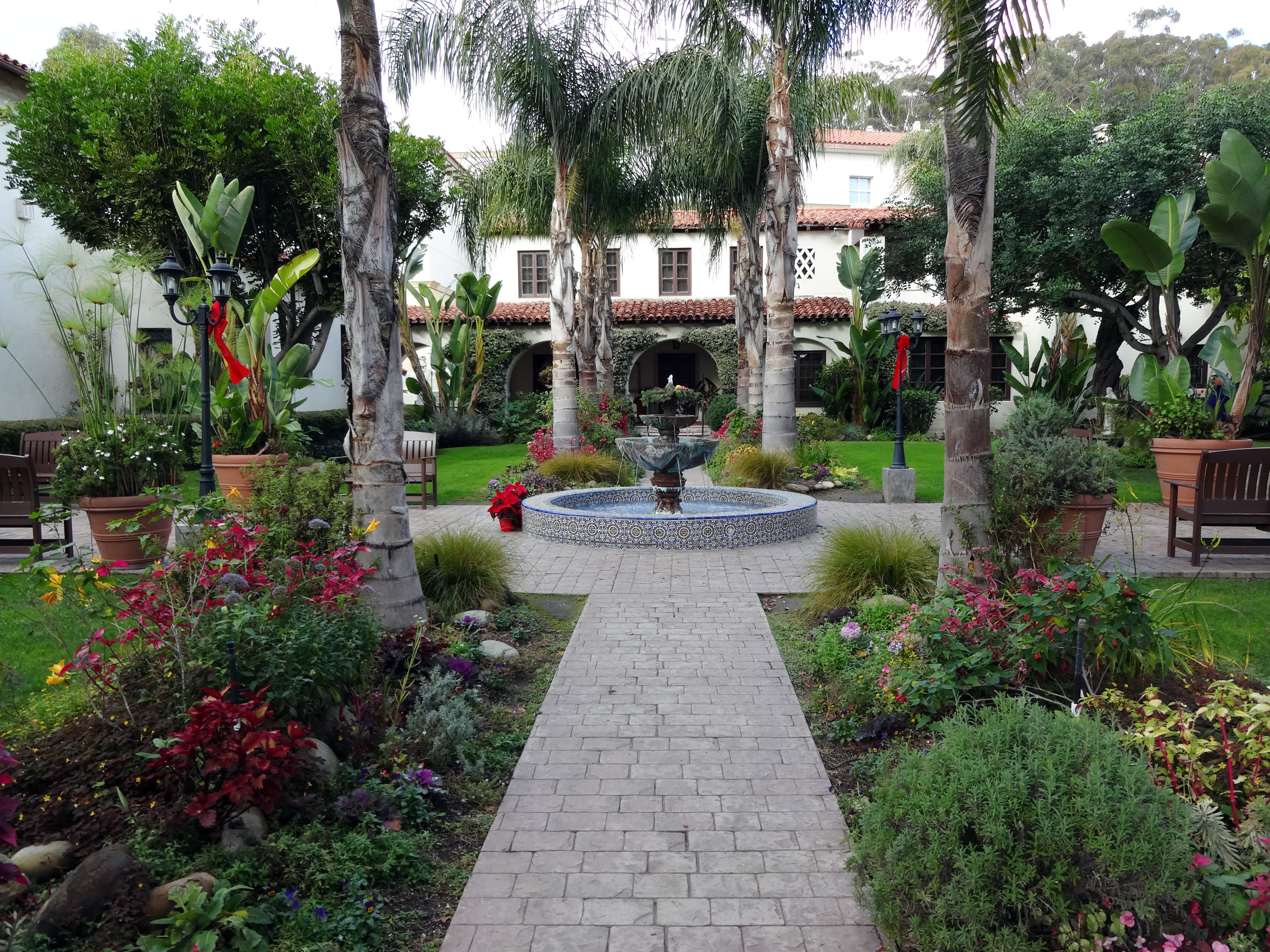
Mission San Buenaventura
The bells borrowed from Mission Santa Barbara in 1782 were never returned. They still hang in the tower of Mission San Buenaventura, their inscriptions dating to 1781, calling the faithful to Mass in a church that has stood through fire, earthquake, tsunami, and pirate attack. This was the mission that Junipero Serra wanted most to build, planned as the third in California's chain but destined by circumstance to become his ninth and last. On Easter morning 1782, thirty-three years and one day after he first committed himself to missionary work in the New World, the aging friar raised a cross on the beach of the Santa Barbara Channel and dedicated a place of worship to St. Bonaventure.
Thirty-Three Years in the Making
The delay that pushed San Buenaventura from third to ninth in the mission chain came down to soldiers. Military escorts were scarce in the frontier territory of Alta California, and without them, missionaries could not safely establish new settlements among the Chumash people. But when Serra finally raised that cross at "la playa de la canal de Santa Barbara," he was 68 years old and had only two years left to live. Of the twenty-one missions eventually built in California, he would personally dedicate only six, and this would be his last. The Chumash, whose traditional territory this was, would construct not only the church but an engineering marvel: a seven-mile aqueduct of stone masonry and ditches, built between 1805 and 1815, carrying water from the Ventura River to sustain flourishing orchards and gardens that English navigator George Vancouver declared the finest he had ever seen.
Trial by Fire and Sea
The first church burned in 1793, just eleven years after its founding. A second attempt was abandoned when its door collapsed. The permanent replacement, completed in 1812, still stands today. That same year, earthquakes and a seismic sea wave forced the friars and their Chumash converts to flee inland. Six years later, they fled again, carrying sacred objects into the hills as the Argentine pirate Hippolyte de Bouchard pillaged his way up the California coast. The mission had just survived an attack on Mission San Juan Capistrano, and the padres at San Buenaventura took no chances. The 1857 Fort Tejon earthquake damaged the church so severely that its traditional tile roof had to be replaced with shingles. The Mexican-American War brought skirmishes near the mission grounds. Yet through it all, worship continued.
The Only Wooden Bells
The mission's bells tell stories spanning two continents. The oldest, dated 1770, was a gift from the Spanish Viceroy, inscribed "Marquez de Croix Mexico November 12, 1770." Another bears the words "Ave Maria Pruysyma D Sapoyan Ano D 1825," originally cast for the church of Zapopan in Mexico before finding its way to California. But the most remarkable artifacts are two wooden bells, about two feet tall, displayed in the small museum. They are the only wooden bells ever used in all of California's missions, a testament to the ingenuity required when bronze and iron were scarce on the frontier. At its agricultural peak in 1818, the mission sustained 35,274 cattle roaming as far as the Oxnard Plain, along with orchards producing apples, grapes, bananas, pears, pomegranates, figs, and oranges.
A Basilica Rises
Pope Francis elevated Mission San Buenaventura to a minor basilica on June 9, 2020, a recognition of its historical and spiritual significance announced on the feast day of its patron saint. The church now serves approximately 2,000 families, making it one of the few California missions where the center of commerce and community remained at the original founding site. A 1956-1957 restoration under Aubrey J. O'Reilly uncovered the original beamed ceiling and tile floor that had been covered during an ill-advised 1893 "modernization." The windows were reconstructed to their original size. A new three-story school building was dedicated in 2001. And in 2024, the statue of Father Serra that had been removed from Ventura City Hall found a new home in the mission garden, returning the founder to the place he had waited thirty-three years to establish.
Endurance in the Elements
As recently as December 2025, a rainstorm damaged the bell tower, a reminder that the forces which have tested this mission for nearly 250 years have not relented. The original aqueduct, damaged by floods in 1862, survives in two sections of cobblestone and mortar viaduct on Canada Larga Road. The reservoir settling tanks can still be found in Eastwood Park. And on the hill known as La Loma de la Cruz, the site where Serra planted his first cross overlooks the Pacific, a California Historical Landmark marking where one determined friar finally completed a journey he had begun on Palm Sunday 1749.
From the Air
Mission San Buenaventura sits in downtown Ventura at coordinates 34.281N, 119.298W, visible along the coast roughly 60 nautical miles northwest of Los Angeles. The white-walled church with its bell tower is a recognizable landmark from low altitude. Nearby airports include Camarillo Airport (KCMA) approximately 15 nm southeast and Santa Barbara Airport (KSBA) approximately 25 nm northwest. Best viewed at 1,500-2,000 feet AGL in clear conditions. The mission is located near the mouth of the Ventura River, with the Santa Barbara Channel visible to the south.