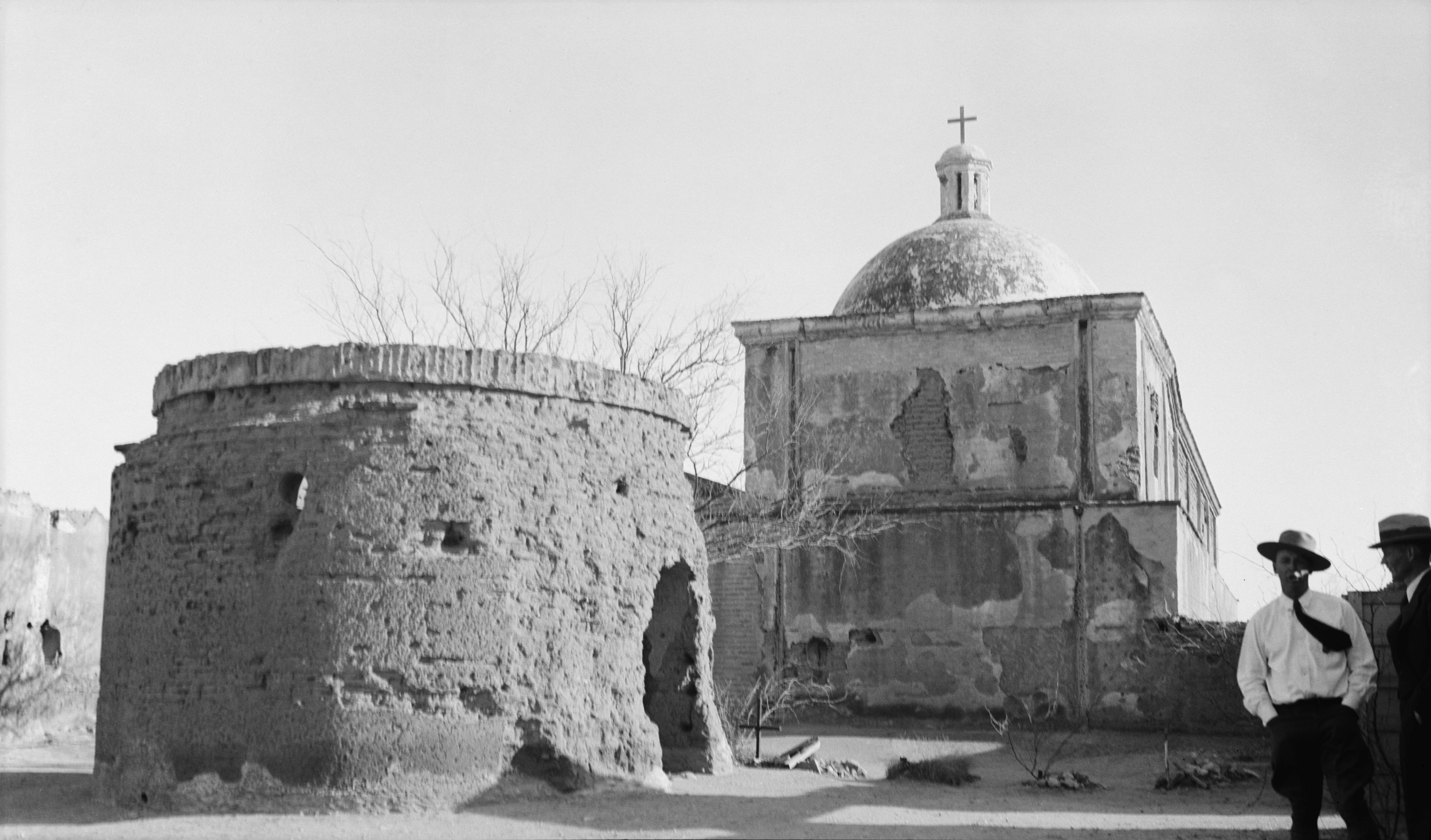
Mission San Jose de Tumacacori
The name Tumacacori rolls off the tongue like a prayer, and it has been one for over three centuries. This weathered adobe church stands roofless against the Arizona sky, its ochre walls still holding the shape of devotion long after the faithful departed. The O'odham people called this place home before Spanish missionaries arrived in 1691, and their descendants farmed these fields until Apache warriors drove them away in 1848. Today the mission's hollow nave frames nothing but sunlight and mountain air, yet somehow manages to say more about faith, empire, and survival than any intact cathedral.
Where Two Rivers Met
Jesuit Father Eusebio Kino visited the Sobaipuri village on the east bank of the Santa Cruz River in 1691, establishing Mission San Cayetano del Tumacacori near a settlement that had existed for generations. The O'odham people who lived here had already mastered farming in this unforgiving landscape, channeling seasonal floods to irrigate crops of corn, beans, and squash. Kino saw opportunity in their industry. The first church was modest, an adobe structure built by villagers who accepted baptism alongside their ancestral ways. For sixty years, this arrangement held together. Then came 1751, when the O'odham rose up across Pimeria Alta in rebellion against Spanish rule. The mission fell silent.
A Church Reborn, Priests Expelled
By 1753, the mission had moved to its present location on the west bank of the Santa Cruz River. Franciscan architects envisioned grandeur in Spanish Colonial style, and by 1757 the new church rose from the desert floor. But the Jesuits who nurtured this frontier outpost would never see their dream completed. In February 1768, King Carlos III ordered every Jesuit forcibly expelled from New Spain, convinced that the order had grown too wealthy and powerful. Soldiers escorted the black-robed priests to ships bound for Spain. Franciscan missionaries inherited their abandoned churches, arriving to find half-finished walls and confused congregations. At Tumacacori, the brown-robed friars picked up where their rivals left off, eventually completing the sanctuary that stands in ruins today.
A Promise Made, A Promise Broken
In 1806, the O'odham who had worked this land for over a century petitioned the Spanish crown for official title. Alejo Garcia Conde, the intendant-governor of Arizpe, granted their request that December, recognizing what the indigenous farmers already knew: this land belonged to them. Legal interviews and boundary surveys followed in 1807, extending the mission's territory. But paper promises mean little without power to enforce them. The deed to Tumacacori vanished in 1841. Two years later, the mission was declared abandoned. In 1844, it went on the auction block, purchased for five hundred pesos by a man buying on behalf of his brother-in-law. The O'odham continued to farm, but their legal claim had evaporated.
The Final Exodus
Apache raids intensified throughout the 1840s as Mexican authority weakened in this borderland between nations. A small O'odham community still clung to the mission fields, planting crops and tending livestock as their ancestors had done. In 1848, the inevitable arrived. Apache warriors struck the settlement, killing nine people. The survivors gathered what they could carry and walked away, leaving behind adobe walls that would never again echo with prayers or harvest songs. The mission stood empty, its roof eventually collapsing, its altar exposed to rain and sun. Nature began reclaiming what faith had built.
Preserved in Absence
Today Tumacacori National Historical Park protects not a restored church but an honest ruin. The walls remain unroofed, their exposed adobe bricks slowly returning to earth. Visitors walk through the same arched doorway that welcomed O'odham farmers, Jesuit priests, Franciscan friars, and Spanish soldiers. The cemetery holds the bones of those who believed this place would endure. In preserving the mission's incompleteness, the National Park Service tells a truer story than any reconstruction could, a story of how empires rise and fall, how indigenous peoples adapt and resist, and how the desert eventually wins every argument.
From the Air
Located at 31.57°N, 111.05°W in southern Arizona, approximately 3 miles from Nogales and the Mexican border. The mission complex is visible from low altitude as a collection of adobe structures with the distinctive roofless church sanctuary. Nearest airport is Nogales International Airport (KOLS), about 5nm south. The Santa Cruz River valley provides a clear navigation reference running north-south. Best viewed in morning light when shadows define the ruined architecture.