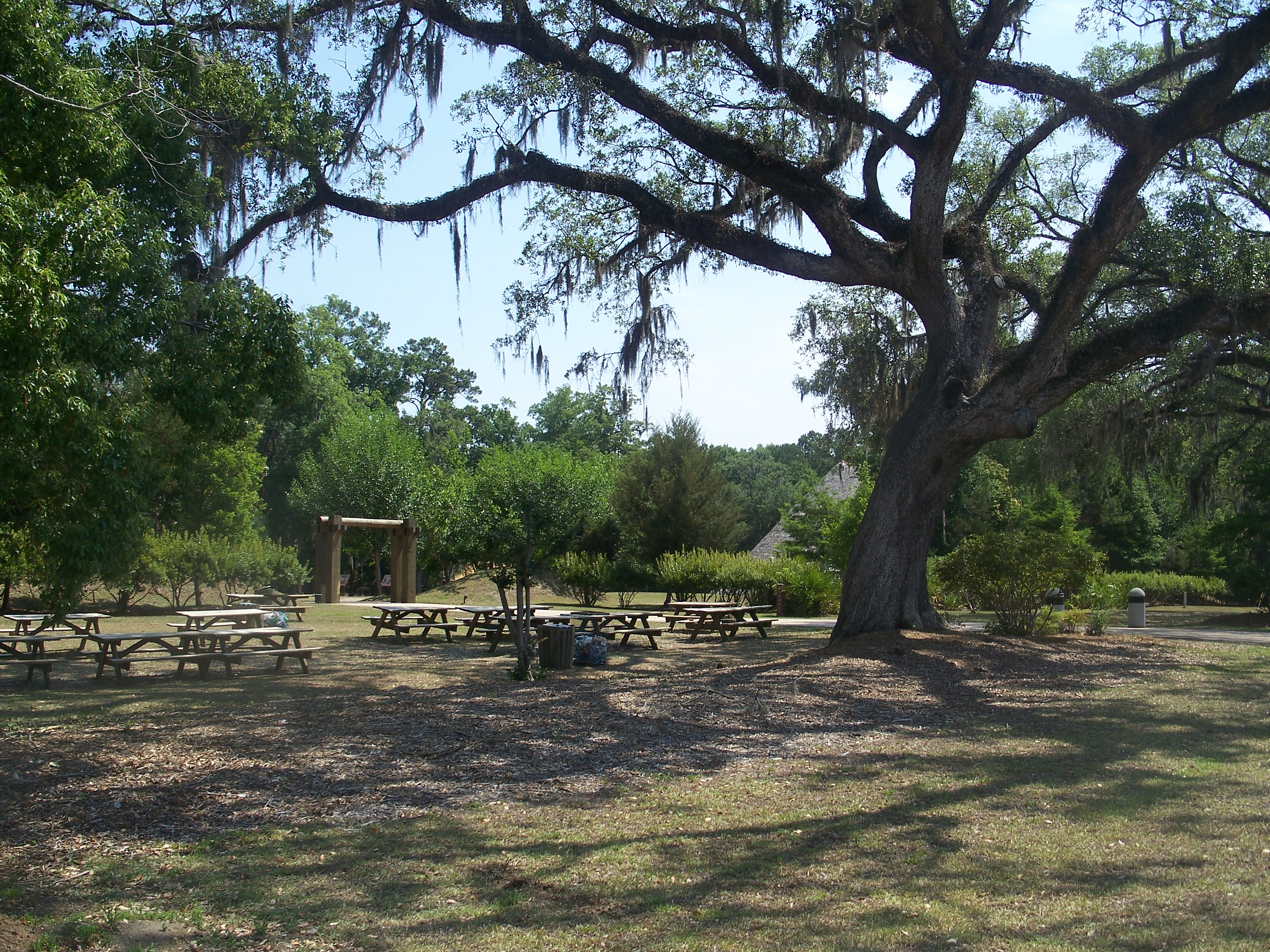
Mission San Luis de Apalache
At the end of July 1704, the Apalachee and Spanish garrison at San Luis did something remarkable. Faced with an approaching force of Creek warriors and English colonists from South Carolina who had already devastated missions across the province, the defenders did not surrender, did not flee, and did not fight. Instead, the Apalachee and Spanish together set fire to the fort, the church, the council house, the residences -- the entire village -- and walked away from the ashes. It was an act of mutual destruction between two peoples who had spent nearly 50 years building a shared settlement on one of the highest hilltops in the Florida Panhandle, two miles west of where the state capitol building stands today. The mission they burned had housed over 1,400 Apalachee and several hundred Spaniards, and its council house was the largest known historic Native American structure in the southeastern United States.
Before the Friars Came
The Apalachee were no minor tribe waiting to be discovered. They were the most populous and powerful indigenous people in Florida, surpassing the Timucua, Potano, Tocobaga, and Calusa in both population and political organization. Part of the Mississippian mound-building tradition, they had well-established administrative and religious systems centuries before Europeans arrived. The first recorded European presence came in 1528, when Panfilo de Narvaez set up camp south of the Apalachee capital of Anhaica near present-day St. Marks. Eleven years later, Hernando de Soto wintered at Anhaica itself -- in what is now Tallahassee -- celebrating what is recorded as the first Christmas in North America. The Apalachee were not passive recipients of European contact. In 1607, they requested Franciscan friars. In 1612, they formally asked for a mission. The Spanish, preoccupied with their garrison at St. Augustine, did not oblige for another two decades.
The Hilltop Capital
In 1633, Franciscan missionaries Pedro Munoz and Francisco Martinez finally launched a formal mission effort in Apalachee Province at the request of Apalachee chiefs. The original site proved indefensible -- Spanish military authorities described it as extending for miles with no natural protection. In 1656, the Spanish authorities decided to relocate their western capital to one of the region's highest hilltops for strategic purposes. The inhabitants of San Luis moved to the present site at Spanish request. What grew there over the next half-century was something unusual in colonial Florida: a genuinely mixed settlement. The Apalachee built the structures, farmed the fields, and fed both the mission and distant outposts like St. Augustine and Havana. They even contributed labor to the construction of the Castillo de San Marcos under the repartimiento, the colonial labor system that pulled workers away from their own farms for months at a time. Spanish soldiers married Apalachee women. The garrison swelled from 12 men to 25, then to 40. By 1675, the population had grown to over 1,400 Apalachee and several hundred Spanish under San Luis's jurisdiction.
A Council House That Held Thousands
The buildings at San Luis reflected both cultures. There were Spanish and Apalachee residential areas, a Franciscan church, and a Spanish fort that evolved from a blockhouse described in 1675 as a mere "fortified country house" into a proper palisaded structure with parapets and a dry moat by 1703. But the most extraordinary structure was the Apalachee council house -- the largest known historic Native American building in the southeastern United States, capable of holding 2,000 to 3,000 people. This was not a Spanish imposition. It was an Apalachee civic space built on Apalachee terms, a place where the indigenous political and social life of the settlement continued alongside the mission's religious functions. The tension between these two worlds was constant. In 1698, Spanish residents commandeered Apalachee houses and land, took lumber meant for church repairs, and forced indigenous residents to build Spanish homes. The cooperative veneer was wearing thin.
The Burning
The end came swiftly. In October 1702, a Spanish-Apalachee force was defeated on the Flint River, and the blockhouse was hastily converted into a proper fort. A severe epidemic in 1703 weakened the already strained settlement. Then came the raids -- English colonists from the Province of Carolina and their Creek allies swept through Apalachee territory in a series of devastating attacks. By July 1704, the Apalachee had had enough. They would not fight alongside the Spanish any longer. Some dispersed west, east, and north voluntarily. Many others were enslaved by the English. The decision to burn San Luis was the final act of a partnership that had lasted nearly 50 years -- neither side would leave anything for the invaders to use. The ashes of the mission settled over the hilltop and the site fell silent.
Raised from the Ashes
The hilltop where San Luis burned was designated a National Historic Landmark on October 15, 1966. The State of Florida purchased the 64-acre site in 1983, and archaeological research continued for 15 years. In 1998, reconstruction began based on archaeological and historical evidence, led by Renker Eich Parks Architects of St. Petersburg with architect Herchel Sheperd. The rebuilt structures -- the Franciscan church, the convento, the council house, the chief's house, the fort and blockhouse, and a typical Spanish residence -- were constructed directly atop their original locations. Today Mission San Luis operates as a living-history museum with an artifact gallery, reconstructed buildings, and costumed interpreters. It stands two miles from the Florida Capitol, a reminder that Tallahassee's history as a seat of power did not begin with statehood but stretches back through the Apalachee to the Mississippian mound builders before them.
From the Air
Located at 30.45°N, 84.32°W approximately 2 miles west of the Florida State Capitol in Tallahassee, Leon County. The 64-acre site sits on one of the highest hilltops in the area, making it a recognizable clearing with reconstructed colonial-era structures visible at lower altitudes. Tallahassee Regional Airport (KTLH) lies approximately 6nm to the southwest. The Florida Capitol dome is a prominent nearby landmark to the east. Best viewed at 1,500-3,000 feet AGL; the reconstructed church, fort, and large circular council house are distinctive from the air.