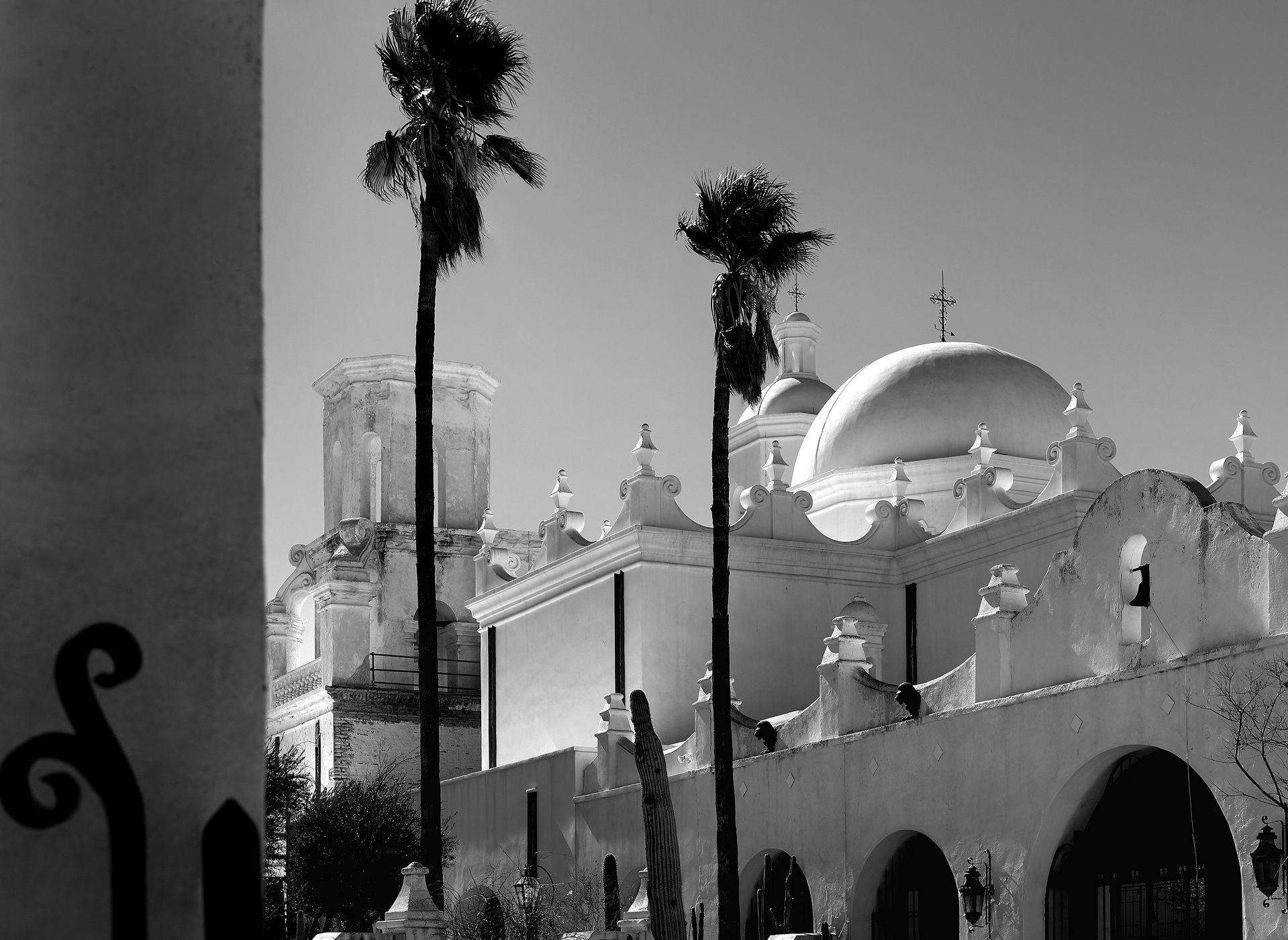
Mission San Xavier del Bac
The Tohono O'odham call this place Wa:k - "Water Place" - for the springs that once fed the Santa Cruz River here year-round. In 1692, when Father Eusebio Kino rode into this valley on horseback and declared he would build a mission, the river still ran. The springs still flowed. The O'odham people had farmed this land for generations. More than three centuries later, the river runs only part of the year and the springs have gone silent, but the white-domed church that Kino envisioned still rises from the desert south of Tucson - the finest example of Spanish colonial architecture in the United States, a building so beautiful that novelist Willa Cather called it "the most beautiful church on the continent."
Father Kino's Vision
Eusebio Francisco Kino was a Jesuit of Italian descent who spent his life establishing missions across the Sonoran Desert. San Xavier del Bac was part of a chain stretching through what was then the Pimería Alta, the colonial frontier of New Spain. Kino founded the mission in 1692, but the church you see today came later. Apache raids interrupted construction repeatedly, and work did not resume in earnest until 1756 under Father Alonso Ignacio Benito Espinosa. By 1763, services could finally be held inside, though foundation problems plagued the structure. The building that stands today was completed by O'odham laborers under architect Ignacio Gaona, funded by a loan from a Sonoran rancher - a church built by indigenous hands on indigenous land, financed by colonial commerce, in service of an imported faith.
The Architecture of Faith
San Xavier's exterior is a study in contrasts: elegant white stucco walls against the brown desert, Moorish-inspired domes rising above the saguaros. The massive entrance doors are carved from mesquite wood, and visitors passing through them often gasp at the coolness inside - and at the explosion of color. The interior is alive with paintings, frescoes, gilded carvings, and painted statues, the work of at least three different artists. The floor plan follows the classic Latin cross, with a main aisle separated from the sanctuary by the transept. The dome above rises supported by arches and squinches, flooding the space with desert light. The architecture is entirely European Baroque with no indigenous Piman influence - a transplanted aesthetic that nonetheless feels rooted in this landscape after three centuries of wind, sun, and prayer.
Flags and Faiths
San Xavier has served under three flags and survived the expulsion of two religious orders. The Jesuits staffed it until 1767, when Spain expelled them from all its territories; Franciscans took their place. When the Gadsden Purchase transferred this land to the United States in 1853, the mission fell into neglect until the Santa Fe Diocese claimed jurisdiction in 1859. The Diocese of Tucson was established in 1868, bringing regular services back to the church. In 1872, the Sisters of St. Joseph of Carondelet opened a school for Tohono O'odham children at the mission. The Franciscans returned in 1913 and built a new school in 1947. Through Mexican independence, American territorial expansion, and the establishment of the San Xavier Indian Reservation, the mission has remained a working church, serving the same community Father Kino first visited on horseback.
Sacred Ground, Living Culture
Today, Mission San Xavier del Bac anchors both the spiritual life of the Tohono O'odham Nation and the heritage tourism of southern Arizona. The church was declared a National Historic Landmark in 1960 and listed on the National Register of Historic Places in 1966. Each year on the Friday after Easter, the San Xavier Festival brings Tohono O'odham and Yaqui tribal members together for a torch-light procession - a celebration that blends indigenous tradition with Catholic ritual. The adjacent Mission Garden occupies one of the longest continuously cultivated areas in the United States, a living link to the agricultural heritage that sustained this community for millennia. In 2024, the National Park Service awarded $749,000 from the Historic Preservation Fund to restore the mission's tan plaster exterior - the latest chapter in a preservation effort that has kept the White Dove flying for over three hundred years.
The White Dove Endures
From the air, the mission appears suddenly against the brown desert floor - a flash of white that seems almost to glow. The twin bell towers frame the central dome, and the surrounding cemetery and garden spread in careful order. The contrast is startling: here is a piece of 18th-century Spain set down in the Sonoran Desert, maintained across centuries by hands that belong to many peoples. The Santa Cruz River valley stretches to the north toward Tucson; to the south, the landscape rolls toward the Mexican border. San Xavier del Bac has watched empires rise and fall, survived neglect and restoration, and remains what Father Kino intended: a place where faith meets the desert, where beauty rises from the sand, where the O'odham word for water still names a place where water once flowed.
From the Air
Located at 32.11°N, 111.01°W on the Tohono O'odham Nation San Xavier Indian Reservation, approximately 9nm south of downtown Tucson. The white-domed mission is highly visible from the air against the brown desert floor. Nearest airports: Tucson International Airport (KTUS) approximately 7nm northeast; Ryan Airfield (KRYN) approximately 12nm northwest. Interstate 19 runs nearby. The mission complex includes the main church, cemetery, museum, and adjacent Mission Garden. Best viewed at 2,000-4,000 feet AGL for architectural detail. The Santa Cruz River channel is visible to the east, though it typically runs dry.