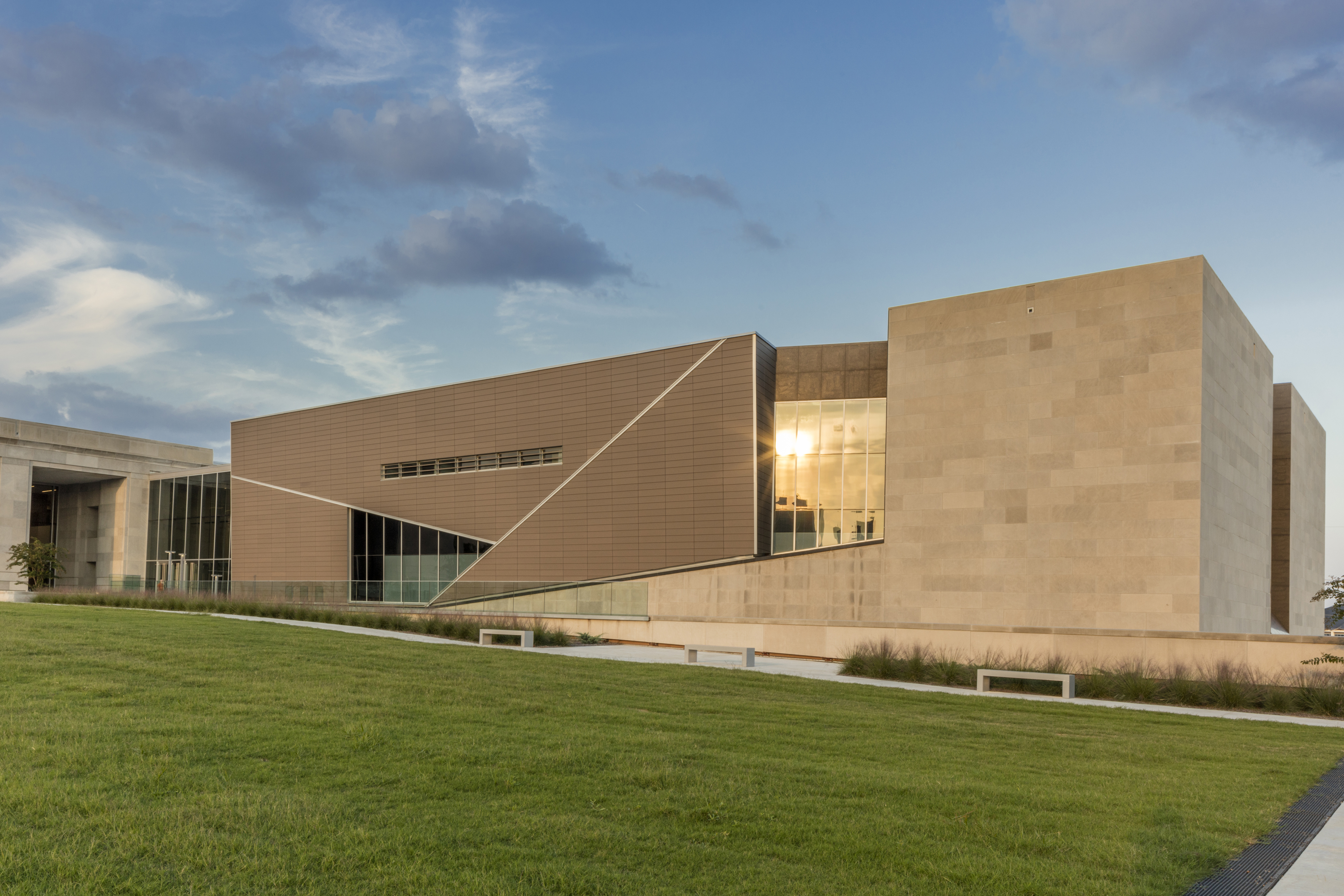
Mississippi Civil Rights Museum
Visitors enter through a room about the slave trade, then pass exhibits on Reconstruction and the brief flowering of Black communities. Then they walk into a large room dominated by a tree. Its leaves carry images of lynchings. The names of more than 600 African Americans lynched in Mississippi are etched onto five memorial stones surrounding it. The first three galleries are deliberately cramped, the physical space designed to press against visitors the way slavery and Jim Crow pressed against millions of lives. Then the museum opens up. Light floods in. And the story of resistance begins. This is the Mississippi Civil Rights Museum in Jackson, the first museum about the American civil rights movement to be sponsored by a U.S. state, and it refuses to sugarcoat a single page of history.
A Decade of Fighting Just to Build It
The museum almost did not happen. Beginning in 2000, state Senator John Horhn introduced legislation to fund a civil rights museum year after year, and the bill died every time. African Americans in Mississippi, long accustomed to exclusion from museum efforts, worried the state would produce a whitewashed version of their struggle. When Governor Haley Barbour threw his support behind the project in 2006, some Republicans finally felt political cover to back it, but legislators then fought bitterly over the location. Jackson, the Mississippi Delta, Hattiesburg, Philadelphia, Natchez, and Tougaloo College all competed for the site. The late-2000s recession froze progress entirely. Barbour spent the $2.1 million he had on a trail of historic markers instead. It took an embarrassing national incident in 2010, when the governor appeared to minimize Mississippi's racial intolerance in a magazine interview, to finally break the logjam. In his 2011 State of the State address, Barbour declared the museum must be built. Even then, the legislature nearly missed its own constitutional deadline for passing the funding bill.
From Dark Tunnels Into Light
Designed by African American architect Philip Freelon, the museum opened on December 9, 2017, connected to the Museum of Mississippi History through a shared lobby. The layout is intentionally circular, with seven galleries ringing a central rotunda. The design concept moves visitors through dark tunnels representing the darkest periods of Mississippi history before they emerge into well-lit, contemplative spaces. Most galleries are small and tight, with low light and exhibits stretching from floor to ceiling. Gallery 2, titled "Mississippi in Black and White," covers the years between the end of the Civil War and 1941, focusing on lynching, the Ku Klux Klan, and Jim Crow. Five monuments within that gallery carry the names of those who were lynched in Mississippi. A large theater screens a documentary about the murder of Emmett Till, while a smaller theater, shaped like a jail cell, shows a film about the Freedom Riders.
The State That Had to Tell Its Own Story
What makes this museum unusual is not just its content but its sponsor. Mississippi, the state where Medgar Evers was assassinated, where three civil rights workers were murdered in Philadelphia during Freedom Summer, where the Citizens' Councils organized white resistance to integration, chose to tell that story itself with $20 million in state bonds and a matching public-private fundraising scheme. Civil rights activists who attended the dedication praised it as "an honest depiction of Mississippi's past." The museum focuses on a 30-year period during which Mississippi stood at the epicenter of the civil rights struggle, from 1945 to 1970. It does not flinch from documenting individuals murdered for their activism. By February 2018, barely two months after opening, more than 80,000 people had visited. As of 2023, attendance has surpassed 500,000, making it one of the most visited civil rights museums in the American South.
Complicated Ground
The museum's very existence reflects the contradictions of the place that built it. The dedication ceremony in December 2017 was overshadowed by political controversy when the sitting president accepted an invitation to attend. The NAACP asked him not to come. Congressman John Lewis, himself a veteran of the civil rights movement, boycotted the event, along with U.S. Representative Bennie Thompson and Jackson Mayor Chokwe Antar Lumumba. The museum sits on North Street in downtown Jackson, on a parcel bounded by Mississippi Street and North Jefferson Street, adjacent to the state archives building. It stands in a city that remains deeply segregated by race and income, in a state that still grapples with the legacy the museum documents. That tension is part of the point. The museum does not pretend Mississippi has resolved its history. It invites visitors to walk through it.
From the Air
Located at 32.30N, 90.18W in downtown Jackson, Mississippi. The museum is near the Old Capitol building in the center of the city. Nearest airport is Jackson-Medgar Wiley Evers International Airport (KJAN), approximately 8 nm east of the city center. Jackson is also served by Hawkins Field (KHKS) closer to downtown. Best viewed at 2,000-3,000 ft AGL. The Pearl River is a useful visual reference running east of the city.