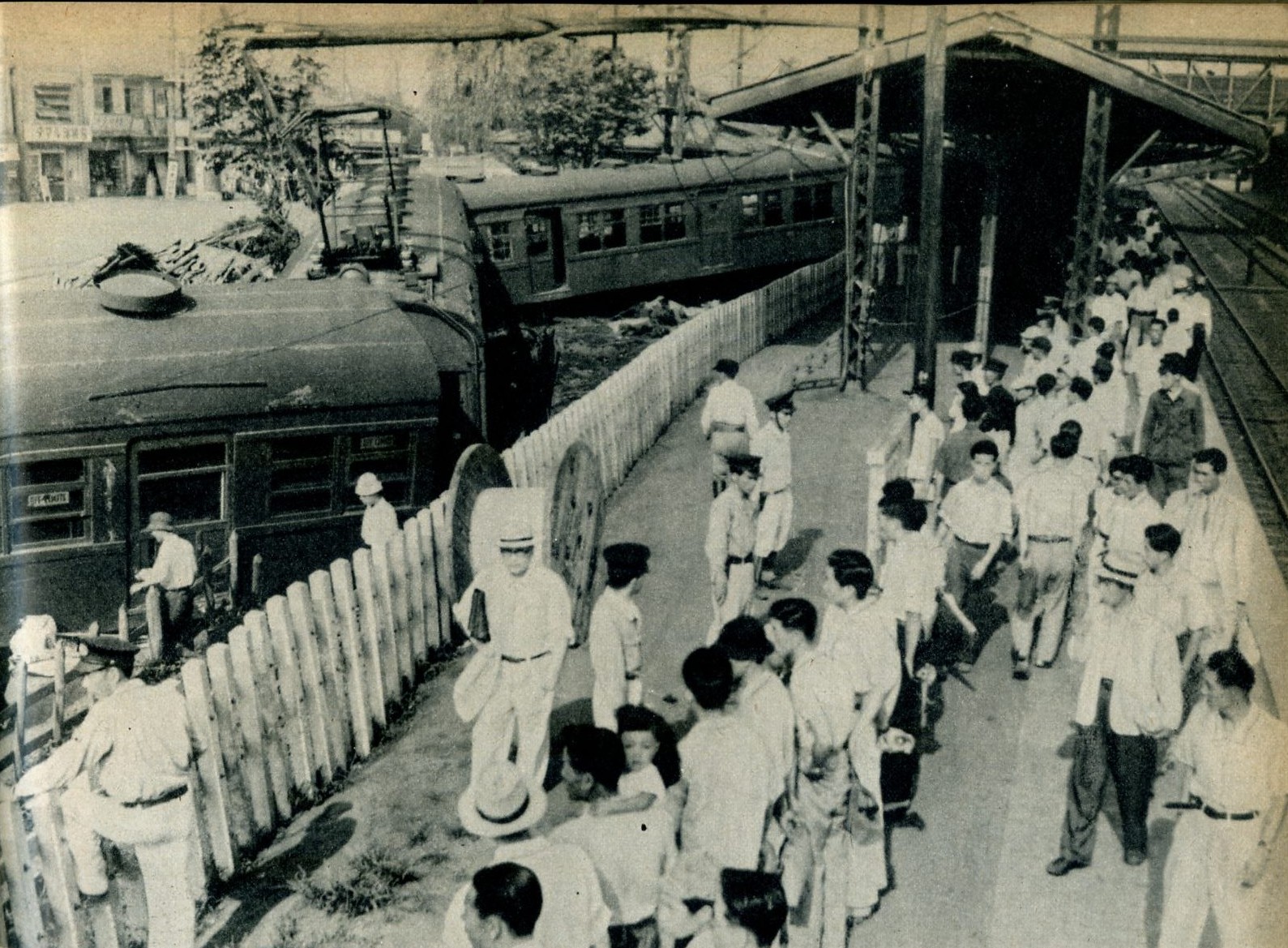
Mitaka Incident
On the evening of July 15, 1949, a 63-series commuter train rolled out of a rail yard near Mitaka Station on Tokyo's Chuo Line with no one at the controls. Its operating handle had been tied down. The unmanned train plowed through the station and derailed, killing six people and injuring twenty. It was the second of three bizarre railway disasters that struck Japan in a single summer -- a chain of events so tangled in Cold War politics, labor unrest, and possible intelligence operations that the truth remains contested more than seventy-five years later.
The Summer of Three Mysteries
The Mitaka derailment did not arrive in isolation. Ten days earlier, on July 5, Sadanori Shimoyama -- the first president of Japanese National Railways, the man responsible for announcing the layoffs of tens of thousands of workers under the American-imposed Dodge Line austerity program -- had vanished on his way to work. His dismembered body was found on train tracks in Adachi. Whether he was murdered or died by suicide was never resolved. Then, a month after Mitaka, on August 17, a passenger train on the Tohoku Main Line derailed near Matsukawa in Fukushima Prefecture after someone removed rail spikes and loosened track bolts, killing three crew members. All three incidents were blamed on Communist agitators. All three remain officially unsolved in any satisfying sense. Together, the Shimoyama, Mitaka, and Matsukawa cases became known as Japan's Three Great Railway Mysteries.
A Conductor with No Alibi
The government indicted ten people for the Mitaka sabotage, including a railway conductor named Keisuke Takeuchi -- who was not inside the train when it derailed. On the day of the incident, all four police officers assigned to Mitaka Station had inexplicably abandoned their posts, a fact never explained at trial. Two alleged co-conspirators were separately charged with perjury. Takeuchi's own defense lawyer refused to allow a co-worker to testify that the two of them had been at a public bathhouse together at the time the train left the yard -- an alibi that could have proven at least one other person was involved. The lawyer dismissed the testimony as irrelevant. Takeuchi was sentenced to death. Every other defendant was acquitted. Every one of the acquitted had been a member of the Japanese Communist Party. Takeuchi was not.
Ghosts of the Dodge Line
The context was everything. In early 1949, American occupation authorities imposed the Dodge Line, a severe austerity program designed to stamp out Japan's postwar inflation. Japanese National Railways bore the brunt: roughly 100,000 positions were eliminated, with a dismissal list of approximately 37,000 names published on July 4 -- the day before Shimoyama disappeared. The labor movement, heavily influenced by the Japanese Communist Party, was engaged in strikes and direct actions. The occupation authorities and Japan's conservative government saw an opportunity to discredit the left. Many historians believe the arrested men were framed to slander the Communist Party and justify a crackdown on organized labor. Others argue that disgruntled railway workers, furious over the layoffs, took matters into their own hands. The truth likely died with the principals.
A Death in Prison, a Son's Crusade
Takeuchi never stopped declaring his innocence. His death sentence was effectively commuted to life imprisonment through the appeals process, but every formal appeal was rejected. In 2010, the Japan Times reported that his original confession had been extracted under police duress. Takeuchi died of a brain tumor in prison in 1967, still protesting that he had been wrongly convicted. His cause did not die with him. In 2019, the Tokyo High Court denied a request from his son, Kenichiro Takeuchi, for a retrial. In April 2024, the Supreme Court rejected a special appeal, confirming there would be no new trial. Undeterred, Takeuchi's eldest son filed a request for a third retrial in September 2024. Mitaka Station still stands on the Chuo Line, a busy commuter hub where tens of thousands pass through daily. Nothing marks the spot where six people died and one man's life was destroyed by a verdict that has never stopped raising questions.
From the Air
Mitaka Station sits at 35.70N, 139.56E in western Tokyo, along the Chuo Line corridor that runs east-west through the city's suburban sprawl. From the air, the Chuo Line is identifiable as the rail corridor cutting through dense residential neighborhoods between Shinjuku and the Tama area. Best viewed at 3,000-4,000 feet. Nearby Chofu Airport (RJTF) lies approximately 3 km to the south. Tokyo's complex airspace applies; Haneda (RJTT) is roughly 25 km southeast.