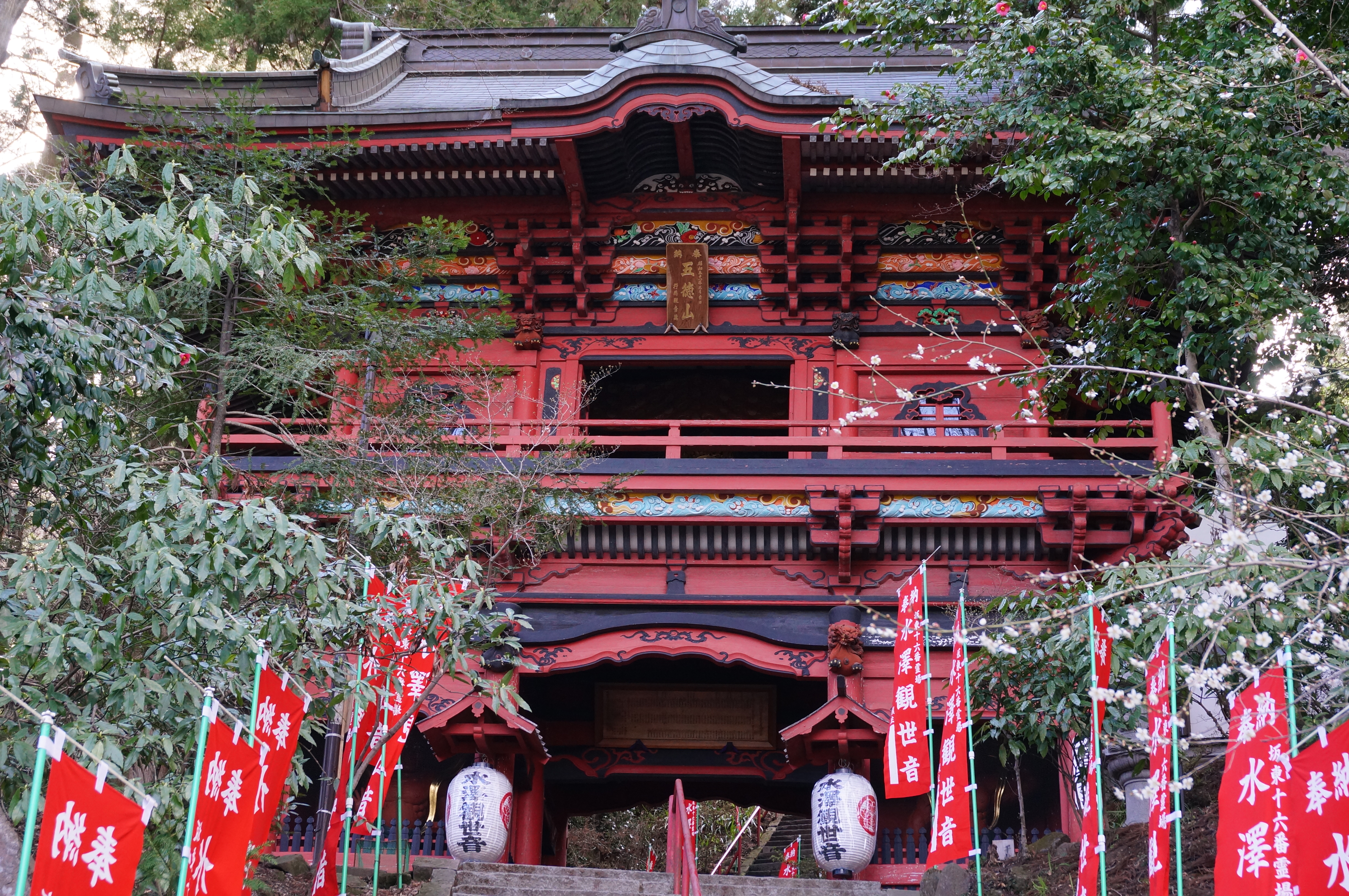
Mizusawa-dera: Temple of the Rescued Princess
Somewhere inside the two-story hexagonal hall at Mizusawa-dera, a wooden mechanism still turns. Built between 1775 and 1787, the Rokkaku-do houses a rotating sutra library on its ground floor -- a device that allows the faithful to spin the entire collection of Buddhist scriptures rather than read each one, receiving the merit of the whole canon in a single revolution. On the second story sits a statue of Dainichi Nyorai, the cosmic Buddha who illuminates all things. It is a building that compresses the infinite into a small, turning space, and it sits on a mountainside in Gunma Prefecture where pilgrims have been climbing for the better part of a thousand years. Mizusawa-dera is the sixteenth stop on the Bando Sanjusankasho, a circuit of thirty-three temples across the Kanto region dedicated to Kannon, the bodhisattva of compassion. The pilgrimage dates back over 780 years, and this particular temple's own legend reaches even further -- to a princess, a stepmother, an abyss, and a divine rescue.
The Princess and the Abyss
No documents survive from before the Edo period, so the founding of Mizusawa-dera lives entirely in temple legend. The story reaches back to the Asuka period, when the Kokushi -- the provincial governor -- of Kozuke Province was a man named Takanobe Ienari. He had three daughters, and their stepmother wanted all three dead. When the youngest, Princess Ihaho, was about to be drowned in an abyss, Kannon Bosatsu intervened and saved her life. Princess Ihaho went on to marry the next governor, Lieutenant General Takamitsu. Later, Empress Suiko invited Ekan, a high-ranking Buddhist prelate from the Korean kingdom of Goguryeo, to bring Buddhism deeper into the region. By then the widowed Princess Ihaho donated her personal statue of Kannon Bosatsu to serve as the temple's honzon -- its principal object of worship. The story reads like a fairy tale, but the temple it explains is very real.
Station Sixteen on the Kannon Road
The Bando Sanjusankasho is a pilgrimage circuit of thirty-three Buddhist temples stretching across seven prefectures of the Kanto region. Tradition credits its founding to Minamoto no Yoritomo, the first shogun of the Kamakura bakufu, and the earliest historical record of the route dates to 1234. The number thirty-three reflects the belief that Kannon Bosatsu manifests in thirty-three different forms to aid suffering beings. Mizusawa-dera sits as the sixteenth station on this journey, its full formal name being Gotokuzan Muryoju-in Jion-ji. The temple belongs to the Tendai sect, one of the oldest schools of Japanese Buddhism, and its honzon is a statue of Senju Kannon Bosatsu -- the Thousand-Armed Kannon, each arm representing a different means of reaching out to those in need. For pilgrims walking the full 1,300-kilometer circuit, Mizusawa-dera offers a mountain pause in the green hills of Gunma, roughly 8.4 kilometers west of Shibukawa Station on the JR East Joetsu Line.
What the Flames Took and Time Rebuilt
Fire has been a recurring antagonist in Mizusawa-dera's long existence. The temple has burned and been rebuilt multiple times across the centuries, each reconstruction reflecting the architectural sensibilities and patronage of its era. The current main hall -- the Kannon-do -- dates to the Genroku era, the late seventeenth-century period of cultural flourishing during which the arts, kabuki theater, and temple architecture all reached new heights of refinement. The hall then underwent a major renovation lasting thirty-three years, completed in the seventh year of Tenmei. Among the temple's most prized cultural properties is a wooden statue of an eleven-faced Kannon from the Heian period, attributed to the Jocho school of Buddhist sculpture. The Jocho school, named after the master sculptor who created the famous Amida Buddha at Byodo-in in Uji, defined the classical Japanese approach to Buddhist statuary -- serene, balanced, elegant. That an eleventh-century work from this school survives at Mizusawa-dera speaks to the care with which the temple has guarded its treasures through centuries of fire and rebuilding.
The Spinning Library
The Rokkaku-do is the structure that catches the eye. Two stories tall and hexagonal in plan, it was built between 1775 and 1787 -- the late Edo period, when Japanese temple architecture combined structural ingenuity with devotional purpose. The ground floor houses a rinzo, a rotating sutra library. The concept is elegant in its simplicity: the complete Buddhist canon, physically present in the building, is mounted on a mechanism that allows it to be spun. A single rotation confers the spiritual merit of having read the entire collection. Upstairs, a statue of Dainichi Nyorai -- Vairocana, the cosmic Buddha of illumination -- presides over the second story. The Rokkaku-do is designated a Gunma Prefectural Tangible Cultural Property, but its value goes beyond the architectural. It embodies a Buddhist idea about access: that the teachings should be available to everyone, even those who cannot read, even those with only a moment to spare. One turn of the wheel, and the whole dharma passes through your hands.
From the Air
Located at 36.479°N, 138.945°E on a forested mountainside west of Shibukawa, Gunma Prefecture. The temple sits in the foothills extending from the Haruna volcanic complex, surrounded by dense tree cover that makes it difficult to spot from high altitude. Best viewed below 3,000 feet AGL on approach from the east, where the clearing of the temple grounds contrasts with the surrounding forest. The Joetsu Shinkansen line and JR Joetsu Line run through the nearby Shibukawa valley. Mount Haruna (1,449m) rises prominently to the southwest. The nearest significant airport is Matsumoto Airport (RJAF) approximately 55 nautical miles to the west. Tokyo Haneda (RJTT) lies roughly 70 nautical miles to the southeast.