MO Museum
Two scientists started a museum because Lithuania did not yet have one for its modern art. Viktoras Butkus and Danguole Butkiene began collecting in 2008, then spent the next decade running what they called an art museum without walls - exhibitions in borrowed spaces, public projects on Vilnius streets, education programs in schools - while raising the money and the cultural support to build a permanent home. In October 2018 it opened. The building is by Daniel Libeskind. The collection now holds about 6,000 pieces of Lithuanian modern and contemporary art, much of it never previously visible in any single institution. MO is the largest private art museum in independent Lithuania and the first major Libeskind project in the Baltic states.
A Spiral Staircase, on Purpose
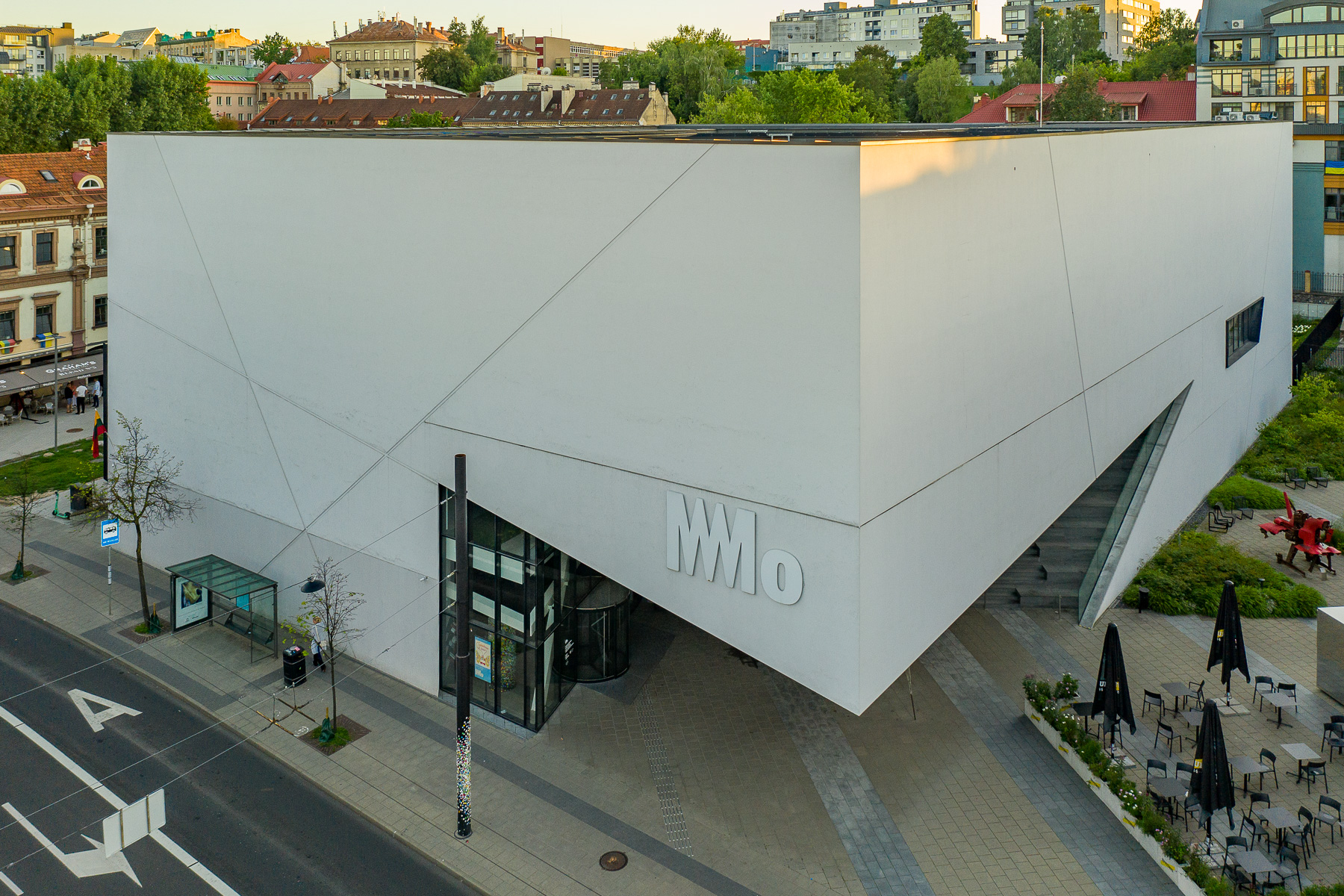
The Libeskind design is unusual within the Studio Libeskind catalog. At 3,100 square meters of floor area and 17 meters tall, MO is one of the smallest projects the firm has built. Libeskind has said it is also one of his favorites, and it contains his first use of a circular form - the spiral staircase that anchors the interior and that visitors photograph more than any other feature. The siting was deliberate: the building sits between Vilnius's medieval Old Town and the New Town that grew up in the 18th century, and it was conceived as a symbolic gateway between those two epochs of the city. A time capsule was buried under the foundations at the construction kickoff in 2009. Italian news agency ANSA included MO in its top ten 21st-century museums to visit. The Lithuanian architecture studio Do Architects served as local partner.
A Collection of a Lithuania the Soviets Tried to Hide
The art inside tracks something that older state museums could not, or would not, document fully. The MO collection focuses on Lithuanian work from the 1950s onward - the period when the Stalin era ended and a slow, partial cultural liberation began under Soviet rule. The core is painting, with works by approximately 250 artists, beginning with the modern interwar masters Antanas Gudaitis, Leonas Katinas, and Algirdas Petrulis. The collection moves through the colorful, decorative, deliberately counter-social-realist painting of the 1970s by Jonas Svazas, Vincas Kisarauskas and others; the neo-expressionist work of the 1980s by Antanas Martinaitis, Algimantas Jonas Kuras, and Kostas Dereskevicius; the abstraction of Linas Katinas, Eugenijus Cukermanas, and Laima Drazdauskaite. Work by Stasys Eidrigevicius, the Lithuanian poster artist who built an international career from Warsaw, is also held. The newer painting includes neo-expressionist, neoromantic, neo-academicist, and conceptual realist work, much by artists in their 30s and 40s.
Photography, Sculpture, Video, Young Artists
The graphics and photography holdings include the humanist street and rural photography of Antanas Sutkus, Aleksandras Macijauskas, and Romualdas Rakauskas - the so-called Lithuanian school whose 1960s and 1970s work earned international recognition for its intimate, dignified portraits of Soviet-era Lithuanian life. Later photographers including Alfonsas Budvytis and Vytautas Balcytis carry the documentation forward. The video art collection ranges from the social-realist documentary mode of Arturas Raila and Robertas Antinis to the surrealist-personal work of Jurga Barilaite and the duo Svajone and Paulius Stanikai. The sculpture holdings include work by Petras Mazura, Mindaugas Navakas, and Gediminas Akstinas. A separate young artists section features Andrius Zakarauskas, Linas Jusionis, Adomas Danusevicius, Egle Karpaviciute, and others working today.
The Museum That Spilled Into the Streets
MO is unusual for taking the city as part of its program rather than treating exhibitions as the only output. The Literatu Street project, in collaboration with curator Egle Vertelkaite and over 100 artists, installed more than 200 small art plates along the wall of Literatu Street in the Old Town - each plate dedicated to a Lithuanian writer or literary work, turning a quiet medieval lane into an open-air anthology of national literature. The Vilnius Talking Statues project, launched in 2015, made 15 of the city's monuments interactive: visitors can use their phones to hear scripts written by famous Lithuanian writers and voiced by professional actors, turning Vilnius into the fourth city in an international Talking Statues network alongside New York and Copenhagen. From above, MO appears as a low, white, slightly cantilevered geometric shape pressed between the older buildings of central Vilnius - a 21st-century intervention of unusual restraint, by an architect more often associated with sharp angles than with quiet ones.
From the Air
54.68N, 25.28E. MO Museum is in central Vilnius near the boundary between the Old Town and the New Town, just south of the city center. Recommended viewing altitude 2,000-3,500 feet AGL over central Vilnius. Vilnius International (EYVI) is about 6 km south; standard arrival traffic for EYVI passes near the city. The Vilnius Old Town UNESCO area is the dominant visual context to the north.