Moco Museum
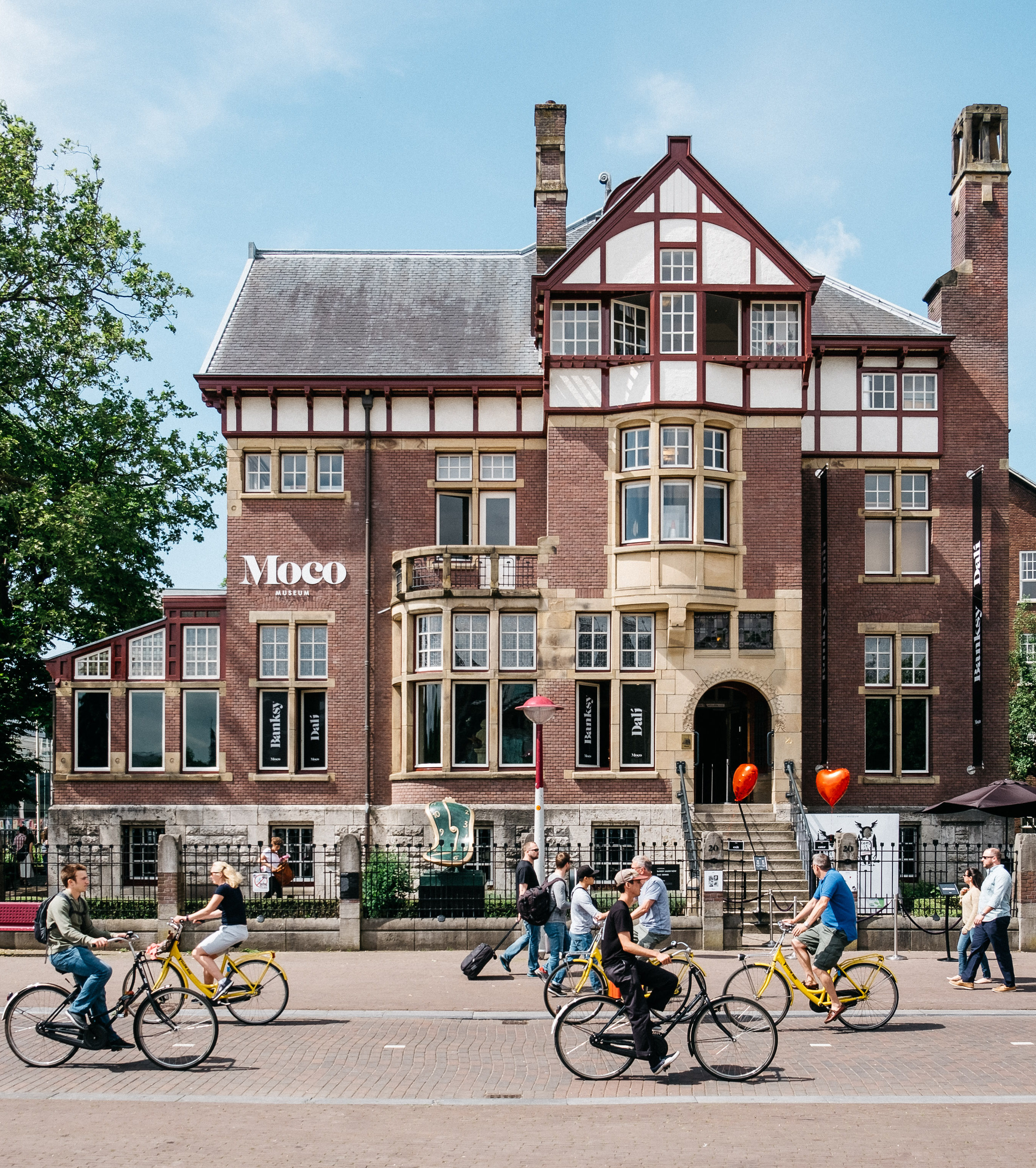
Stand on Museumplein with your back to the Van Gogh and the Stedelijk, and there it is: a sandstone townhouse from 1904 with iron balconies, sitting like a private mansion gate-crashed by tour groups. This is Villa Alsberg, designed by Eduard Cuypers — nephew of Pierre Cuypers, the architect of Amsterdam Centraal and the Rijksmuseum across the square — and built for the banker Siegmund Alsberg. It was one of the first privately owned houses on Museumplein and remained a private residence until 1939. Since 2016, those same rooms have held Banksys, Warhols, and Basquiats. The Moco Museum is the youngest of the institutions on the square, the only one fully private, the loudest in its programming, and one of the most-visited museums in Amsterdam.
Banker's House, Banksy's House
When Kim Logchies-Prins and Lionel Logchies opened Moco in April 2016, they were betting that Amsterdam had room for a different kind of museum experience — short, photogenic, populated by names recognizable from album covers and political graffiti rather than from art-history surveys. The Villa Alsberg helped. It is a small building by Museumplein standards, which forces a denser exhibition and a faster pace than the Rijksmuseum's marble halls. Cuypers's 1904 interior has been adapted for gallery use, with immersive and digital installations slotted into rooms that were drawn for a banker's family. There are still moldings and fireplaces and stair railings; there is also a Studio Irma installation called Reflecting Forward swallowing one of the rooms in light.
Cuypers, Junior
Eduard Cuypers spent his career standing slightly outside his uncle Pierre's monumental shadow. While Pierre Cuypers built the institutional Amsterdam of the late nineteenth century — the train station that everyone arrives at, the museum where everyone goes to see Rembrandt — Eduard took private commissions, designed houses for bankers and merchants, and ran an architecture office that trained a generation of Dutch and Indonesian architects. Villa Alsberg is one of his clearest surviving works in Amsterdam. There is a small irony in the building's afterlife: Eduard's domestic architecture, designed to keep the public out, now lets the public in by the hundreds of thousands. The nephew's house has become a museum because his uncle's museum is across the square.
What Hangs Inside
The permanent collection rotates around a now-familiar roster of contemporary and modern crowd-favorites: Banksy, Warhol, Basquiat, Keith Haring, Yayoi Kusama, KAWS, Jeff Koons, JR, Tracey Emin, Damien Hirst, Marina Abramovic. The ongoing Banksy: Laugh Now show is presented as an "unauthorised" exhibition — Banksy himself has been famously hostile to the secondary market that puts his stenciled work on museum walls, but the prints, screenprints, and editions on display here are legitimate works in private hands. Beanfield, Girl with a Balloon, and Flower Thrower hang in rooms once used for family dinners. Past exhibitions have given platforms to the Iranian street-art brothers Icy and Sot, to Daniel Arsham's Dutch debut, to Yayoi Kusama's mirror infinities, and to Robbie Williams's first foray into curated visual art.
The Tourist Numbers
Moco is unapologetically a tourist museum, and the numbers prove it works. According to Amsterdam Tips, the museum logged roughly 769,000 visitors in 2023 — its highest single-year attendance — before dipping to around 610,000 in 2024 as Amsterdam's wider tourism pulled back. Across its Amsterdam, Barcelona, and London locations combined, the group reports more than six million visitors from over a hundred and twenty countries since opening. Those are public-museum-scale numbers, achieved by a private gallery in a townhouse. The exhibitions are short on wall text and long on installation atmosphere; people come, take photographs, walk through in an hour, and leave talking about it. Critics argue this is not what museums are for. Visitors argue that it is exactly what museums should be.
On Museumplein
The location is the joke and the strategy. Moco faces the Rijksmuseum directly. The Van Gogh Museum is steps away. The Stedelijk leans in from the other side. A visitor with a single afternoon and three museum choices is being asked to decide whether to spend it with Rembrandt and Vermeer, with Van Gogh, or with Banksy and Kusama. The Moco answers that question by being shorter, brighter, and louder than its neighbors, and by being open later on weekends than most of them. There are no rules about what a serious museum has to look like. The Villa Alsberg, with Cuypers's iron balconies and Banksy's stenciled girl reaching for a balloon in an upstairs window, makes the case in its own way.
From the Air
Located at 52.3587 N, 4.8819 E on Amsterdam's Museumplein, directly opposite the Rijksmuseum. Nearest airport: Amsterdam Schiphol (EHAM/AMS), 13 km southwest. From a low approach to Schiphol, Museumplein appears as a clear rectangular green just south of the canal ring; the Rijksmuseum's twin towers anchor the north end and Moco's Villa Alsberg sits on the smaller Honthorststraat side.