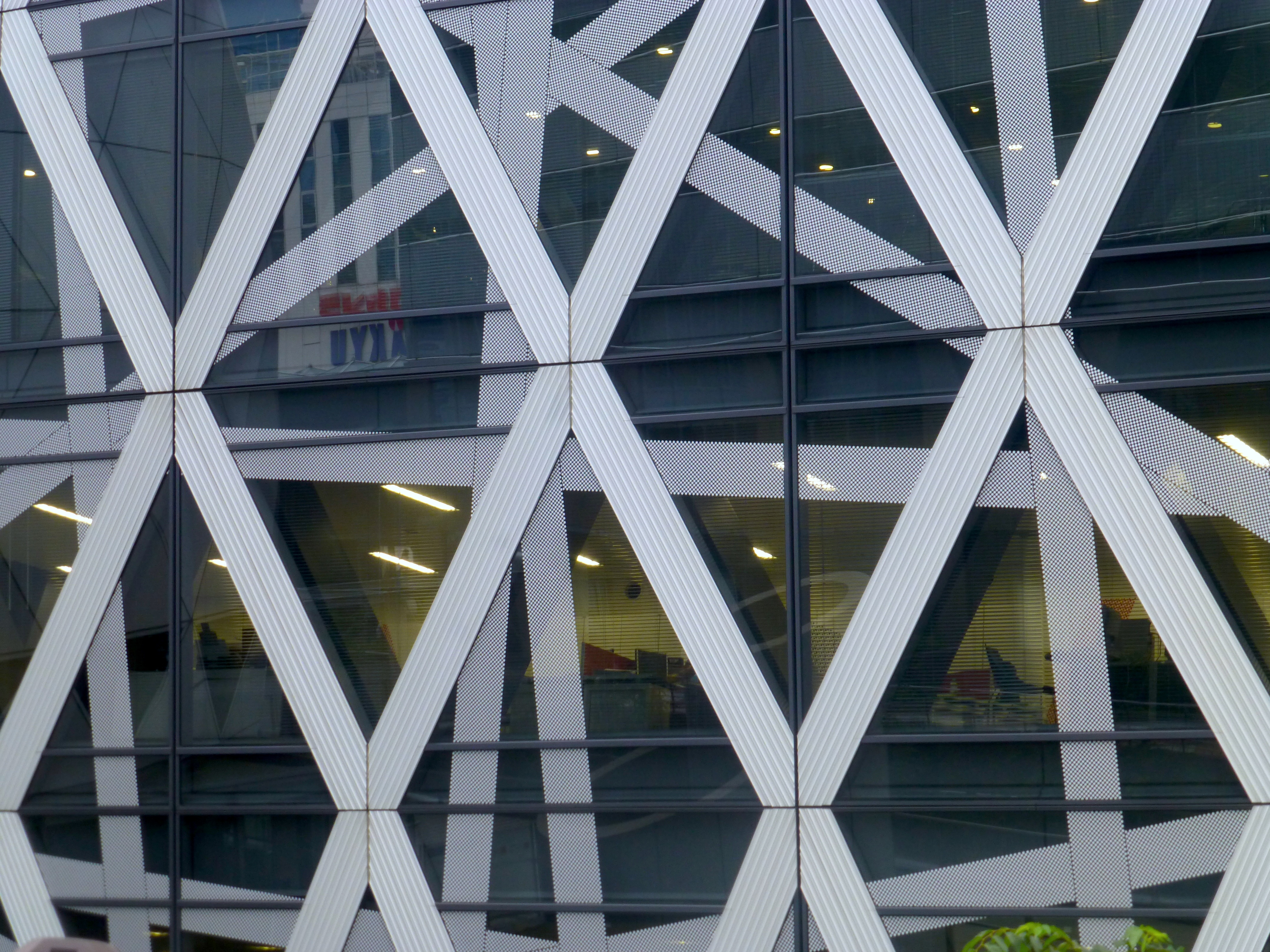
Mode Gakuen Cocoon Tower
The competition brief contained a single, audacious condition: the building could not be rectangular. Fifty architecture firms submitted more than 150 proposals for Mode Gakuen's new Tokyo campus, and the winning design looked like nothing else on the Shinjuku skyline. Completed in October 2008, the Cocoon Tower rises 204 meters above Nishi-Shinjuku in a lattice of white aluminum and dark blue glass, its curving walls crosshatched with diagonal lines that earned it comparisons to a silkworm's cocoon. The metaphor was intentional. Tange Associates, led by Paul Noritaka Tange, designed the building to symbolize nurturing -- the cocoon protecting and developing the students within.
A Dynasty of Bold Design
Paul Noritaka Tange is the son of Kenzo Tange, one of the most influential architects in Japanese history, the man who designed the iconic Yoyogi National Gymnasium for the 1964 Tokyo Olympics. The younger Tange inherited his father's appetite for structures that refuse to blend in. For the Cocoon Tower, Tange Associates envisioned something that would serve as a gateway between Shinjuku Station -- the busiest railway station in the world -- and the Shinjuku central business district's cluster of skyscrapers. The result is a building that manages to be both organic and futuristic, its white lattice shell catching the light differently at every hour, glowing pale blue against the evening sky and shimmering white under midday sun.
Vertical Campus
Inside the cocoon, 10,000 students attend three vocational schools stacked vertically. Tokyo Mode Gakuen teaches fashion design. HAL Tokyo trains students in information technology and digital design. Shuto Iko prepares future medical professionals. Each floor contains three rectangular classrooms arranged around a central core of elevators, staircases, and structural support. Every three floors, the classrooms give way to a triple-height student lounge -- open, light-filled spaces that face three different directions: east, southwest, and northwest. These lounges break the vertical rhythm of the building and give students panoramic views of the Tokyo skyline, turning study breaks into moments of visual immersion in the city below.
Rising from Shinjuku's Steel Forest
The tower stands on the former site of the Asahi Life insurance company headquarters, which was demolished to make way for construction beginning in May 2006. Nishi-Shinjuku had already established itself as Tokyo's skyscraper district, a dense cluster of glass and steel towers that emerged in the 1970s. The Cocoon Tower added something the neighborhood had lacked: personality. Where surrounding buildings are sharp-edged and corporate, the Cocoon Tower's elliptical profile and woven facade bring an almost biological quality to the skyline. In 2008, Emporis awarded it Skyscraper of the Year, recognizing its design innovation. At 50 stories, it stood as the second-tallest educational building in the world at its completion, a vertical campus wrapped in a shell that makes architecture itself part of the curriculum.
After Dark
The Cocoon Tower transforms at night. Interior lighting seeps through the lattice shell, turning the building into a glowing blue-white lantern visible across the Shinjuku skyline. The diagonal web pattern becomes more dramatic after sunset, the white aluminum lines standing out against the illuminated dark blue glass. Photographers gather on the streets below and from rooftop bars in neighboring towers to capture the effect. The building has become one of the most photographed structures in Tokyo, a city already crowded with architectural spectacles. For a vocational school -- a building type rarely associated with architectural ambition -- the Cocoon Tower proves that educational design can be as bold and imaginative as anything built for corporations or governments.
From the Air
Located at 35.6917N, 139.6969E in the Nishi-Shinjuku skyscraper district. At 204 meters, the tower is identifiable from the air by its distinctive oval profile and white lattice shell amid the rectangular towers of Shinjuku. Look for the cluster of skyscrapers west of Shinjuku Station. Nearest major airport is Tokyo Haneda (RJTT), approximately 18 km to the south. Narita International (RJAA) is 71 km to the northeast. Best viewed at 3,000-5,000 ft AGL on approach from the west.