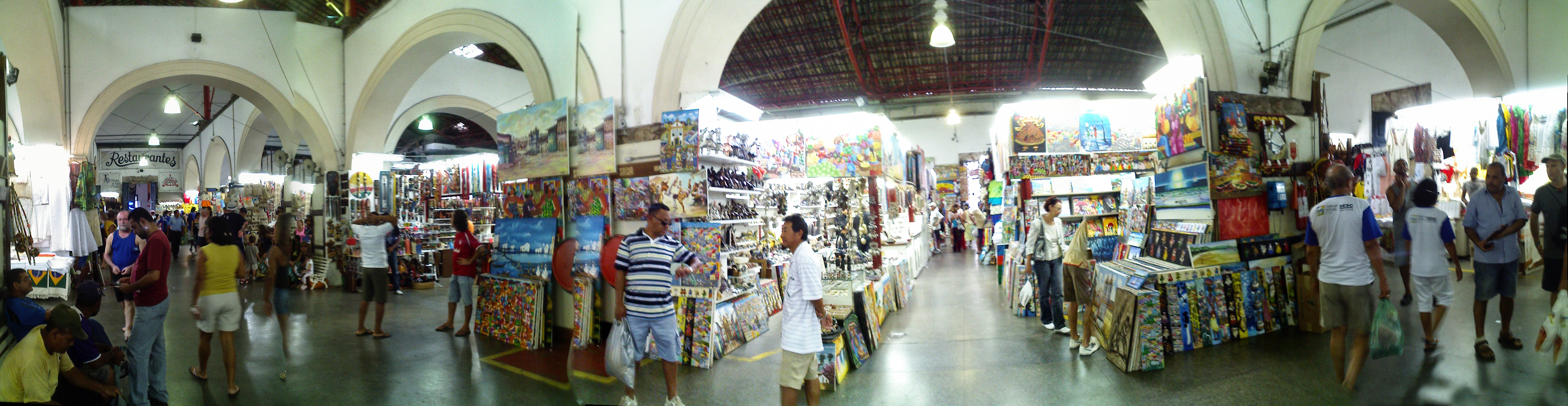
Modelo Market
Walk down the stone ramp on a high tide and the lower level of Mercado Modelo is ankle-deep in seawater. It has been that way for as long as anyone can remember. The basement of this neoclassical building - Salvador's old Customs House, completed in 1861 - sits below sea level. When the bay rises, the bay comes in. Today tourists cross on raised concrete slabs to photograph the brick arches; restaurants operate above. But the damp walls and the tidal floor carry a weight that the gift shops and acarajé vendors upstairs cannot wash off. This is the building where, according to long-held local tradition, enslaved Africans disembarked from the holds of ships and were held before being sold into Bahia's plantations. Whether it was formally a *senzala* or a general warehouse remains debated by historians, but the association is inseparable from the place, and the Afro-Brazilian culture that pulses through the market above is, among other things, the answer those descendants have made to that history.
The Building That Became a Market
The first Mercado Modelo opened on February 2, 1912, on Salvador's waterfront in the Comércio neighborhood - the oldest commercial district in Brazil's first capital. Schooners crossed the Bay of All Saints carrying goods from the Recôncavo, the fertile sugar hinterland that fed the city, and unloaded at the ramp that still bears the market's name. Fires found the market again and again. A first blaze in 1917. Another on January 7, 1922, destroyed so much that repainting it green afterward earned it the nickname *Tartaruga Verde* - the Green Turtle. A third fire came on a Sunday in February 1943. The most violent came on August 1, 1969, so destructive that the original building could not be rebuilt. In its place, sculptor Mário Cravo Júnior raised his Monument to the City of Salvador. The market itself migrated a short distance to the 19th-century Customs House, where it reopened on February 2, 1971 - the same date, fifty-nine years to the day.
Beneath the Arches
To understand why the basement matters, remember what the port of Salvador was. From the 16th century until the transatlantic slave trade was formally abolished in 1850, ships brought hundreds of thousands of captive Africans across the Atlantic into the Bay of All Saints. Bahia received more enslaved people than any other region of the Americas. Whatever the precise paperwork of which warehouse held which people on which tide, the ground under Mercado Modelo is the ground they stepped onto - wet, sunless, crowded. Some who were chained below sea level drowned when the tide rose. Modern visitors can walk down into those chambers today; a small marker acknowledges the site. The architecture is arresting. The silence, once you notice it against the market noise above, is something else.
What Rose From It
Upstairs and outside, the market hums. Capoeira circles form on the pavement facing the Bay of All Saints, two dancers spinning through a martial art that enslaved people developed, disguised as play. Vendors sell carved turtles, leather sandals, hammocks, bottles of dendê palm oil, jars of malagueta peppers. The scent of acarajé - black-eyed-pea fritters deep-fried in dendê, served with vatapá and shrimp - rolls out of the stalls of baianas in their starched white dresses. Eighty percent of Salvador's tourists pass through here, according to the market's own reckoning. Every object sold carries some version of the same story: African traditions that refused to be erased, filtered through four centuries of Bahian making, offered to whoever walks in.
The City Above
Step outside and the Lacerda Elevator rises ninety meters above you, linking the lower city to Pelourinho and the historic center declared a UNESCO World Heritage Site in 1985. The Bay of All Saints spreads westward, the same water that brought the schooners and, before them, the slave ships. IPHAN, Brazil's national heritage institute, lists the Mercado Modelo building itself as protected patrimony. Another fire struck in 1984 and forced extensive renovation; the market reopened on January 10 of that year. Management has shifted between the permit-holders' association and the municipal government more than once. What stays constant is the tide coming in and out of the lower level, the rhythm of the place that built Salvador refusing to be quieted.
From the Air
Located at 12.97°S, 38.51°W on the western edge of Salvador's peninsula, facing the Bay of All Saints (Baía de Todos-os-Santos). The market sits at the base of the Lacerda Elevator, directly below Pelourinho and the historic cidade alta. Recommended viewing altitude 2,000-3,000 ft AGL for the full harbor and bay context; higher cruise shows the bay's horseshoe shape clearly. Nearest airport is Salvador–Deputado Luís Eduardo Magalhães International (SBSV), about 25 km northeast with ILS approaches to runway 10. Sea breezes typically set in by late morning; afternoon cumulus builds over the Recôncavo to the west. Watch for heavy shipping traffic in and out of the Port of Salvador just north of the waterfront.