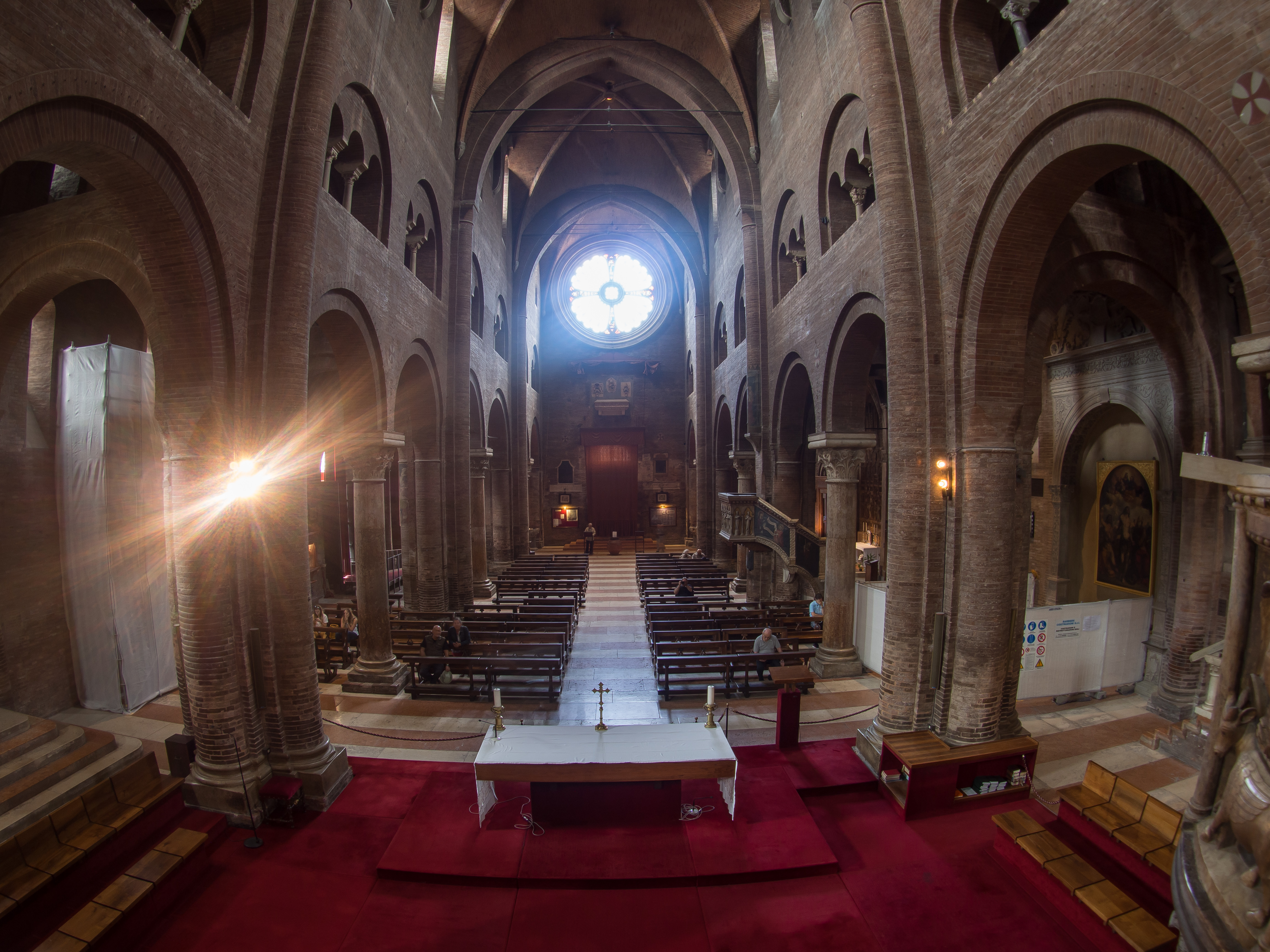
Modena Cathedral
Carved into the marble archivolt above the north portal of Modena Cathedral, King Arthur charges on horseback with his lance leveled. The inscription identifies him as 'Artus de Bretania.' Beside him ride Yder, Gawain, and Kay, battling to rescue Guinevere -- here called 'Winlogee' -- from a castle defended by the pickaxe-wielding 'Burmaltus.' Dated to sometime between 1120 and 1140, this carving may be the earliest monumental sculpture depicting the Arthurian legend anywhere in Europe. It predates the great written Arthurian romances by decades. That it appears not in Britain or France but on a cathedral in the Po Valley tells you something essential about Modena Cathedral: this building has always been full of surprises.
A Saint Beneath the Stones
Two earlier churches stood on this site from the 5th century onward. The discovery of the burial site of Saint Geminianus, Modena's patron saint, prompted their demolition and replacement. An architect known as Lanfranco -- about whom virtually nothing else is recorded -- designed the new cathedral, which was substantially complete by 1099. Pope Lucius III consecrated the building on July 12, 1184. Together with its bell tower, the Torre della Ghirlandina, the cathedral was designated a UNESCO World Heritage Site, recognized as one of the most important Romanesque buildings in Europe. The saint's remains still lie in the crypt, exhibited in the space directly beneath the nave where services have been conducted for nearly a thousand years. The adjacent Torre della Ghirlandina displays a replica of a far more peculiar relic: the bucket stolen from Bologna during the War of the Bucket in 1325, a conflict so absurd that poets have been satirizing it ever since.
Wiligelmus and the Biblical Facade
The cathedral's exterior is a gallery of medieval sculpture. Wiligelmus, a contemporary of Lanfranco, carved the facade's most celebrated reliefs: portraits of prophets and patriarchs, and above all, the Biblical Stories -- scenes depicting the creation of Adam and Eve, original sin, and the story of Noah that scholars consider a masterpiece of Romanesque sculpture. After Wiligelmus, the work continued under Anselmo da Campione and his heirs, the so-called Campionese masters, who added the majestic rose window in the 13th century. Two stone lions supporting the entrance columns date not to the medieval period but to Roman times, probably discovered during excavation of the foundations -- an accidental link between the Christian cathedral and the pagan city that preceded it. Side portals add further richness: the Porta dei Principi depicts episodes from the life of Saint Geminianus, while the Porta Regia di Piazza displays the Campionese masters' later, more refined style.
Arthur at the Fish Market Door
The Porta della Pescheria -- the fish market portal on the cathedral's north side -- is the source of Modena's greatest art-historical puzzle. The lintel carries carvings of a cross, birds, animals, and a man riding a hippocamp. But it is the archivolt above that has fascinated scholars for over a century. Inscriptions identify the figures as Arthurian characters: Artus de Bretania, Galvagin (Gawain), Che (Kay), Isdernus (likely Yder), and Winlogee (Guinevere). The scene depicts the rescue of the imprisoned queen from a castle -- an episode that corresponds to the Abduction of Guinevere, one of the oldest elements of Arthurian legend. Roger Sherman Loomis argued the carving dated to the early 12th century, which would make it decades older than any written Arthurian romance on the continent. Later scholarship by Jacques Stiennon and Rita Lejeune suggests a date between 1120 and 1140. The sculptor, dubbed the 'Arthur Master,' shows more ambition than refinement, but faithfully captures realistic architectural details and dress. How Arthurian legend reached Modena before it was written down -- through oral tradition, Breton storytellers, pilgrim routes -- remains an open question.
A Tenor's Farewell
The interior divides into three naves, its proportions emphasizing the verticality that Romanesque architecture could achieve before Gothic pointed arches carried the eye even higher. Between the central nave and the crypt, a marble parapet by Anselmo da Campione portrays the Passion of Christ, including the Last Supper. Arrigo da Campione's pulpit is decorated with small terracotta statues, while a 14th-century wood crucifix hangs in the nave. Two nativity scenes by great Modenese artists survive: Antonio Begarelli's from 1527 and Guido Mazzoni's from 1480, the latter known as the Madonna della Pappa. The Torre della Ghirlandina rises beside the cathedral, its distinctive garland-like balustrade giving the tower its name. In September 2007, the cathedral served as the setting for a farewell that brought the world's attention: the funeral of Luciano Pavarotti, Modena's most famous son, whose voice had filled opera houses from La Scala to the Metropolitan. Thousands gathered in the Piazza Grande as the tenor was mourned in the same nave where Saint Geminianus has been venerated for a millennium.
From the Air
Located at 44.646N, 10.925E in central Modena, in the Po Valley of Emilia-Romagna. The cathedral and the adjacent Torre della Ghirlandina are visible from the air within Modena's historic center. Best viewed at 2,000-4,000 feet AGL. Nearest airports: Bologna Guglielmo Marconi (LIPE/BLQ, 37 km southeast) and Modena-Marzaglia (no ICAO, small airfield). The cathedral faces the Piazza Grande, Modena's central square. The flat Po Valley terrain provides good visibility in clear weather.