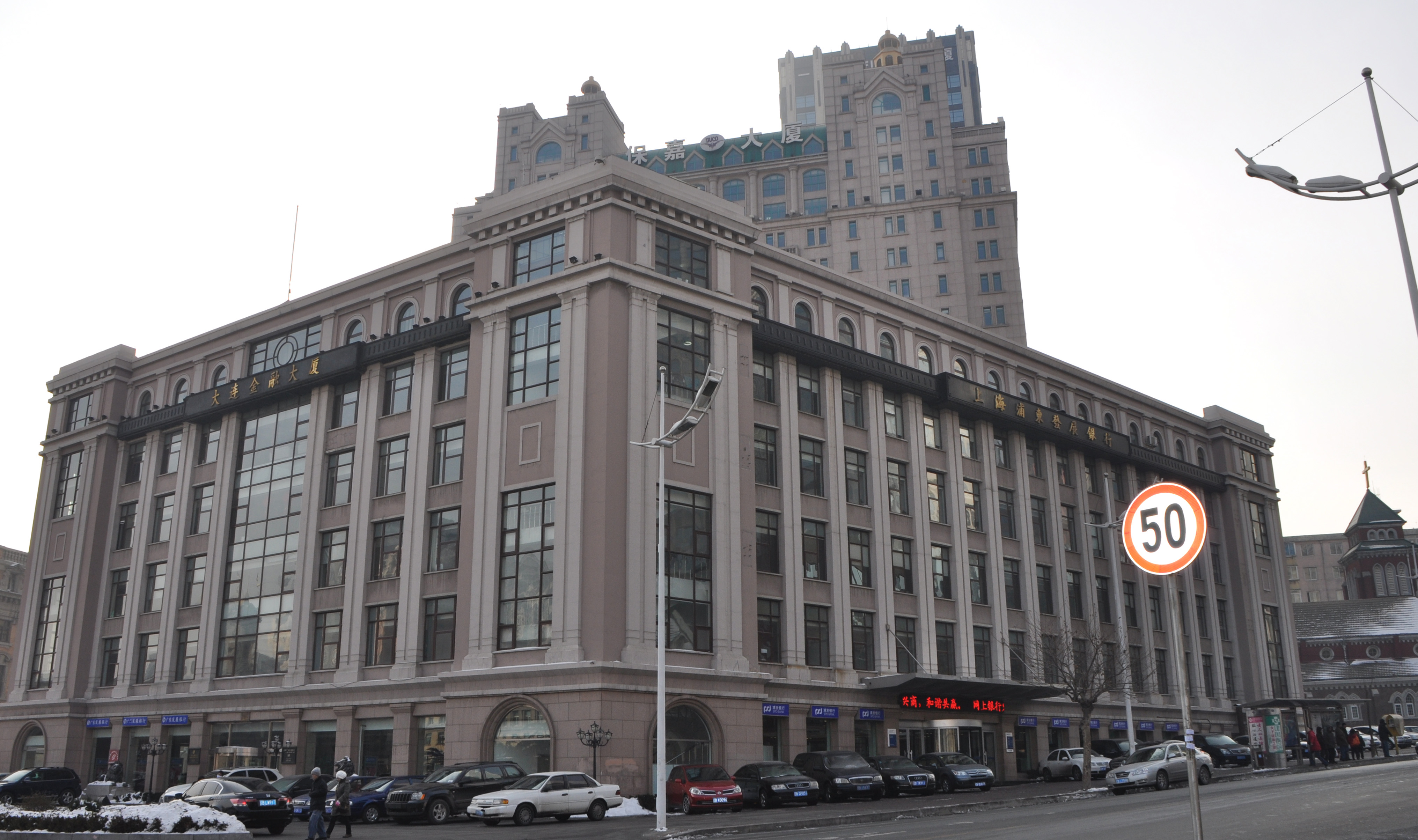
Modern Buildings on Zhongshan Square in Dalian
Walk around Zhongshan Square in Dalian and you will pass ten buildings that have changed their names more often than their facades. The Renaissance-columned structure that was once the Bank of Chosen is now an Industrial and Commercial Bank of China branch. The 1908 police station designed by an architect who later became a professor at what is now Tokyo Institute of Technology houses Citibank. The Yokohama Specie Bank became the Soviet Union's Far East Bank, then Bank of China. Together, these buildings form what has been compared, on a smaller scale, to Shanghai's famous Bund: a ring of colonial-era architecture whose occupants keep changing while the stone stays put.
Nikolai's Circle, Sun Yat-sen's Square
The square itself was built by Russia in 1898 as Nikolayevskaya Square, named for Tsar Nicholas II. When Japan took control after the Russo-Japanese War, it became Ohiroba, simply "the large plaza." After 1945, it was renamed Zhongshan Square in honor of Sun Yat-sen, the first president of the Republic of China. The circular design has endured through every regime change: 213 meters in diameter, with ten roads radiating outward like spokes from a wheel. Zhongshan Road heads west, Renmin Road heads east, and between them, eight smaller streets fan out to connect the square to the surrounding city. The geometry is Russian, the buildings are Japanese, and the current life of the place is entirely Chinese.
A Century of Architecture in Ten Addresses
The oldest building on the square is No. 2, the former Dalian Police Station, completed in 1908 and designed by Shoin Maeda of the Kwantung government. No. 9, now Bank of China, was built in 1909 as the Yokohama Specie Bank, designed by Tsumaki Yorinaka. The former Daqing Bank at No. 7 dates to 1910 in French Renaissance style. The Bank of Chosen at No. 1, with its Corinthian columns, went up in 1920. The Dalian Yamato Hotel at No. 4, owned by the South Manchuria Railway, opened in 1914 with Ionic columns and four stories of Renaissance elegance. The most recent colonial-era addition is the Art Deco Oriental Development Company building at No. 6, completed in 1936. Only two structures break the pattern: the Dalian People's Culture Club at No. 8, built in 1951 by a Soviet team led by a Belarusian engineer, and the postmodern Dalian Financial Building at No. 3, added in 2000.
Protected Layers
In 2001, the Chinese State Government declared the colonial-era buildings on the square Cultural Heritage Sites under national protection. The following year, the Dalian Municipal Government added its own heritage designation. The recognition formalized what residents had long understood: these buildings represent an irreplaceable record of early twentieth-century architecture in China, constructed by Japanese architects who drew on European styles to project imperial prestige. The British Consulate General's building, completed in 1914, did not survive; it was demolished in 1995 to make way for the Financial Building. But nearby, the former Dalian Anglican Church, a red-brick structure built in 1928 through joint effort of the Church of England and the Japanese Anglican Church, still stands on Yuguang Street, serving as Yuguang Street Church.
Banking on History
Today the square functions as the core of Dalian's central business district, with Chinese banks occupying buildings originally designed for their Japanese predecessors. The irony is structural as much as historical: Renaissance columns that once signaled the Bank of Chosen's reach across the Japanese Empire now frame teller windows where transactions happen in yuan. The Yamato Hotel is simply the Dalian Hotel. The Kwantung Bureau of Communications is the post office. Inside the five-lane roundabout, a green zone and paved gathering area draw people who dance on summer evenings or practice foreign languages in corner groups. The 36 audio systems installed in 1995 made this China's first musical square. The architecture speaks in European accents, commissioned by Japanese administrators, on a plaza designed by Russians, in a city that is unmistakably Chinese.
From the Air
Located at 38.92N, 121.64E in the Zhongshan District of central Dalian. The distinctive circular square with ten radiating roads is visible from low altitude as a prominent urban landmark. Nearest major airport is Dalian Zhoushuizi International (ZYTL/DLC), approximately 10 km northwest. Renmin Road leads east toward the Port of Dalian and Zhongshan Road leads west through the city center.