Moffett Field Museum
The model train layout was already there when the museum moved in. Building 126 at Moffett Federal Airfield had served as a U.S. Navy recreation center, and someone had built an elaborate model railway that no one had the heart to dismantle. When the Moffett Field Museum reopened in this building in April 2005, the trains stayed, an accidental exhibit alongside Cobra attack helicopters, F/A-18 Hornet cockpits, and a Lockheed U-2 spy plane. The museum's history is itself a story of persistence against institutional indifference, having been evicted from its original home in the cavernous Hangar One and nearly shut down permanently.
Saving History from a Closing Base
In 1992, the U.S. Navy announced that Naval Air Station Moffett Field would close and transfer to NASA. A group of individuals formed the Hail and Farewell Committee to collect historical artifacts before they were lost. Carol Henderson and Rose Lesslie founded the Moffett Field Historical Society in May 1993. The museum originally opened in 1994 in a 30,000-square-foot portion of Hangar One, the iconic dirigible hangar built in 1933 for the USS Macon. The Navy Reserve sponsored the museum for five years. But when NASA raised the rent in 1999 and required a sprinkler system the museum could not afford, it was forced to close in January 2002.
Aircraft and Artifacts
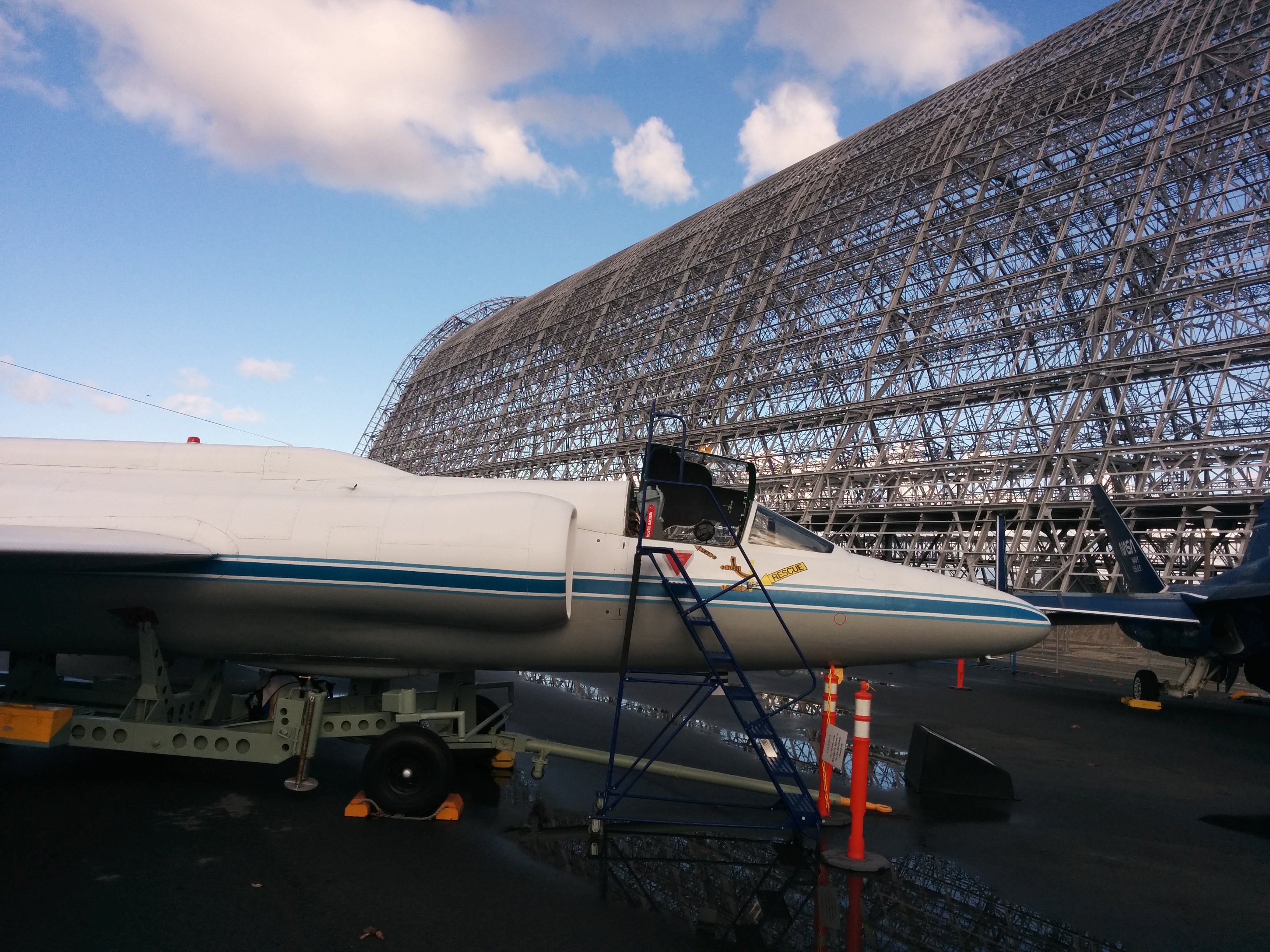
The museum's collection includes a Bell AH-1S Cobra, a Lockheed U-2C spy plane prepared for display starting in 2014, a Lockheed TF-104G Starfighter, a P-3A Orion patrol aircraft, and cockpit sections of a Hawker Siddeley AV-8A Harrier and Vought F-8A Crusader. In April 2018, the museum received an official duplicate of Rear Admiral William A. Moffett's Medal of Honor and sword -- Moffett being the naval aviation pioneer for whom the airfield is named. Other exhibits cover electronic warfare, navigation equipment, aircrew survival gear, and a vintage Link Trainer flight simulator. A collection of ship's silver serving dishes adds an unexpected note of elegance.
STEM in the Shadow of Hangar One
The museum holds bimonthly STEM clinics, bringing science and technology education to young visitors in a setting where real aircraft serve as the teaching aids. The institution operates across the street from Hangar One, one of the most recognizable structures in Silicon Valley -- a structure so large that fog once formed inside it. The museum's modest scale belies its significance: it preserves the military aviation heritage of a region now known entirely for software and semiconductors. That a handful of volunteers could save this history from a base closure, survive an eviction, and maintain a functioning museum for three decades in one of the most expensive real estate markets on Earth is its own kind of heroism.
From the Air
The Moffett Field Museum is at 37.41°N, 122.05°W at Moffett Federal Airfield in Mountain View. The massive Hangar One (1,133 ft long) is directly visible from the air and is one of the most distinctive landmarks on the south Bay. Aircraft on static display are visible outside the museum. Nearby airport: Moffett Federal Airfield (KNUQ) itself.