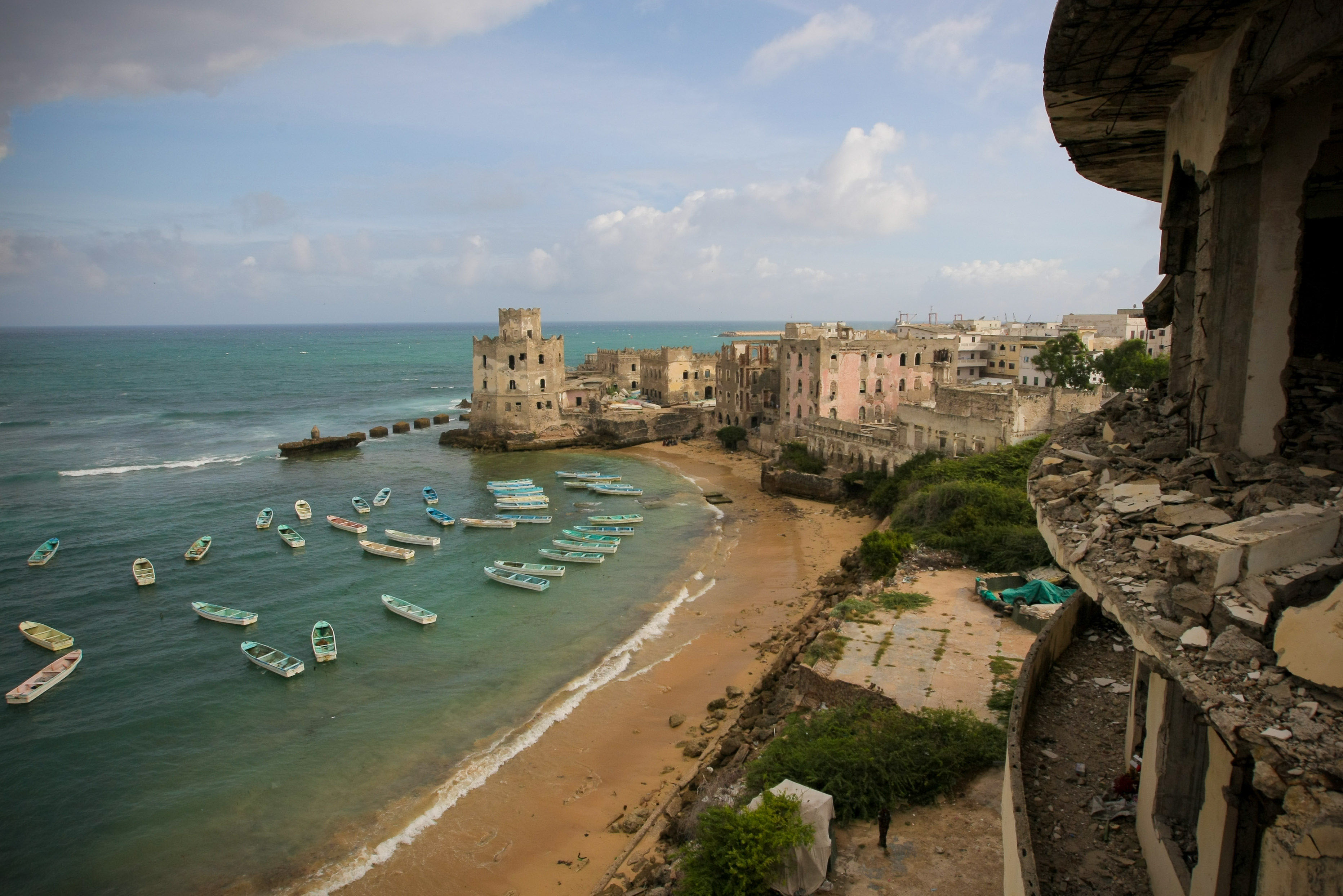
Mogadishu Lighthouse
On May 10, 2023, the seaward-facing wall of the Mogadishu Lighthouse gave way and collapsed into the Indian Ocean. Four displaced people who had been living inside the structure died. The Al-Munaara, as the lighthouse is known locally, had stood on the old harbor since Italian colonial engineers completed it in 1941. It had survived decades of civil war, shelling that destroyed its lantern room, and years of neglect that left it exposed to salt air and monsoon rains. But gravity and time finally accomplished what artillery had not. The partial collapse transformed the lighthouse from a slowly decaying landmark into an urgent conservation crisis, and set in motion international efforts that may yet save what remains.
The Faro del Lido Secondo
Construction began in 1938 as part of a new urban plan for Italian Mogadishu, on the site of a small harbor crane. The Faro del Lido Secondo, as the Italians called it, was completed in 1941 and served as a crucial navigational aid for ships entering one of the Horn of Africa's key commercial ports. The structure was a white, conical stone tower rising from an octagonal base, topped with a lantern room and gallery. Its architectural style blended traditional Somali and Italian influences, characteristic of the colonial-era buildings that once defined Mogadishu's waterfront. For half a century it guided vessels through the harbor approach, its light a fixed point in a city that would prove anything but fixed.
Dark After 1991
The lighthouse went dark in the early 1990s when Somalia's central government collapsed and the civil war engulfed Mogadishu. The battles for control of the port were especially fierce, and the lighthouse, standing prominently on the harbor, was heavily shelled. The lantern and the top section of the tower were destroyed. What remained was the main stone structure, stripped of its original purpose but still recognizable against the coastline. For three decades it stood that way, a hollow column marking the spot where a functioning city used to be. Displaced families moved in, finding shelter in the thick-walled ruin. It became one of the most photographed landmarks in Mogadishu, its broken silhouette appearing in nearly every photographic essay about the city's destruction and tentative recovery.
The Collapse and Its Toll
Years of exposure to ocean weather, combined with the structural damage from shelling, weakened the lighthouse until the May 2023 collapse. The loss of four lives underscored a grim reality across Mogadishu: historic ruins that sheltered displaced people were themselves becoming hazards. The event drew international attention and catalyzed action. The ALIPH Foundation, working with the Heritage Institute for Policy Studies and local Somali authorities, launched an emergency consolidation project to stabilize what remained of the tower, prevent further collapse, and begin documenting the structure for future restoration planning.
Reviving Mogadishu's Culture
In 2024, the lighthouse became the centerpiece of a major UNESCO initiative called Reviving Mogadishu's Culture, funded by the United Arab Emirates. The project involves comprehensive 3D laser scanning of the ruin, detailed structural assessments, and something arguably more important than the building itself: the training of local Somali professionals in advanced conservation techniques. The goal is not just to develop a restoration plan for the Al-Munaara but to create a model for preserving other historic sites across the city. Mogadishu's colonial-era architecture, whatever its complicated origins, represents a layer of the city's identity. The lighthouse, if it can be saved, would stand as proof that heritage can survive even when everything around it has been shattered.
From the Air
Located at 2.032N, 45.345E on the Mogadishu waterfront, at the old harbor. The lighthouse remnant is visible from low altitude as a white stone structure near the water's edge, though its reduced height after the 2023 collapse limits visibility from higher altitudes. Aden Abdulle International Airport (HCMM) is approximately 6 km southwest. The coastline and harbor breakwater provide good visual references when approaching from the sea.