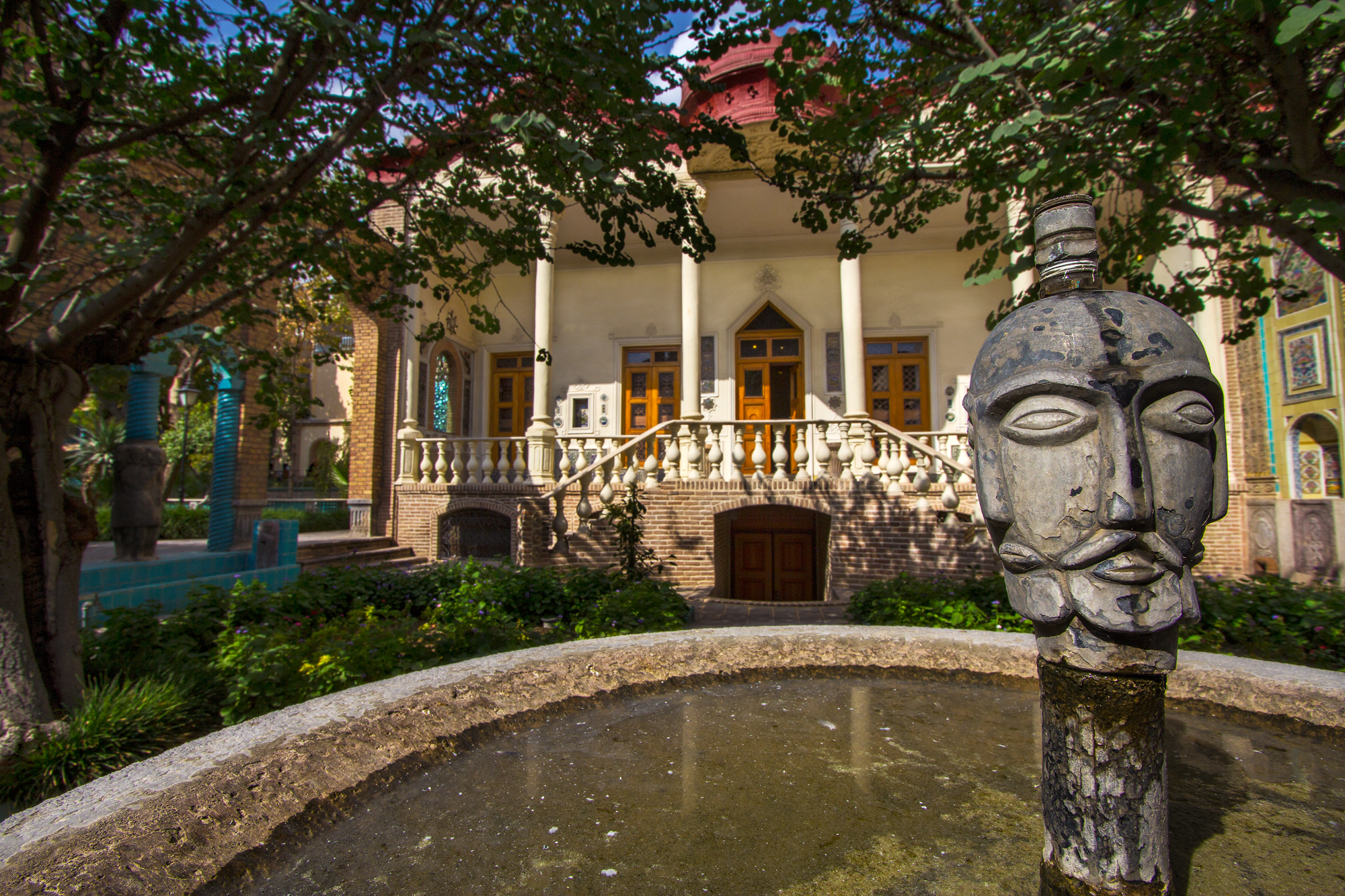
Moghadam House and Museum
Most museums keep their collections behind glass. At the Moghadam House in Tehran, centuries of Persian tiles are mortared directly into basement walls, fragments of ancient pottery line stairwells, and carved stone pieces sit where an archaeologist placed them decades ago -- not as exhibits, but as decoration for the home where he ate breakfast, hosted guests, and argued about antiquities with his Bulgarian-born wife. The result is something no conventional museum could replicate: a place where Iran's artistic heritage feels less like a curated display and more like something you stumbled into by accident, as if the past simply refused to leave.
A Courtier's Grand Residence
The house was built during the late Qajar dynasty for Mohammad Taghi Khan Ehtesab al-Molk, a prominent figure in the Persian court who served as the head of Tehran's municipal administration and later as Iran's diplomatic minister to Switzerland. His ambitions were reflected in the scale of the residence: 2,117 square meters divided into three distinct courtyards -- the outer courtyard for receiving guests, the inner courtyard for family life, and a third for the estate's caretakers. The architecture followed the classic patterns of wealthy Qajar homes, with its careful separation of public and private space, its gardens and reflecting pools, its rooms oriented to catch light and breeze. It was a house built to impress, and it did.
The Archaeologist's Obsession
The house might have faded into the anonymous roster of old Tehran mansions had it not passed to Ehtesab al-Molk's son, Mohsen Moghadam. A professor of archaeology at the University of Tehran, Moghadam turned his inherited home into something between a private museum and a personal statement about Iran's cultural continuity. Together with his wife, Selma Kouyoumjian -- born in Bulgaria, trained as a librarian, and eventually appointed director of the library at the National Museum of Iran -- he spent decades collecting. Tiles, pottery, glasswork, paintings, mosaics, coins, historical documents, fabrics, hookahs, and carved stone all accumulated within the house. But Moghadam did not simply store these objects. He installed them into the architecture itself, embedding tiles and stone fragments into walls and surfaces so that the house became inseparable from its contents.
Walls That Tell Millennia
The basement level, known as the Hozkhaneh, offers the most striking example of Moghadam's approach. Built during the original Mozaffari period construction, its walls are decorated with tiles and terracotta fragments spanning from the 4th to the 13th centuries of the Islamic calendar -- roughly the 10th through 19th centuries CE. Walking through this single room traces the entire evolution of Iran's pottery and tile-making traditions. Glazed ceramics from the Seljuk period sit near Safavid-era tilework. Each piece was chosen and placed with intent, creating a visual timeline that conventional museums achieve only through careful labeling and white walls. Here, the context is the house itself. The fragments are not specimens. They are part of a home.
From Private Collection to Public Trust
In 1972, Mohsen Moghadam donated the house and its entire contents to the University of Tehran. The gesture preserved not just the objects but the idiosyncratic way they had been displayed -- a curatorial vision that no institution would have invented on its own. The house was registered as a national heritage site of Iran in 2000, formally recognizing what visitors had understood for years: that the Moghadam House represents something distinct in Tehran's cultural landscape. It is not a palace repurposed as a museum, nor a modern gallery filled with acquisitions. It is the physical record of two lives devoted to the idea that Iran's artistic past should not be locked away in storage rooms or scattered among foreign collections, but lived with, surrounded by, and passed on.
From the Air
Located at 35.687N, 51.405E in central Tehran, near the University of Tehran campus. The house sits within the dense urban grid of central Tehran and is not individually distinguishable from altitude, but the university grounds and adjacent parks provide orientation. Mehrabad International Airport (OIII) is approximately 8 km to the west. The Alborz Mountains provide a dramatic northern horizon line when approaching the city.