Moghalmari
The locals called the mound Sakhisener dhibi. For generations, villagers in Moghalmari walked past it without knowing what lay beneath their feet -- bricks from a Buddhist monastery complex that had been sleeping under the soil of West Bengal's Paschim Medinipur district for more than a thousand years. When Professor Asok Datta of Calcutta University's Department of Archaeology began excavating in 2003, the first artifacts confirmed what the Chinese pilgrims Fa Hien and Hiuen Tsang had recorded in their travel memoirs centuries ago: this stretch of Bengal, far from the well-known Buddhist centers of Bihar, had harbored its own thriving monastic culture. What Datta and his team found would rewrite the region's spiritual history.
The Mound Speaks
Two sites were selected for the first excavation phase in 2003-04. The primary site, designated MGM1, was the structural mound with bricks scattered across its surface. A second site, MGM2, sat beneath present-day habitation and revealed five circular brick bases -- the foundations of stupas -- along with pottery fragments. At MGM1, archaeologists uncovered a triratha projection in the western section: a wall running north-south that formed part of a small monastic complex. Square and rectangular structures emerged from the earth, their proportions consistent with monks' cells. The artifacts dated to the 6th and 7th centuries. Digging deeper, the team passed through 55 centimeters of silt deposition and discovered a layer of Black and Red Wares, pushing the site's history further back in time than anyone had anticipated.
Figures in the Walls
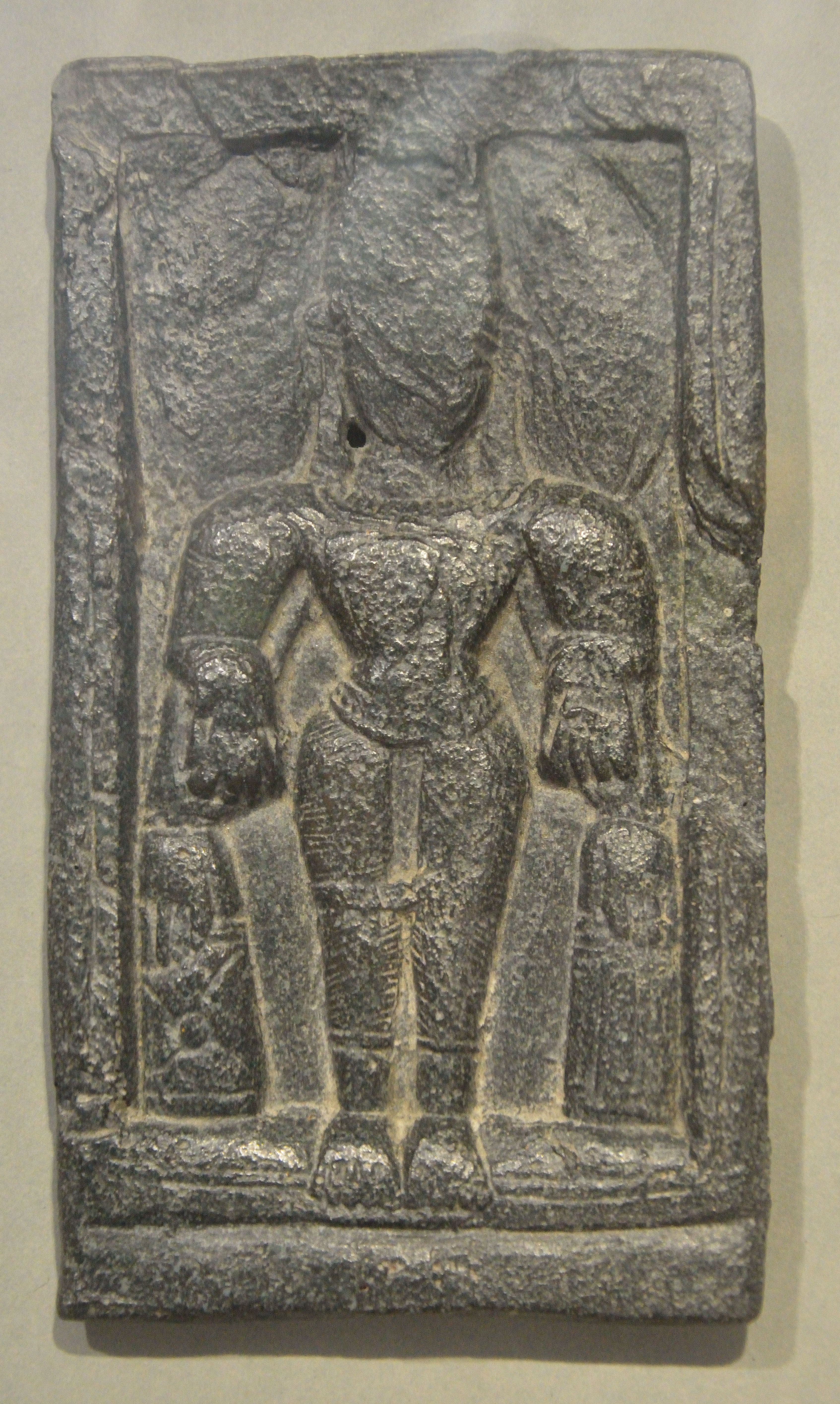
When excavations resumed at MGM1 and a new site called MGM3 in 2006-07, the monastery began revealing its artistic wealth. A long wall surfaced, its face covered in stucco decorations depicting flowers, animals, and human figures. The craftsmanship suggested two distinct stages of construction, as if later builders had expanded and embellished what their predecessors had begun. Among the most significant discoveries was a Buddha image carved on a slate stone -- evidence that the monastery had served not merely as a residence for monks but as a center of active devotion. By 2012, further excavation exposed votive tablets bearing the figure of Buddha as their central element, flanked by Bodhisattvas and inscribed with Buddhist texts. A pradakshina path -- the circumambulatory walkway that devotees used for ritual walking meditation -- emerged along the eastern and southern perimeters.
Where Vajrayana Took Root
The excavation's most consequential finding came from the architecture itself. A central temple structure surrounded by cells arranged around a square courtyard pointed to a specific phase in Buddhist history. Rajat Sanyal, a member of the excavating team, identified the layout as characteristic of Vajrayana Buddhism, the tradition in which deity worship became central to practice. Figures of Jambala, the Buddhist deity of wealth, and Saraswati, the goddess of learning, adorned the monastery walls -- deities whose presence marked a departure from earlier Buddhist traditions that emphasized meditation over iconography. The artistic style bore the unmistakable influence of the Gupta tradition from the middle Ganga region, suggesting that Moghalmari was connected to a wider network of cultural exchange stretching across the Indo-Gangetic plain.
The Missing Link
Hiuen Tsang traveled through Bengal in the 7th century and recorded the existence of Buddhist viharas in this region. For decades, scholars treated his accounts as descriptions of sites that had vanished without a trace. Moghalmari has changed that understanding. The monastery's timeline -- spanning from the 6th to the 12th century -- aligns precisely with the period when Buddhism flourished across Bengal before its gradual decline. The site also fills a geographic gap, demonstrating that Buddhist monastic life extended well into the western reaches of Bengal, far from the famous centers at Nalanda and Vikramashila in Bihar. Today the excavation site sits in open farmland near Dantan in the Kharagpur subdivision, its exposed brick walls and stupa bases quietly contradicting centuries of historical silence about Bengali Buddhism's western frontier.
From the Air
Located at 21.99N, 87.30E in the Dantan I CD block, Kharagpur subdivision, Paschim Medinipur district, West Bengal. The archaeological site appears as exposed brick foundations in flat agricultural terrain. Nearest airport is Kalaikunda Air Force Station (VEDX), approximately 30 km to the north. Kolkata's VECC is about 150 km northeast. At 2,000-3,000 feet AGL, look for the excavation site near Moghalmari village, identifiable by cleared mounds amid surrounding green farmland along the road between Dantan and Kharagpur.