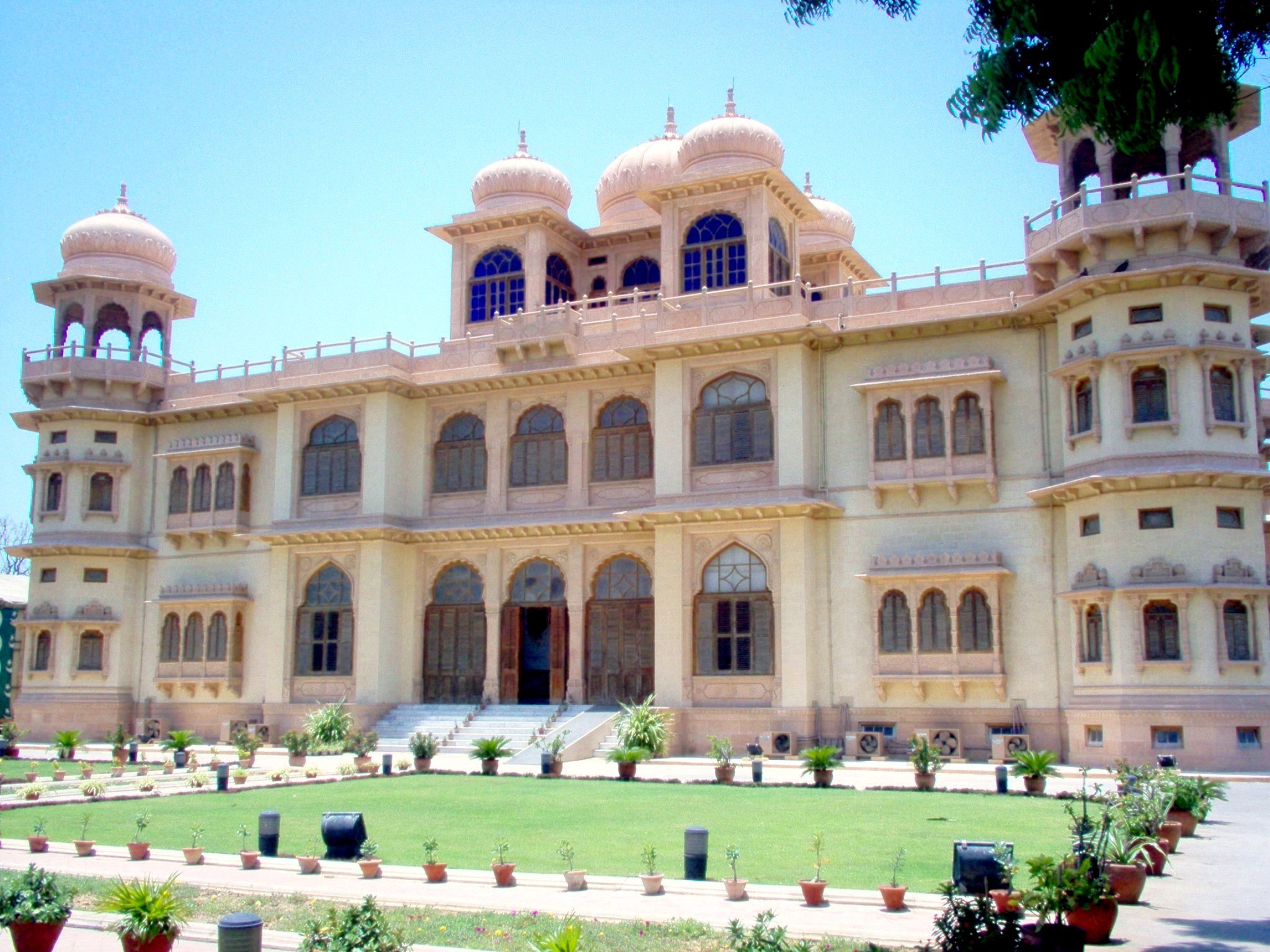
Mohatta Palace
Shivratan Mohatta made his fortune manufacturing palm olive soap in Karachi. In 1927, he used that fortune to build a summer palace in the seaside neighborhood of Clifton, importing pink stone from Jodhpur and combining it with local yellow stone from nearby Gizri. He enjoyed the palace for about twenty years. Then came Partition. Mohatta left for India in 1947, and his palace became government property. The soap tycoon's summer home now serves as one of Pakistan's finest museums.
From Bikaner to Karachi
The Mohatta family's recorded history begins with Motilal Mohata, who migrated from Bikaner, Rajasthan, to Hyderabad in 1842 to work as a shop clerk. His children moved to Calcutta and became leading cloth merchants. One son, Govardhan Mohta, relocated to Karachi in 1883. His older son Ramgopal became a scholar, and Karachi's Hindu Gymkhana was officially named after him. The younger son, Shivratan, became the industrialist who would commission the palace. Architect Ahmed Hussain Agha designed it in the tradition of Rajasthani stone palaces, a building that transplanted the aesthetics of India's desert kingdom to the coast of the Arabian Sea.
Nine Domes and a Temple to Shiva
The palace rises on three levels, from a basement with a hot-water pool chamber to a rooftop crowned by nine domes, the central one surrounded by four smaller companions. Each corner features an octagonal tower topped with chattris. The building is made entirely of teak wood inside, with polished staircases, long corridors, and the distinctive feature of doors opening within doors. Blue windows face the front gardens while arched stained-glass windows illuminate the rear. On the terrace, a family temple was dedicated to the Hindu god Shiva. Peacock motifs appear in the stonework around every dome. Marigold and hibiscus flowers are carved between windows. The palace sat in an elegant neighborhood characterized by Indo-Saracenic architecture, not far from the sea.
Exiled Statues of the Raj
After Mohatta's departure, the Government of Pakistan acquired the palace to house the Ministry of Foreign Affairs. A trust was eventually established to manage the property, and the Mohatta Palace Museum formally opened in 1999. Next to the main building stands a small collection of statues that once occupied prominent public locations across Karachi: figures of Queen Victoria, soldiers of the Raj, and other colonial-era monuments. During political turmoil in 1960 and 1961, public fury led to these statues being damaged and removed from their original sites. They found refuge in the grounds of a palace built by a man who had himself been displaced by political upheaval.
A Living Gallery
The museum has hosted exhibitions spanning Pakistan's cultural breadth since its opening. Treasures of the Talpurs, the arts of Gandhara, the ceramic tradition of Pakistan, and retrospectives of artists like Sadequain and Jamil Naqsh have filled the stately rooms that Mohatta designed for entertainment. The 2010 exhibition "The Birth of Pakistan," hosted by the Citizens Archive of Pakistan, turned the palace into a space for national memory. Rare maps and prints, Kashmir miniatures, and the stone monuments of Makli have all been displayed beneath the nine domes. The palace that a Hindu businessman built as a retreat from the Karachi heat now serves as a repository for the art and artifacts of the nation that formed around it.
From the Air
Located at 24.86N, 67.01E in the Clifton neighborhood of Karachi, near the Arabian Sea coast. The palace's nine domes and octagonal towers give it a distinctive silhouette. Jinnah International Airport (OPKC) is approximately 14 km to the east. The coastline is visible nearby, and the building sits amid the upscale residential area of Clifton.