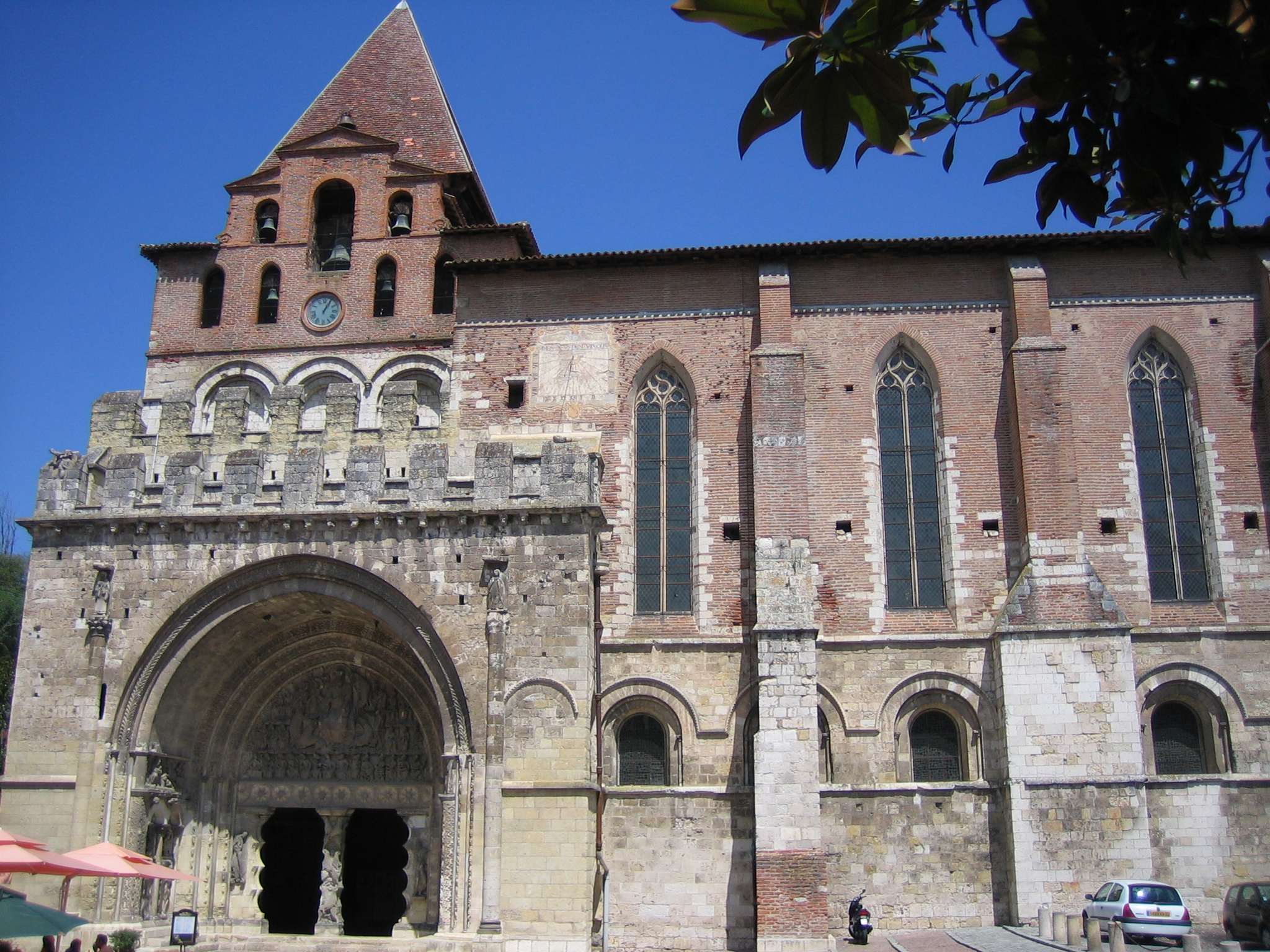
Moissac Abbey
The legend says Clovis threw a javelin from the top of a hill to mark where the abbey should stand, and the javelin landed in a swamp. That should have been an omen. Moissac Abbey, in the Tarn-et-Garonne of southwestern France, has spent nearly fourteen centuries being sacked, burned, collapsed, secularized, looted, and nearly demolished for a railway cutting — and yet it survives, its south portal still bearing one of the supreme masterpieces of Romanesque sculpture. If architecture is frozen music, Moissac is a song that has been interrupted by catastrophe a dozen times and never stopped playing.
Born in Swampland, Forged by Fire
Historical records indicate the abbey was founded by Saint Didier, Bishop of Cahors, in the mid-7th century, though the more colorful legend attributes it to the Frankish king Clovis, who supposedly vowed to build a monastery for a thousand monks after defeating the Visigoths in 506. From the beginning, the abbey existed at the intersection of hostile forces. Moors from al-Andalus sacked it twice around 732. Norman pirates looted it in the 9th century. Hungarians raided it in the 10th. The abbey was rebuilt each time, but by the 11th century, years of neglect had taken a toll that violence had not. In 1030, the roof simply collapsed. A fire followed in 1042. The abbey was dying not from enemies but from indifference.
The Cluniac Renaissance
Salvation came in the form of reform. In 1047, Durand de Bredons, Bishop of Toulouse, brought in the Abbot of Cluny, Odilon de Mercœur, to impose the Cluniac reforms on Moissac's lax monks. The transformation was swift. A new church was built in 1063. When Pope Urban II visited in 1097, he consecrated the high altar, issued a Papal Bull restoring forty churches to the abbey's control, and ordered the construction of the cloister, which was completed by 1100. Under the reforming guidance of Durand de Bredons — who served simultaneously as abbot of Moissac and bishop of Toulouse — the abbey became one of the most powerful in France. Its location on the pilgrimage road to Santiago de Compostela brought a steady flow of travelers, wealth, and influence. By the 12th century, the abbot of Moissac ranked second in the entire Cluniac hierarchy, behind only the abbot of Cluny itself.
The Tympanum That Changed Everything
The abbey's greatest achievement is visible before you even step inside. The south-west portal, built under Abbots Dom Hunaud de Gavarret and Dom Ansquitil in the early 12th century, is one of the masterworks of Romanesque art. The tympanum above the doorway depicts the Apocalypse from the Book of Revelation — Christ in Majesty surrounded by the four evangelists and the twenty-four elders — carved with a precision and expressiveness that expanded what medieval sculpture was thought capable of. Below the tympanum, a trumeau bears a figure of the prophet Isaiah, his body twisted into an elongated spiral that art historians compare to the finest work at the Abbey of Santo Domingo de Silos in Spain. The portal marked a turning point: for the first time, monumental sculpture was being used not just inside sanctuaries but on the public exterior, turning the entrance itself into a theological statement that pilgrims encountered before crossing the threshold.
Revolution, Rails, and Rescue
A second golden age under abbots Pierre and Antoine de Caraman in the 15th century added Gothic elements to the church, but the abbey's long decline was already underway. In 1626, secularization drove out the Benedictine monks after nearly a millennium. They were replaced by Augustinian canons under commendatory abbots, including the powerful cardinals Mazarin and de Brienne. The French Revolution ended monastic life entirely in 1793. The outlying buildings suffered, and the abbey's treasures were scattered. Then came the most unlikely threat of all: in the mid-19th century, plans for a new railway line called for tracks to be cut directly through the cloister. The cloister was saved — barely — though the refectory was demolished to make way for the railway cutting. The near miss catalyzed the abbey's listing as a historic monument.
Stone on the Pilgrim's Road
Since 1998, the church and cloisters of Moissac Abbey have been internationally protected as part of a UNESCO World Heritage Site: the Routes of Santiago de Compostela in France. The abbey church of Saint Pierre remains an active place of worship, its Romanesque and Gothic elements in conversation across eight centuries of construction. The cloister, though much reduced from its original double-level form, still features carved capitals whose Romanesque imagery survived looting, revolution, and industrial progress. Pilgrims still pass through Moissac on their way to Spain, as they have since the 11th century. For them, the south portal is not a museum piece but a threshold — the same threshold that greeted travelers a thousand years ago, when this abbey at the edge of a swamp had become one of the most powerful religious houses in France.
From the Air
Located at 44.11°N, 1.08°E in the Tarn-et-Garonne department of southwestern France, along the Tarn River near its confluence with the Garonne. The abbey and town are visible in the river valley. Best viewed at 2,000-4,000 ft AGL. Nearest airports: LFBO (Toulouse-Blagnac) about 70 km southeast, LFBG (Agen-La Garenne) about 35 km northwest.