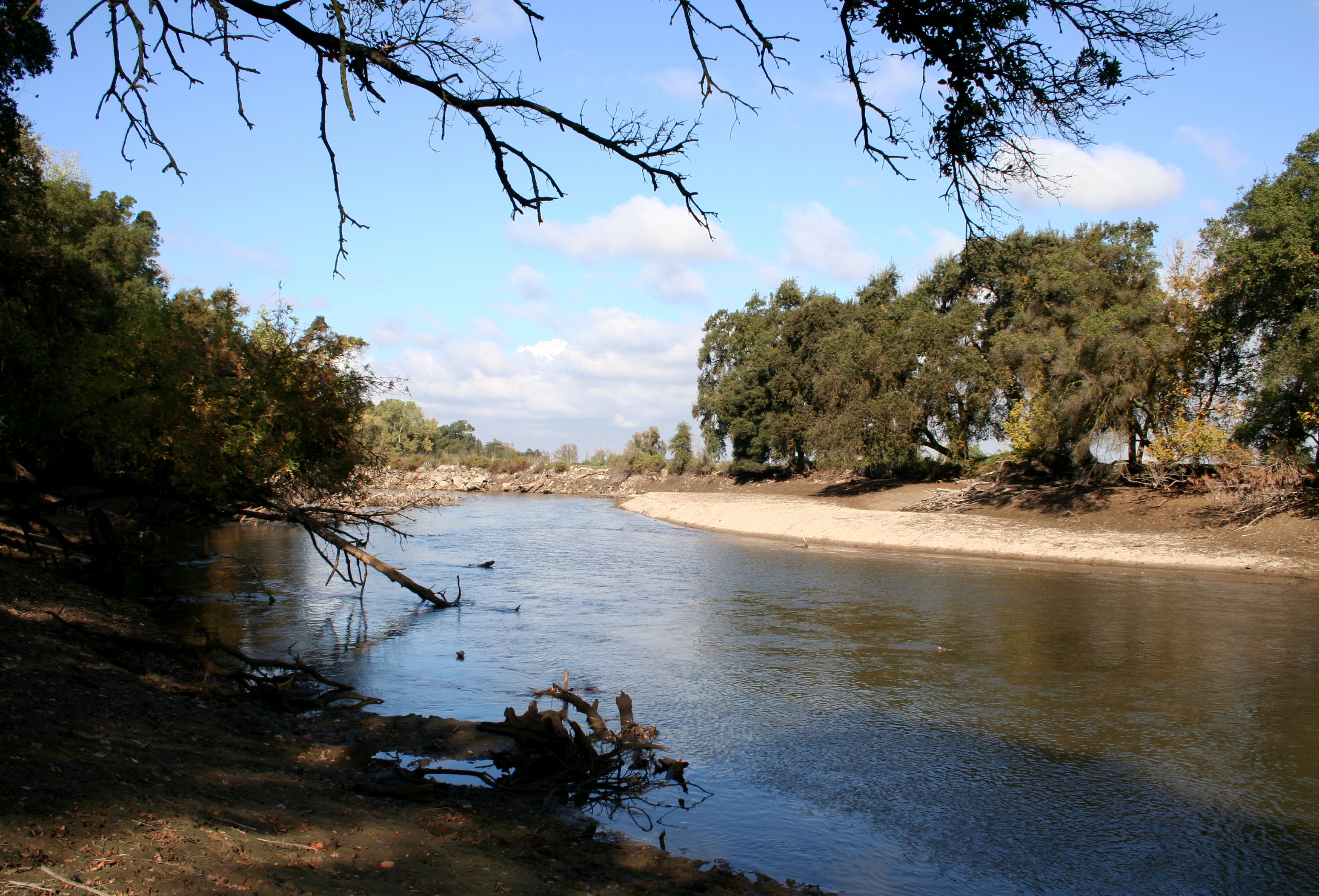
Mokelumne River: People of the Fish Net
The name tells you everything: Mokelumne, from the Plains Miwok moke-umne, meaning "people of the fish net." Long before dam engineers and gold miners reshaped its course, this river defined the people who lived along it. They were net-makers and net-casters, their identity woven into the water itself. Today the Mokelumne flows 95 miles from rugged Sierra granite to the tidal maze of the Sacramento-San Joaquin Delta, passing through wilderness, reservoirs, vineyards, and some of the most contested water politics in the American West. It is a river that has been dammed, diverted, mined, litigated, and loved -- sometimes all at once.
From Granite to Tide
The Mokelumne begins at Lower Highland Lake, 8,584 feet up in the central Sierra Nevada. Its North Fork -- the longest of three -- tumbles west through the Stanislaus National Forest, passing Salt Springs Reservoir before merging with the Middle Fork southeast of Pine Grove. The South Fork starts near the head of the Middle Fork at 6,380 feet, and all three branches converge above the foothills. Below Pardee and Camanche Dams, the river slows and broadens, receiving Dry Creek and then its major tributary, the Cosumnes River, before entering the Delta. There, tidal influence takes over. The Mokelumne splits around the 9,100-acre Staten Island before rejoining and emptying into the San Joaquin River. Together with the Cosumnes, it drains 2,143 square miles across five California counties -- a watershed that ranges from alpine meadows to sea-level marshland.
Gold, Greed, and Boomtowns
Charles Weber likely found gold in the Mokelumne in 1848, but he didn't linger. He moved on to the Coloma diggings and then established a supply center at what became Stockton, shrewdly positioning himself to profit from the miners who stayed. Samuel W. Pearsall had more patience. He struck gold at Mokelumne Hill that same year, and by 1850 the settlement had swelled to 15,000 people -- a frenzied camp where French, Chilean, Chinese, and American miners worked claims along the river's gravel bars. The Gold Rush left scars. Miners dammed and diverted the river, washed hillsides into its channels, and stripped the surrounding forests. But it also left behind the romantic foothill towns -- Jackson, West Point, Mokelumne Hill -- that still line the upper river corridor, their names echoing an era when fortunes and lives could change in a single afternoon.
Taming the River, Feeding the Cities
The modern Mokelumne is an engineered river. In 1929, the East Bay Municipal Utility District completed Pardee Dam, creating a reservoir that stores roughly a quarter of the river's annual flow. From Pardee, the 95-mile Mokelumne Aqueduct carries water to 35 municipalities in Alameda and Contra Costa Counties -- the lifeblood of the eastern San Francisco Bay Area. The first deliveries flowed on June 23, 1929. Camanche Dam followed in 1963, adding flood control capacity of 431,000 acre-feet directly below Pardee. The dams stabilized the lower river for agriculture, transforming the valley into what it is today: grape country. Vineyards now cover 51 percent of the basin's farmland, anchoring the Mokelumne River American Viticultural Area, one of California's recognized wine appellations. But stabilization came at a cost. Camanche Dam blocked salmon from miles of prime spawning habitat, forcing construction of the Mokelumne River Fish Hatchery in 1964 to compensate for the lost runs.
Wild Water, White Water
Above the dams, the Mokelumne reveals its wilder face. Five whitewater kayaking runs descend through the upper canyon, ranging from the Class II-III Electra-Middle Bar stretch to the ferocious Class V+ Fantasy Falls, a 26-mile wilderness run below Highway 4 that ends in the backwaters of Salt Springs Reservoir. The 105,165-acre Mokelumne Wilderness protects much of the upper watershed, offering backcountry that demands real skill to navigate. Along Electra Road east of Highway 49, the granite-lined river draws runners, swimmers, and gold panners to its pools. And in May 2021, the Mokelumne made headlines for a different kind of discovery: a trove of fossils unearthed near Valley Springs, including a two-tusked mastodon, a four-tusked gomphothere, rhinoceros, camel, and horse -- remnants of a landscape five to ten million years gone.
The Fight for Wild and Scenic
The Mokelumne's future has been as contested as its past. When EBMUD proposed expanding Pardee Reservoir in its 2040 water plan, the proposal would have drowned more than a mile of river and irreplaceable cultural sites. A coalition of conservationists, local governments, and fishing advocates sued, and in April 2011 a Sacramento court voided the plan. EBMUD's board voted 7-0 to drop the expansion entirely in 2012. Meanwhile, advocates pushed to designate 37 miles of the river -- from Salt Springs to Pardee -- as Wild and Scenic under both state and federal systems. The effort produced compromise legislation in 2015 that mandated a suitability study and granted interim protections. California's Natural Resources Agency released its study in January 2018, finding the Mokelumne eligible for designation. The river that once meant "people of the fish net" may yet earn permanent protection -- a recognition that some waters are worth more unshackled than stored.
From the Air
Located at approximately 38.23°N, 121.50°W where the Mokelumne enters the Delta lowlands. The river is visible from altitude as a winding course through the Central Valley, with Pardee and Camanche Reservoirs prominent features in the Sierra foothills to the east. Staten Island, encircled by the North and South Mokelumne distributaries, is a distinctive Delta landmark. Nearby airports include Stockton Metropolitan Airport (KSCK) to the south and Sacramento Executive Airport (KSAC) to the north. The upper canyon section near Highway 49 shows dramatic granite terrain. Best viewed at 3,000-5,000 feet AGL for the Delta section; the upper river requires lower passes through the foothills.