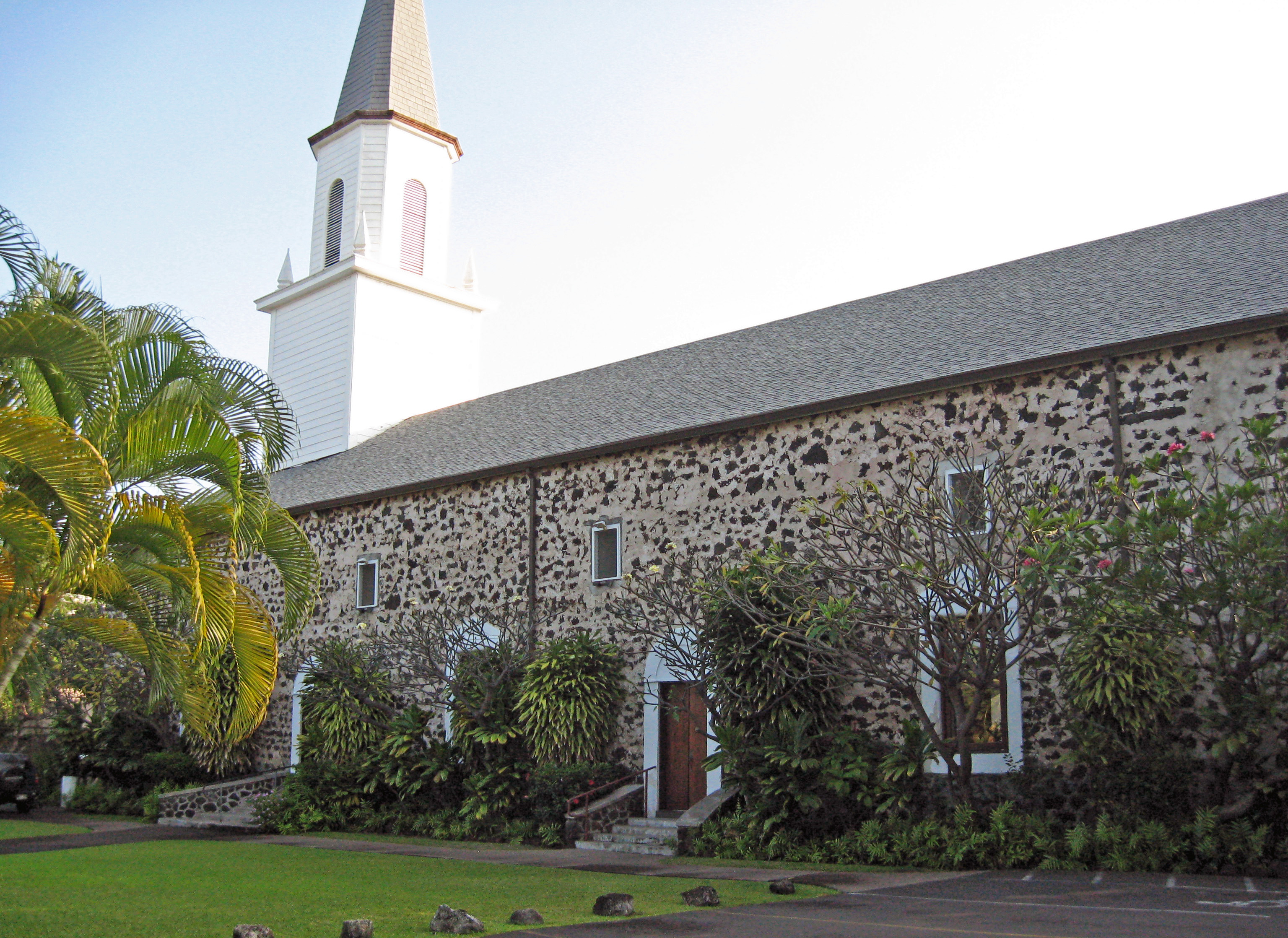
Mokuʻaikaua Church
The stones have lived two lives. Some of them once formed a heiau -- an ancient Hawaiian temple -- before being pulled apart and reassembled into the walls of Mokuaikaua Church, the oldest Christian church in the Hawaiian Islands. That recycling of sacred material, temple stone reborn as church wall, is almost too neat a metaphor for what happened in Kailua-Kona in the 1820s and 1830s: an entire spiritual world dismantled and rebuilt into something unrecognizable.
The Brig Thaddeus
The congregation began in 1820, when Asa and Lucy Goodale Thurston arrived on the brig Thaddeus as part of the first company of American Christian missionaries to Hawaii. King Kamehameha II and the Queen Regent Kaahumanu granted them permission to teach Christianity -- a decision made easier by the fact that the kapu system had been abolished the previous year, leaving the islands in a religious transition unlike anything in their history. The Thurstons briefly followed the royal court to Honolulu, but by October 1823 they learned that the people of Kailua-Kona had taken matters into their own hands, erecting a small wooden church on their own initiative. The missionaries returned to find a community ready -- or at least willing -- to listen.
From Ohia Wood to Lava Stone
The first structure on the site was modest: ohia wood framing with a thatched roof, built on land provided by Royal Governor Kuakini directly across the street from his Hulihee Palace. The church's name, moku aikaua, translates to "district acquired by war" in Hawaiian, likely a reference to the upland forest where the building timber was harvested. Fire proved a persistent enemy. After several structures burned, construction began around 1835 on the stone building that stands today. The builders used lava rock, supplemented by stones salvaged from a nearby heiau. The interior was finished with warm koa wood, a native hardwood that gave the sanctuary a distinctly Hawaiian character even as its purpose was decidedly imported. The church was completed in 1837.
A Steeple Above the Palms
The church's steeple has been a Kailua-Kona landmark since at least the 1880s, rising above the palm trees along the waterfront in photographs dating back to 1883. Its position across from Hulihee Palace creates an extraordinary historic block: royal power on one side of Alii Drive, spiritual authority on the other, with the Pacific Ocean as backdrop to both. Among the notable figures in that first missionary company was Hiram Bingham I, who would go on to shape the development of written Hawaiian and translate portions of the Bible into the Hawaiian language. A scale model of the Thaddeus is displayed inside the church today.
Still Ringing
Mokuaikaua Church remains an active congregation, its doors open to both worshippers and visitors. The state of Hawaii listed it as a historic site in January 1978, and it was added to the National Register of Historic Places on October 3, 1978. What makes the building remarkable is not just its age but its continuity: it has served the same purpose, in the same location, for over two centuries. The heiau stones in its walls carry no plaques or markers identifying their origin. They simply hold up the roof, as stones do, indifferent to the prayers that have passed over them -- first in Hawaiian, directed skyward to gods older than memory, and then in English, directed to a God who arrived by ship.
From the Air
Mokuaikaua Church is located at 19.640N, 155.994W in Kailua-Kona on the Big Island's west coast, directly across Alii Drive from Hulihee Palace. The church steeple is a recognizable vertical landmark along the waterfront. Best viewed from 1,500-3,000 feet AGL. Nearest airport: Kona International (PHKO) approximately 7 nm north. The Kailua pier and bay shoreline provide strong visual orientation.