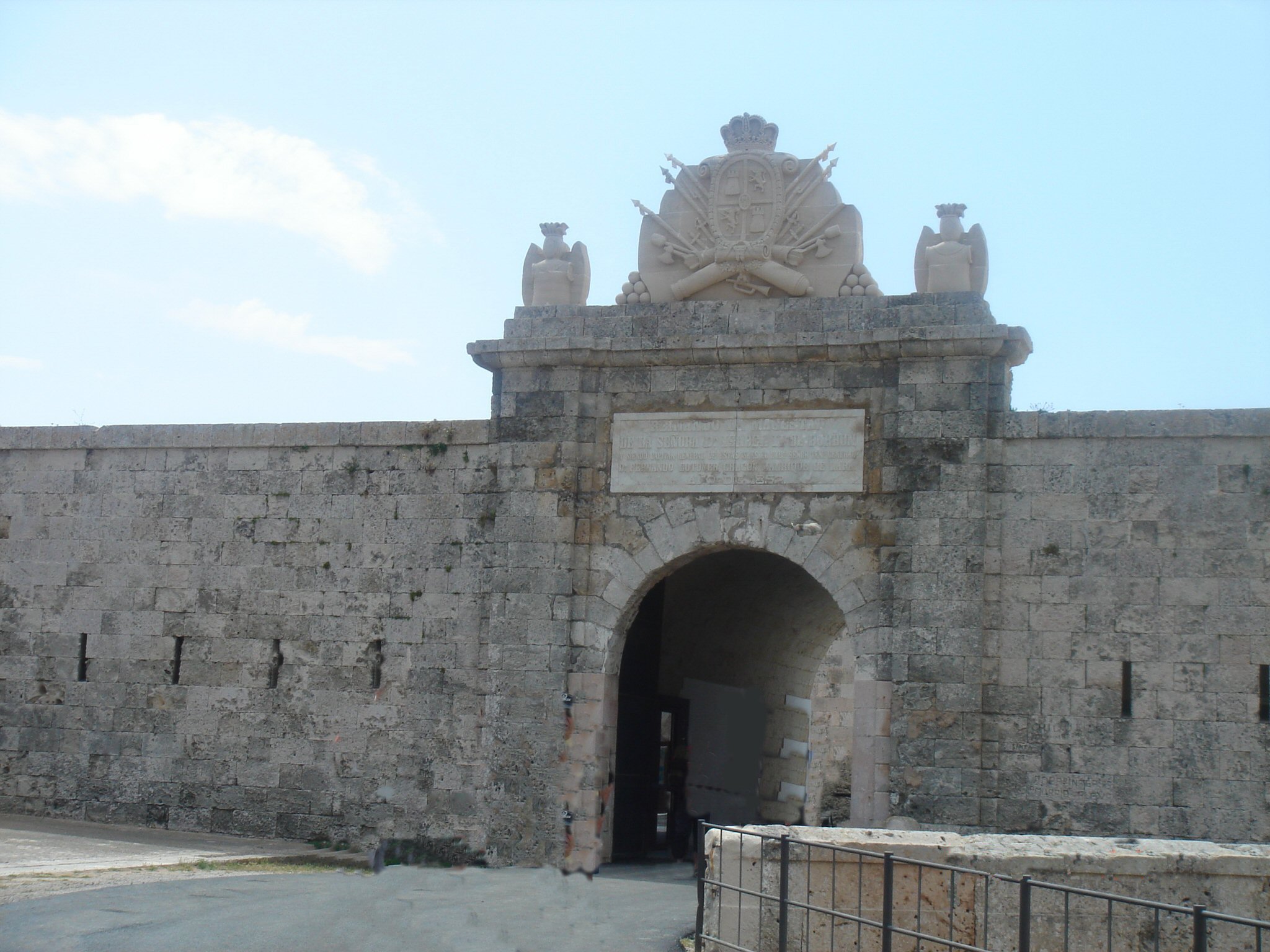
Mola Fortress
"July, August, and the port of Mahon are the best ports in the Mediterranean." The Genoese admiral Andrea Doria supposedly said it in the 16th century, and every power that controlled Menorca since has acted as though it were gospel. Standing on the Mola peninsula at the harbor's eastern mouth, the fortress named for Queen Isabella II is the last and largest attempt to fortify these waters -- a colossal military complex that took twenty-five years to build and was obsolete before the final stone was laid.
The Harbor Worth Fighting Over
Mahon's harbor is a natural wonder of military geography: deep, wide, and sheltered from the prevailing winds of the western Mediterranean. Since the 16th century, it has been contested by every major naval power in the region. Spain used it as a waypoint to its Italian possessions. The British seized the island in 1708 during the War of the Spanish Succession and made it the base for their Mediterranean fleet, expanding the existing Saint Philip's Castle with a double enclosure and adding Fort Marlborough. During their third occupation in 1799, they built two defense towers on the Mola peninsula itself -- Saint Clair and Erskine -- anticipating the strategic value that a later generation would exploit on a far grander scale.
Born from Paranoia
The fortress that stands today owes its existence to 19th-century geopolitics. When France occupied Algeria in the 1830s, the route from Toulon to Algiers suddenly ran past Menorca. Meanwhile, the British Mediterranean route from Gibraltar to Malta also passed nearby. Spain found itself sitting on a strategically critical island with no meaningful defenses -- the old Saint Philip's Castle had been demolished. Fearing that Britain might seize Menorca to prevent another power from controlling it, Spain began construction of a new fortress on the Mola peninsula in 1850. The design was ambitious: the fortress would defend the port, serve as an operational base for all army forces on the island, and function as a last-resort stronghold.
Obsolete at Birth
The fortress was inaugurated in 1852, still incomplete. Queen Isabella II visited the works in 1860, lending her name and her presence to the project. But by the time construction finished in 1875, artillery technology had evolved so dramatically that the fortress's original guns and walls were already inadequate. Rifled cannons, ironclad warships, and explosive shells had transformed naval warfare. In 1896, modern coastal batteries with a range of roughly 40 kilometers were installed around the peninsula, a tacit admission that the fortress's own defenses needed supplementing barely two decades after completion. The Princess Tower, one of the British-built towers from 1799, still stands within the fortified area -- an older generation's defense absorbed into a newer one that was itself already aging.
From Garrison to Nature Reserve
The fortress served various military purposes into the 20th century, but its strategic significance faded as warfare outgrew fixed coastal defenses. In 2007, the Spanish government signed an agreement transferring the old Punta Afuera defense installation for up to 75 years, with plans to convert it into a center for scientific research. The transformation from military bastion to research station reflects the peninsula's other identity: the area around La Mola possesses distinctive geological features that support endemic plant species and serve as nesting grounds for endangered seabirds. It is designated both as a Natural Area of Special Interest and a Special Protection Area for Birds. Next to the fortress lies the easternmost point of Spain -- a quiet geographic footnote at the edge of a harbor that once drew the ambitions of empires.
From the Air
Located at 39.87N, 4.31E on the Mola peninsula at the eastern entrance to Mahon harbor, Menorca. The fortress is visible from low altitude as a large fortified complex commanding the harbor mouth, with Saint Philip's Castle ruins on the opposite shore. Nearest airport is Menorca Airport (LEMH), approximately 5 km southwest. Approach from the east over the Mediterranean for the best view of the fortress guarding the harbor entrance.