Momine Khatun Mausoleum
A son's grief built it. A genius designed it. Eight centuries have not diminished it. The Momine Khatun Mausoleum rises from the center of Nakhchivan city like a ten-sided prism of brick and turquoise, its surfaces covered in geometric patterns so intricate that they seem to shift as you circle the structure. Built in 1186 by the architect Ajami ibn Abubekr Nakhchivani, it originally stood 34 meters tall. Its tent-shaped dome has not survived, leaving the tower at 25 meters, but even truncated it dominates the skyline of this exclave capital. It is the only structure remaining from what was once a grand complex of buildings.
The Mother and the Ruler
Momine Khatun was the wife of Shamsaddin Eldaniz, founder of the Ildegezid dynasty, and the mother of Atabek Jahan Pahlavan and Kyzyl-Arslan, rulers who controlled much of Azerbaijan and northwestern Iran in the 12th century. When she died in 1175, her husband Shamsaddin Eldaniz first ordered a monument over her grave. But it was her son Jahan Pahlavan who, shortly before his own death, decided his mother deserved something far grander. He commissioned Ajami Nakhchivani -- already famous for designing the mausoleum of Yusuf ibn Kuseyir -- to build a new monument. Under Jahan Pahlavan, the structure known as Gumbez Atabek rose over his mother's burial chamber. Additional buildings in the complex were constructed later, during the rule of Momine Khatun's younger son, Kyzyl-Arslan. Of the entire ensemble, including a Juma mosque that once soared 35 to 36 meters high, only the mausoleum has survived.
Geometry as Devotion
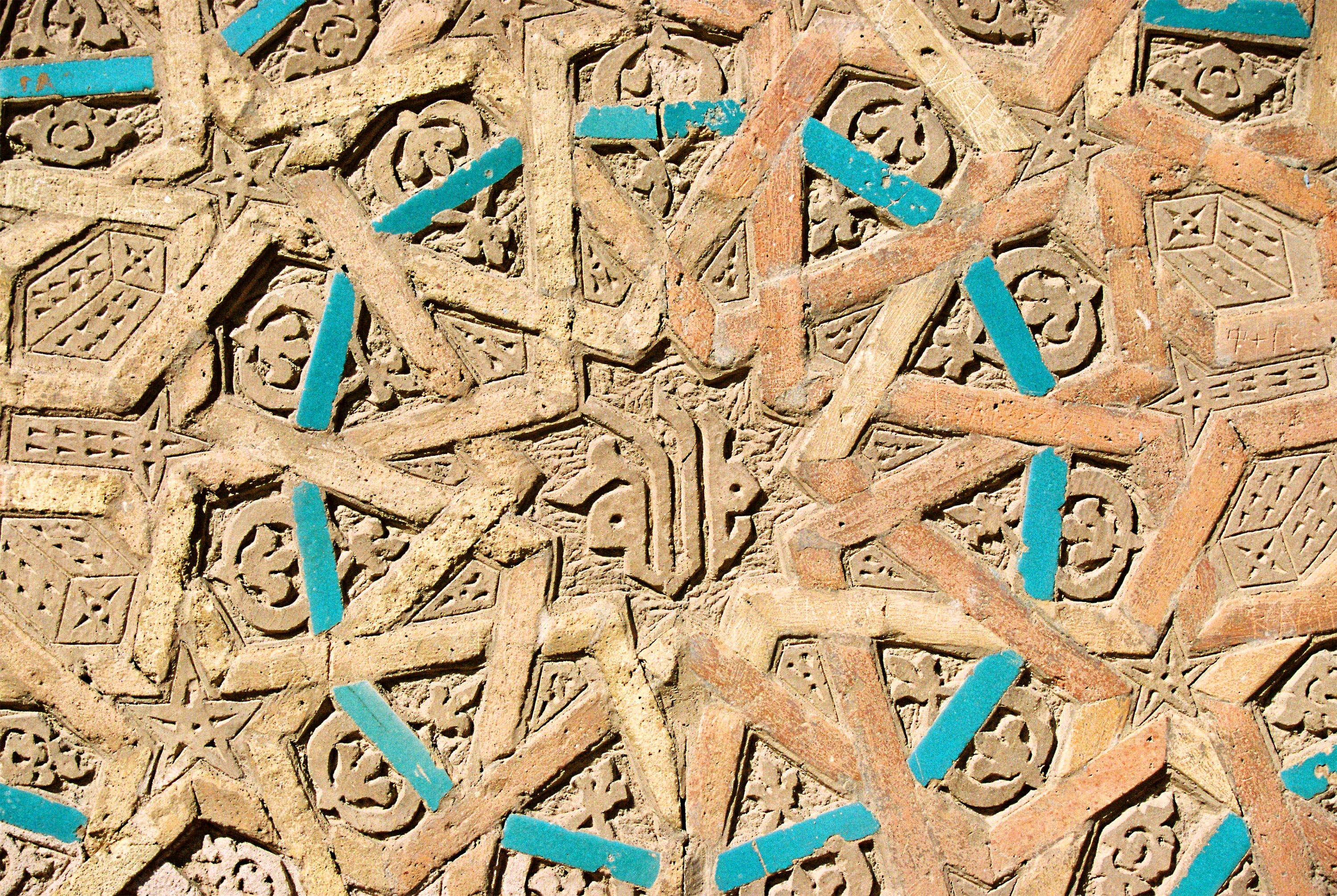
Ajami Nakhchivani was an architect who understood restraint. The mausoleum's general structure consists of an underground crypt and an above-ground tower. The tomb itself lies in the underground level, sealed from pedestrian access. Above ground, the ten-sided tower rises on a massive plinth lined with three rows of red tufa. The walls are fired brick, each of the ten faces decorated with complex geometric ornaments and inscriptions from the Quran in Kufic script. Turquoise glazed bricks provide accents of color. Ajami deliberately avoided differentiating the entrance wall from the other nine sides, preserving the geometric purity of the prismatic form. The rectangular entrance door sits within a shallow lancet arch, above which runs a brick inscription. Every surface rewards close attention, yet the overall effect is one of calm proportion rather than excess.
The Technique Behind the Beauty
Ajami paid particular attention to the foundation. The low platform is decagonal, covered with large polished diorite slabs. He had developed his structural techniques 38 years earlier when building the Red Dome mausoleum, and refined them here. The mausoleum belongs to the central-dome tower type of Islamic architecture, a form that concentrates visual weight upward. Inside, Ajami chose simplicity over complexity, favoring spatial integrity. The exterior carries all the ornamental weight. This approach -- austere interiors, elaborate exteriors -- became a hallmark of the Nakhchivan school of architecture. The mausoleums of Nakhchivan were submitted for consideration on UNESCO's World Heritage List in 1998. Today a statue of Ajami stands near his masterwork, alongside a bust of Heydar Aliyev, the former president of Azerbaijan who was born in this city.
From the Air
Located at 39.21N, 45.41E in the center of Nakhchivan city, capital of the Nakhchivan Autonomous Republic of Azerbaijan. The ten-sided mausoleum is one of the most prominent landmarks in the city, visible from approaches. Nakhchivan International Airport (UBBN) is approximately 5 km to the southeast. The city sits in a broad valley surrounded by mountains, with the Aras River to the south forming the border with Iran. The mausoleum's distinctive decagonal shape makes it identifiable from lower altitudes.