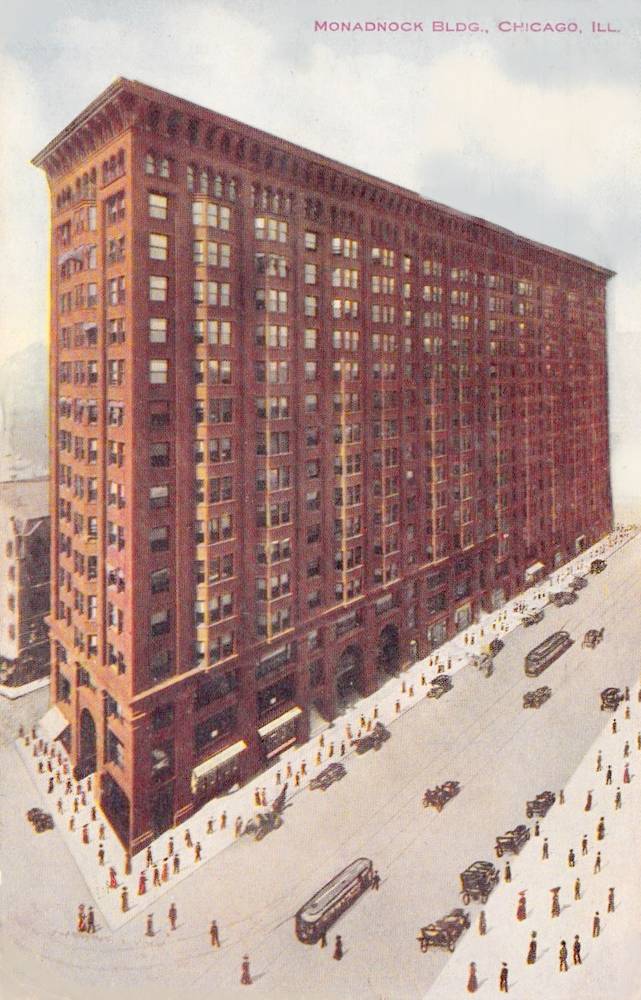
Monadnock Building
When Ludwig Mies van der Rohe arrived in Chicago in 1938, fleeing Nazi Germany to begin his American career, he declared: 'The Monadnock block is of such vigor and force that I am at once proud and happy to make my home here.' What inspired such admiration was a building with no ornament whatsoever -- a 16-story slab of purple-brown brick on Jackson Boulevard that rises from the sidewalk like an Egyptian pylon, flaring gently at base and top, its surface broken only by rows of projecting oriel windows. When it opened in 1891, critics called it 'an engineer's house' and 'thoroughly puritanical.' A French architect dismissed it as 'the work of a laborer.' But the Monadnock outlasted them all, and today it stands as one of the most celebrated buildings in American architecture -- the tallest load-bearing brick structure ever built, and a landmark whose two halves capture the precise moment when skyscraper construction shifted from masonry walls to steel frames.
A Stingy Client and a Stubborn Architect
The Monadnock was commissioned by Boston real estate developers Peter and Shepherd Brooks, who had been investing in Chicago since 1863. Their property manager, Owen F. Aldis -- one of two men Louis Sullivan credited with being 'responsible for the modern office building' -- convinced them to hire the firm of Burnham and Root. The Brooks brothers were notoriously frugal. Peter Brooks insisted on 'the effect of solidity and strength, rather than ornament for a notable appearance.' He wanted no projections of any kind. John Wellborn Root, known for lavish ornamentation on buildings like the Rookery, initially resisted. But while Root was on vacation, Daniel Burnham had a draftsman draw a 'straight up-and-down, uncompromising, unornamented facade.' Root returned, objected, and then reversed himself entirely, declaring that the heavy lines of an Egyptian pyramid had captured his imagination and that he would 'throw the thing up without a single ornament.' The building was Root's last project -- he died suddenly while it was under construction.
Walls Six Feet Thick
The Monadnock's north half, completed in 1891, pushed load-bearing masonry to its absolute limit. The walls at the base are six feet thick, tapering as they rise -- the maximum height at which brick walls could support a building without consuming too much rentable floor space. Root reinforced the masonry with an interior frame of cast and wrought iron, devising the first portal system of wind bracing used in America. The ground-floor staircases were cast in aluminum -- an exotic and expensive material at the time -- representing the first structural use of aluminum in any building. Carrara marble lined the corridors, hand-carved mosaic tiles covered the floors, and feather-chipped glass in the office partitions allowed natural light to filter from the windows through to the central hallway. The building permit was granted on June 3, 1889, after the building commissioner was 'staggered by the sixteen story plan.' The city was about to impose a height restriction, and Aldis rushed to file before the limit took effect.
Two Buildings in One
The south half, designed by Holabird and Roche and completed in 1893, looks like a continuation of the same building -- matching purple-brown brick, the same vertical profile -- but its construction is fundamentally different. The Wachusett portion used a full steel frame, requiring only a thin facing of brick rather than massive load-bearing walls. The result: 15 percent less cost, 15 percent less weight, and 15 percent more rentable space than the north half. When complete, the combined Monadnock was the largest office building in the world, with 1,200 rooms and an occupancy of over 6,000 people. The Chicago Daily Tribune noted that the population of most Illinois towns would fit inside it. Four full-time mail carriers delivered mail six times a day, six days a week -- the building was a postal district unto itself. The four component sections were named for New England mountains: Monadnock, Kearsarge, Katahdin, and Wachusett.
Rescued from Ruin
By 1979, the Monadnock had been 'partly updated every ten years throughout its history,' as new owner William Donnell put it, and 'never done over in its entirety.' The marble wainscoting was painted over, the mosaic floors buried under carpet and vinyl, the aluminum stair rails walled in. Donnell, who had studied architecture at Harvard, spent thirteen years restoring the building to its original 1891 condition. Working from drawings found at the Art Institute of Chicago, he and preservation architect John Vinci tracked down Italian craftsmen to recreate the mosaic floors at $50 per square foot. They found a local firm that could reproduce the feather-chipped glass using the original sandblasting and hide glue process. Donnell bought the woodworking company that had made the original oak doors -- it still used the same 19th-century machinery. A single surviving aluminum staircase was discovered behind a wall and used as the model for rebuilding the lobby metalwork. The National Trust for Historic Preservation recognized it as one of the top restoration projects in the country in 1987.
The End of One Tradition and the Beginning of Another
The Monadnock was among the first five buildings designated a Chicago Architectural Landmark in 1958. It was added to the National Register of Historic Places in 1970 and became part of a National Historic Landmark district in 1976. The Chicago City Council, in its unanimous landmark designation, stated that 'the two halves of this building provide a unique perspective for examining the history and development of modern architecture. Together, they mark the end of one building tradition and the beginning of another.' The building still houses around 300 tenants, mostly independent professional firms and entrepreneurs -- the same kind of occupants it was built for in 1891. It sits within the Printing House Row District alongside the Manhattan Building, the Old Colony Building, and the Fisher Building, a concentration of Chicago's most pioneering early skyscrapers. The south leg of the CTA elevated rail loop still rattles along Van Buren Street beside it, just as it has since the Union Loop opened in 1897.
From the Air
Located at 41.878°N, 87.629°W at 53 West Jackson Boulevard in Chicago's south Loop. The Monadnock is a 16-story dark brick building in the Printing House Row District, visible as part of the dense cluster of historic buildings near the south end of the Loop. The CTA elevated tracks run along its Van Buren Street side. Federal Plaza (Mies van der Rohe) is immediately to the north on Jackson. Best viewed at 1,500-3,000 feet AGL. Nearest airports: Chicago Midway (KMDW, 8 miles southwest) and Chicago O'Hare (KORD, 15 miles northwest).