Monastery of Pedralbes
The name gives it away, if you know where to listen. Petras Albas -- white stones -- is what 14th-century documents called this place, and the pale stone walls of the Monastery of Pedralbes still catch the Catalan light as cleanly as they did when Queen Elisenda de Montcada watched them rise in 1326. She had persuaded her husband, King James II of Aragon, to build it for her, and when he died just a year later, she moved into a palace she had annexed to the cloister. She would live there for the next forty years, a queen in voluntary seclusion, close enough to hear the Poor Clares chanting but never quite one of them.
A Queen's Retreat
Elisenda de Montcada was not a woman who left things to chance. The monastery she commissioned was not merely a convent -- it was a statement of dynastic prestige secured by practical guarantees. She placed it under the direct protection of Barcelona's Consell de Cent, the Council of the Hundred, obligating the city itself to defend the community in times of danger. The nuns she gathered were mostly noblewomen, members of the order of Poor Clares, and the privileges Elisenda granted them ensured the monastery's independence from the usual pressures of ecclesiastical politics. Her alabaster sepulchre still occupies one wing of the cloister -- a double-sided tomb, with one face showing her in royal finery for the public, the other depicting her in a nun's habit for the sisters who prayed beside her. Even in death, she belonged to two worlds.
Frescoes and Devotion
Walk into the Chapel of St. Michael, restored and reopened in 2018, and the 14th century closes in around you. The frescoes that cover its walls were painted by Ferrer Bassa in 1346, and they show an artist deeply influenced by the Italian master Giotto. The figures are solid and grounded, their expressions contemplative rather than hieratic, their settings rendered with a spatial awareness that was revolutionary for Catalan painting of the period. Bassa died just two years after completing the work, a victim of the Black Death, making these frescoes among his final and finest achievements. The church itself is a study in Gothic restraint: a single nave beneath rib vaults, a polygonal apse, a facade dominated by a large rose window, and a retablo by the 15th-century master Jaume Huguet. Every surface carries meaning, but nothing feels cluttered.
The Cloister of Orange Trees
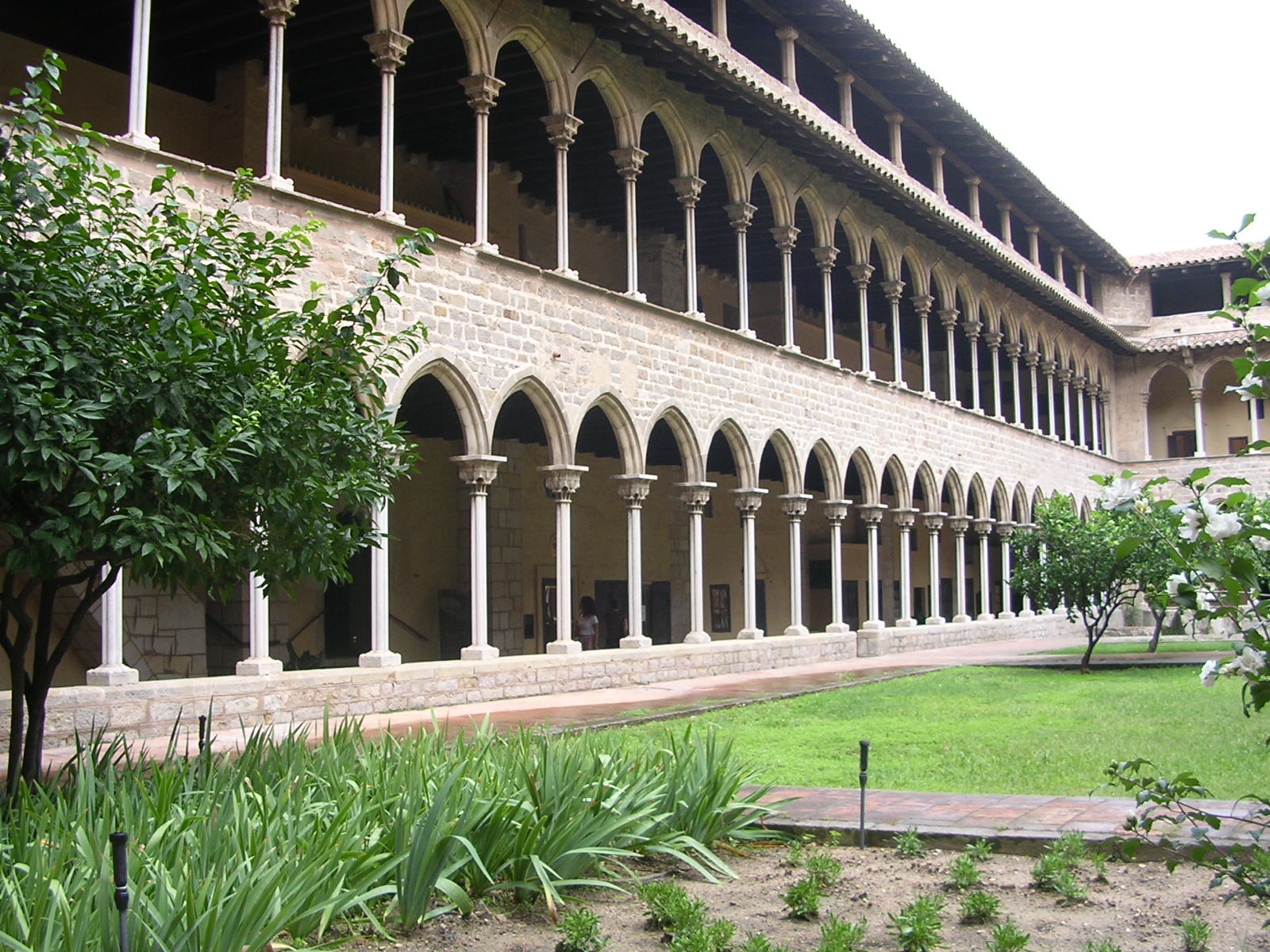
The three-story cloister stretches forty meters along each side, its wide arches rising from columns whose capitals bear the emblems of the Kings of Aragon and the House of Montcada. Orange trees and palms fill the central garden, their greenery framed by stone arcades that have sheltered contemplation since the 14th century. In the 1990s, the former dormitory became an unlikely art gallery, housing works from the Thyssen-Bornemisza Collection -- paintings by Rubens, Canaletto, Tintoretto, Velazquez, and Fra Angelico's Virgin of Humility, one of his acknowledged masterpieces. These works have since moved to the Museu Nacional d'Art de Catalunya and the collection's main home in Madrid, but the dormitory's transformation illustrated something essential about Pedralbes: this is a place that has always attracted beauty, whether sacred or secular.
Still Standing, Still Living
The Reapers' War of the 1640s expelled the nuns, but they returned. Franco's regime threatened Catalan institutions, but Pedralbes endured. The monastery was declared a national monument in 1991, and the remains of Elisenda's palace -- long thought entirely lost -- were rediscovered during excavations in the 1970s. Today the complex operates as a museum, its permanent exhibitions exploring its own art and architectural legacy alongside temporary shows. But the most remarkable fact about Pedralbes is not what it displays -- it is that some nuns still reside in the complex, maintaining a thread of monastic life that stretches back seven centuries to the day Elisenda walked through the gate and chose to stay. Of the original defensive walls, only two towers and one gate survive, but the community they once protected persists.
From the Air
Located at 41.396N, 2.112E on the western edge of Barcelona, in the upscale Pedralbes neighborhood near the Collserola hills. The Gothic monastery compound with its prominent cloister is visible from moderate altitude against the surrounding residential area. Nearest airport: Barcelona-El Prat (LEBL), approximately 15 km south. The monastery sits about 3 km west of central Barcelona, near the Palau Reial de Pedralbes gardens. Best viewed at 2,000-4,000 feet altitude.