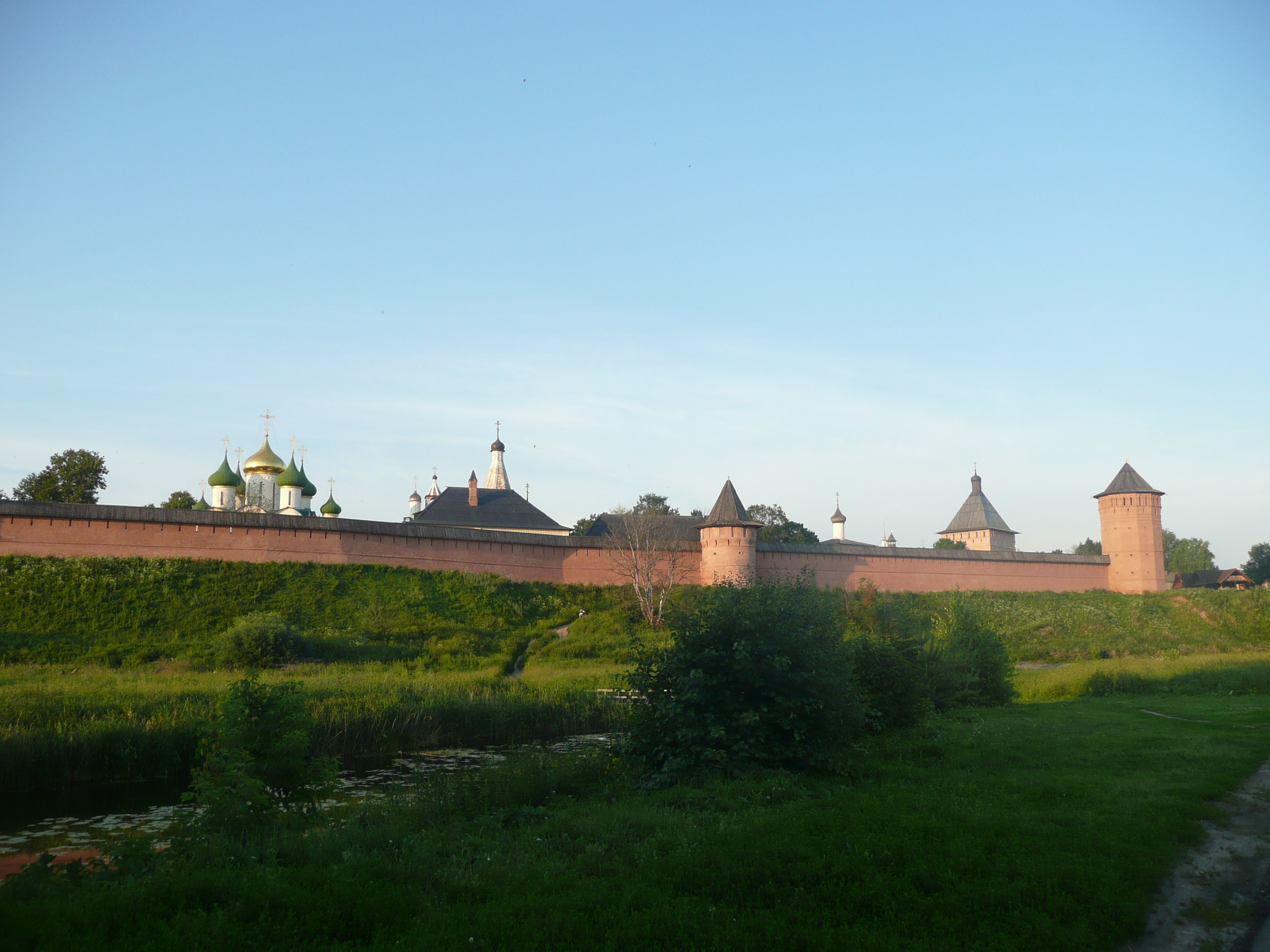
Monastery of Saint Euthymius
Field Marshal Friedrich Paulus, who surrendered the German Sixth Army at Stalingrad, spent part of his captivity behind the same monastery walls that once held religious dissidents imprisoned by Catherine the Great. The Saviour Monastery of Saint Euthymius in Suzdal has been a fortress, a spiritual center, a prison for political dissidents, a Soviet detention facility, and a museum -- sometimes several of these things simultaneously. Founded in 1352 on a bluff above the Kamenka River, it is a building complex whose history reads less like a monastery's chronicle and more like a compressed summary of Russian power across seven centuries.
The Monk from Nizhny Novgorod
In 1352, Prince Boris of Suzdal invited a monk named Yevfimi from Nizhny Novgorod to establish a monastery on a prominent bluff overlooking the Kamenka River. The site was chosen for defense as much as devotion: high ground with clear sightlines, positioned to protect the town from attackers approaching along the river valley. The original buildings were wooden, and nothing is known of their appearance. Yevfimi served as the monastery's first archimandrite until his death in 1404, after which the community renamed itself in his honor -- the Spaso-Yevfimiev Monastery. The name translates roughly as the Saviour-Euthymius Monastery, linking the patron saint to the founding monk. Within decades, the monastery would witness one of medieval Russia's most consequential military defeats when the Battle of Suzdal erupted right outside its walls in 1445.
From Wood to White Stone
The monastery's transformation from a wooden frontier post to a monumental complex unfolded across the sixteenth and seventeenth centuries. The first stone Church of the Transfiguration was built between 1507 and 1511 over Euthymius's tomb, and in 1594 a larger cathedral with four internal piers was constructed around it, preserving the original church as the St. Euthymius aisle. Donations from Vasili III, Ivan the Terrible, and the Pozharsky family -- a noble dynasty of the region -- financed the growth. Between the 1670s and 1680s, the old wooden walls gave way to formidable brick fortifications: twelve towers, eleven round and faceted, plus one main gate tower standing twenty-two meters high and decorated in the ornate uzorochye style. The seven-domed Cathedral of the Transfiguration holds frescoes by the school of Gury Nikitin of Kostroma, dating from 1689, and outside its walls lies the tomb of Dmitry Pozharsky, the national hero who liberated Moscow from Polish occupation in 1612.
Walls That Held Prisoners
In 1764, a prison was built within the monastery compound. Catherine the Great ordered it used for religious dissidents beginning in 1766, and for a century and a half, the monastery served a dual purpose: spiritual community and place of confinement for those whose beliefs troubled the state. The prison closed in 1905, but its reopening during the Soviet period gave the walls a grimmer purpose. Between 1923 and 1939, the old prison functioned as a politisolator -- a detention facility for political prisoners. In 1941, it became an NKVD filtration camp. By 1943, it held prisoners of war, including, for a time, Field Marshal Paulus. The man who had commanded a quarter-million soldiers at Stalingrad found himself behind medieval monastery walls in a town of wooden houses and onion domes.
Boys, Then Visitors
The prison's uses did not end with the war. From 1946 to 1967, the monastery complex served as a youth detention center for boys -- a grim final chapter in its long history of incarceration. Only in 1968 did the complex finally become what it remains today: a museum managed by the Vladimir-Suzdal Museum-Reserve. The campanile, built in the early sixteenth century and topped with a gallery in the seventeenth, lost its original bells when they were destroyed in the 1930s. Seventeen replacement bells now hang in the tower, and their ringing across the Kamenka valley is one of Suzdal's signature sounds. The Annunciation Church Over-the-gate, the refectory Church of the Assumption, the Archimandrite's house, and the fortification towers form a complete architectural ensemble spanning four centuries of Russian building.
Fortress, Prison, Museum
What makes the Monastery of Saint Euthymius compelling is not just its beauty -- the white walls, the seven domes, the river views -- but the uncomfortable density of its history. A place built for prayer became a place of punishment. A fortress designed to keep attackers out was repurposed to keep dissidents in. The same walls that protected medieval monks from Tatar raiders later confined a Nazi field marshal. Each layer of use left its mark on the complex without erasing what came before. The prison castle from the eighteenth century stands beside the cathedral from the sixteenth, and visitors walk between them on paths worn by monks, prisoners, and soldiers across the span of centuries. The monastery is recognized as part of the UNESCO-listed White Monuments of Vladimir and Suzdal, though its story extends far beyond medieval architecture into the darker chapters of Russian statecraft.
From the Air
Located at 56.43N, 40.44E on the northern edge of Suzdal, Vladimir Oblast, Russia. The monastery is one of the most visible landmarks from the air in the Suzdal area: a large rectangular walled compound with prominent towers sitting on a bluff above the Kamenka River. The seven-domed Cathedral of the Transfiguration is visible within the walls. Nearest airports include Vladimir (approximately 35 km south) and Ivanovo-Yuzhny (UUBI, approximately 70 km northeast). Best viewed at 2,000-4,000 feet. The contrast between the massive fortified walls and the small-scale town surrounding them is striking from above.